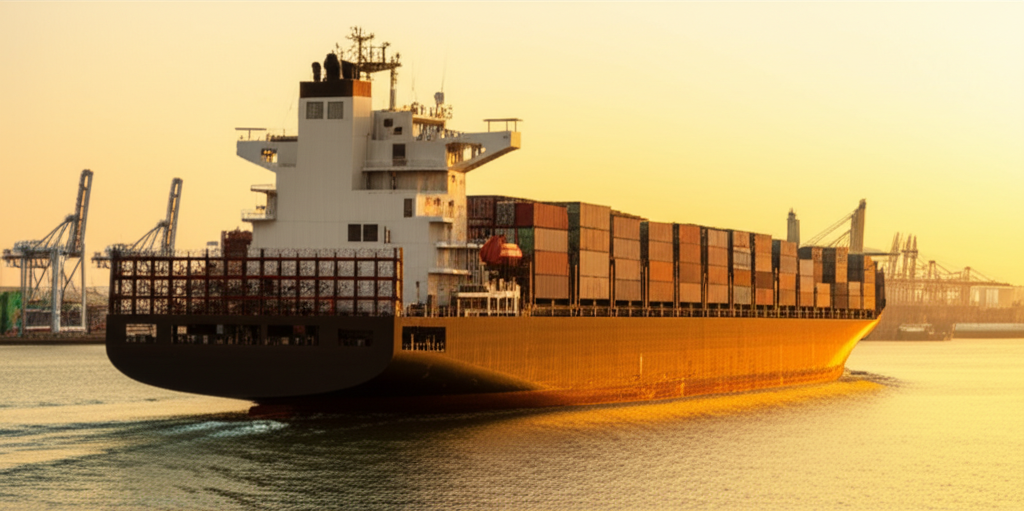
Successfully importing a container from China to Canada involves more than just booking ocean freight. The critical phase is the China to Canada container clearance—a detailed legal process where a single documentation error can trigger a cascade of costly delays. This guide provides actionable, CBSA-compliant steps for Canadian importers, covering everything from pre-shipment document validation to final delivery coordination. Strategic planning is your best defense against supply chain disruptions and unexpected costs at the border.
Demystifying the China to Canada Container Clearance Process
Navigating the import process can be daunting. Importers face numerous challenges, from language barriers with overseas suppliers to the complex regulations of the Canada Border Services Agency (CBSA). A seemingly minor mistake—an inaccurate HS code classification or an incomplete commercial invoice—can bring your entire shipment to a halt at the port, leading to storage fees and delivery penalties.
A thorough understanding of the clearance process is your most valuable asset. It’s not about simply filling out forms; it’s about implementing a proactive strategy that anticipates regulatory hurdles and ensures every compliance requirement is met long before your container is loaded onto a vessel.
Key Pillars of a Successful Import Strategy
For an import to proceed smoothly, your strategy must be built on three core pillars:
Flawless Documentation: All paperwork, including the Bill of Lading, commercial invoice, and any required import permits, must be 100% accurate, complete, and fully compliant with Canadian import standards.
Regulatory Compliance: You must understand and fulfill all your obligations as the Importer of Record. This includes accurate tariff classification, correct valuation, and mandatory registration and financial security posting in the CARM portal.
Proactive Communication: Maintain clear and constant communication between your supplier, freight forwarder, and customs broker. This alignment ensures all parties have the information needed to prevent delays.
Actionable Insight: The most successful importers treat customs clearance as an integral part of their supply chain strategy from the moment a purchase order is placed, not as a final step. This foresight prevents the vast majority of delays and budget-overruns.
This guide will walk you through each stage of the China to Canada container clearance journey, offering practical advice to transform a complex process into a predictable part of your operations. As you plan your logistics, consider reading a practical guide to shipping from China to Amazon FBA to understand how customs fits into the larger e-commerce supply chain. To grasp the critical role of your compliance partner, see our article explaining what a customs broker is.
Preparing Your Shipment for a Smooth Clearance
A successful China to Canada container clearance begins at your supplier's facility in China, not at a Canadian port. The groundwork laid before your container is loaded is the single most critical factor in achieving a quick, penalty-free release from the Canada Border Services Agency (CBSA).
Your shipping documents are your goods' legal passport. Any inconsistencies or missing information will cause your shipment to be flagged for secondary inspection. Verifying your supplier's draft paperwork is not a suggestion—it is an essential risk management step to protect your business.
Mastering the Core Customs Documents
Your entire import declaration is built upon a foundation of key documents. Getting these right is non-negotiable, as CBSA officers scrutinize every detail to assess duties, taxes, and compliance with Canadian law.
Essential Pre-Shipment Document Checklist
| Document | Required Information | Actionable Tip to Avoid Errors |
|---|---|---|
| Commercial Invoice | Seller/buyer details, detailed product descriptions, quantity, unit price, total value, currency, country of origin, and Incoterms. | Avoid vague descriptions like "Auto Parts." Use precise details: "100 units of aftermarket steel brake rotors for 2022 Honda Civic, Part #XYZ." |
| Packing List | Net and gross weight for each package, dimensions, markings, and a detailed list of contents per box or pallet. | Ensure the total quantity and weight on the packing list exactly match the commercial invoice. A discrepancy of even one unit can trigger an exam. |
| Bill of Lading (B/L) or Sea Waybill | Accurate shipper/consignee details (as per legal business name), vessel name, port of loading/discharge, and all container numbers. | Confirm the consignee is listed as your full legal business name and address. Errors here can legally prevent you from claiming your own cargo. |
These documents must be perfectly aligned. A discrepancy in one document can invalidate the others and halt your shipment.
For a deeper dive, our guide on how to prepare shipping documents for smooth customs provides more detailed checklists and best practices.
Why Pre-Shipment Document Review Is Crucial
The costliest customs problems are almost always preventable. A typo in the value, an incorrect currency code (e.g., USD vs. CAD), or a mismatch between the packing list and invoice can stop your container, triggering CBSA exams, warehouse fees, and demurrage charges.
This is where a licensed customs broker provides immense value before your goods are on the water. Submitting your draft documents to a firm like J.W. Smith Customs Brokers for review allows an expert to identify what CBSA will flag.
We act as your compliance firewall. Catching a valuation error on a commercial invoice before shipment might take a ten-minute phone call to resolve. Catching that same error upon arrival in Vancouver could result in a $10,000 penalty and a two-week delay.
Dealing With Regulated and Permitted Goods
Not all goods are treated equally by Canadian regulators. Products like food, health products, specific electronics, textiles, and children's toys are often governed by Other Government Departments (OGDs) such as the Canadian Food Inspection Agency (CFIA), Health Canada, or Global Affairs Canada.
Importing these items without the correct permits, licenses, or certificates is a guaranteed way to have your shipment refused entry. You must secure all necessary OGD permissions before your supplier ships the goods from China.
A customs broker can help identify which OGD regulations apply to your products and guide you through the permitting process. This proactive step ensures your goods are not only customs-compliant but also meet all federal safety and import standards upon arrival, turning a potential compliance nightmare into a routine part of the China to Canada container clearance process.
Navigating HS Codes, CARM, and Landed Costs
With your documents in order, the next phase of your China to Canada container clearance focuses on the financial and legal declarations. This involves three critical components: assigning the correct Harmonized System (HS) codes, managing your obligations through the CBSA Assessment and Revenue Management (CARM) portal, and calculating your total landed cost.
Errors in this stage can lead to significant financial penalties, customs audits, and a negative compliance history with the CBSA.
Decoding Harmonized System Codes
Every product imported into Canada requires a specific 10-digit Harmonized System (HS) code. This code informs the Canada Border Services Agency (CBSA) of the exact nature of your goods and directly determines the rate of duty you will pay.
A minor difference in classification can mean the difference between paying 0% and 18% duty. Relying on the HS code provided by your supplier is a significant risk, as the legal responsibility for accurate classification rests solely with you, the Importer of Record.
Real-World Example: Consider importing LED desk lamps. An importer might use a general code for "lighting fixtures," resulting in an 8% duty rate. An experienced customs broker, however, would identify the specific classification for "LED electric table lamps," which may be duty-free. On a single container, this expertise can save thousands of dollars.
Accurate tariff classification is a cornerstone of customs compliance. For more information, read this guide on understanding HS Codes.
Your Mandatory Registration in the CARM Portal
The CARM portal is the CBSA's official digital system for managing all customs duties, taxes, and trade information. Registration is mandatory for all commercial importers. This platform is where you will manage payments, view your transaction history, and post required financial security.
To ensure your goods are released promptly, you must post a Release Prior to Payment (RPP) bond. This bond acts as financial security for the CBSA, guaranteeing that duties and taxes will be paid and allowing your goods to be released from customs control before final payment is settled.
A crucial step within the portal is delegating authority to your customs broker. You must grant access to a firm like J.W. Smith Customs Brokers, enabling us to manage customs declarations and financial transactions on your behalf. This is essential for a seamless clearance. For a complete guide, review everything importers need to know about CARM.
Calculating Your True Landed Cost
To determine the true profitability of your import, you must calculate its landed cost. This is the total, all-in cost of getting a product from the factory in China to your warehouse in Canada, not just the purchase price.
An accurate landed cost calculation is essential for proper inventory valuation, product pricing, and overall financial planning.
Your landed cost is comprised of several key elements:
Cost of Goods: The price paid to your supplier (e.g., FOB price).
Ocean Freight: The cost of shipping the container from China to a Canadian port.
Customs Duties: Calculated based on the HS code and the value for duty.
GST/HST: Federal and provincial taxes applied to the value of the goods plus the duty amount.
Brokerage Fees: The service fee for your customs broker to manage the clearance.
Terminal & Port Fees: Handling charges at the port of arrival.
Drayage & Inland Freight: Local trucking from the port to your final destination.
These costs are dynamic and can significantly impact your profit margins. For instance, recent fluctuations in transpacific freight rates have presented both challenges and opportunities. While a freight market update can provide insight, working with a logistics partner to forecast these costs is vital for maintaining profitability.
The Arrival and Customs Release Process in Canada
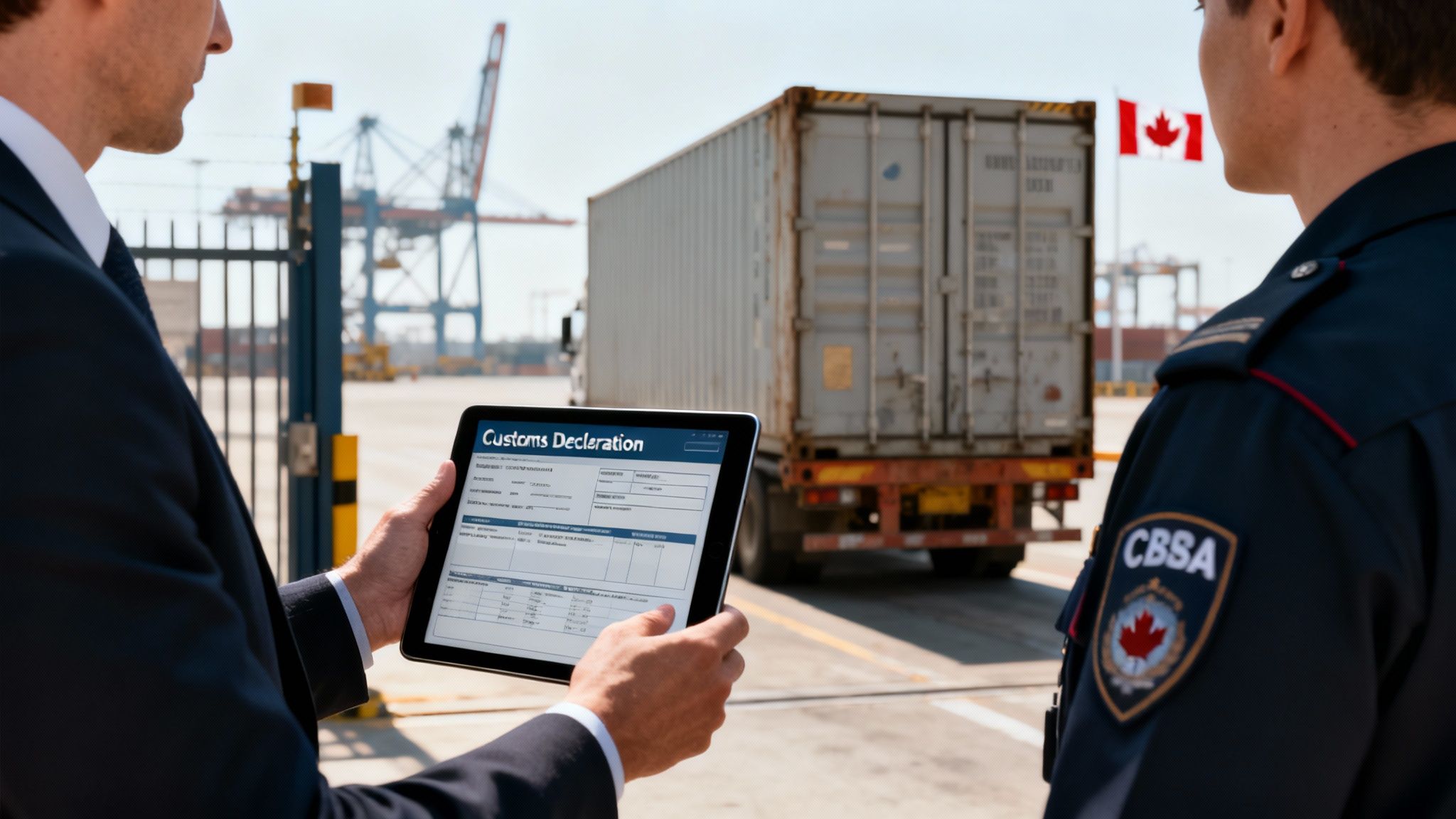
After weeks at sea, your container arrives at a Canadian port such as Vancouver, Prince Rupert, or Montreal. This is the most time-sensitive phase of the import process, where diligent preparation pays off. The clearance is a sequence of coordinated electronic data exchanges between the ocean carrier, the port terminal, your customs broker, and the Canada Border Services Agency (CBSA).
The China to Canada container clearance process technically begins before the vessel even docks. Under the Advance Commercial Information (ACI) program, the ocean carrier must transmit detailed cargo data to the CBSA at least 24 hours before the container is loaded in China. This allows the CBSA to perform an initial risk assessment well in advance of arrival.
The Key Players at the Port
Upon the vessel's arrival, several key partners execute their roles:
The Carrier: The shipping line is responsible for unloading your container from the vessel onto the terminal. They issue an "Arrival Notice" to your customs broker, officially signaling that the goods have landed and are available for customs processing.
The Freight Forwarder: Your forwarder coordinates the payment of all ocean freight charges to provide a "freight release" to the carrier. Without this freight release, the carrier will not allow the container to be picked up, even if customs has been cleared.
The Customs Broker: As your legal representative to the CBSA, your broker monitors the container's status. The moment it is "manifested" (officially logged in the port system), they can submit the final customs declaration (B3) to secure its release.
Securing the Electronic Customs Release
A proactive customs broker acts swiftly. With all documentation and CARM requirements settled in advance, they can transmit the full import declaration to the CBSA as soon as the container is manifested by the carrier. Modern electronic data interchange (EDI) systems make this a rapid process.
At J.W. Smith Customs Brokers, our average release time is approximately one hour after the container is available for processing. This efficiency is only possible because all compliance work—HS code verification, document review, and CARM setup—was completed days or weeks prior.
This speed is essential, especially given recent volatility in global trade. Market dynamics can shift rapidly, as seen when discover more about these global trade trends and their impact on logistics data shows how container volumes fluctuate. In a congested environment, a broker who can secure a fast clearance protects you from costly delays.
Preparing for Potential CBSA Examinations
While the majority of shipments are released electronically without issue, a small percentage are flagged for examination by the CBSA or Other Government Departments (OGDs) like the Canadian Food Inspection Agency (CFIA).
An exam can be triggered for several reasons:
Random Inspection: A percentage of all shipments are selected at random for compliance verification.
Vague Descriptions: Using ambiguous terms like "promotional items" can raise red flags.
High-Risk Goods: Certain commodities, such as food or chemicals, receive greater scrutiny.
Importer History: A history of non-compliance increases the likelihood of future inspections.
If your container is held for examination, your customs broker is notified immediately. They become your single point of contact, coordinating with the CBSA and the examination facility to manage the process, provide you with updates, and work to get the hold resolved as quickly as possible to minimize delays and associated costs.
Avoiding Costly Port Fees and Managing Final Delivery
Receiving a "customs released" notification is a major milestone, but it also starts a new and expensive clock. The period immediately following your China to Canada container clearance is a race against time to avoid fees that can quickly erode your profit margins.
Failure to manage this final stage can result in a trio of costly charges while your container sits idle at the port.
Demurrage, Detention, and Storage: The Price of Standing Still
These terms are often confused, but they are distinct fees charged by different entities. Understanding them is key to avoiding them.
Demurrage: This fee is charged by the shipping line for using their container inside the port terminal beyond the allotted "free time." It is essentially a rental fee for the container and the space it occupies.
Detention: This fee is also charged by the shipping line, but for keeping their container outside the port for too long. This occurs if your trucker picks up the container but fails to return it empty before the free period expires.
Storage: This charge comes directly from the port terminal for your container occupying physical space on their property after the free days have ended. It is often billed in addition to the shipping line's demurrage fee.
Carriers and terminals typically provide 3 to 7 free days. Once this period expires, these charges are applied daily and escalate rapidly. A fee that starts at $150 per day can quickly increase to $300 per day or more.
Proactive Drayage Planning is Your Best Defense
The only effective way to avoid these fees is through proactive coordination. The moment your customs broker confirms customs release, your drayage (trucking) provider must act immediately to book a pickup appointment with the terminal.
A connected customs broker adds significant value here. We don't just secure the release; we immediately notify your entire logistics team, enabling the drayage provider to schedule the pickup without delay. Waiting even a single day to arrange trucking can be the difference between a smooth pickup and a multi-thousand-dollar demurrage bill.
Actionable Insight: A common mistake is for an importer to wait until they receive the release notice before contacting a trucker. By then, all prime appointment slots at the terminal are often taken, forcing a pickup after the last free day and guaranteeing unnecessary fees.
Ensuring a Smooth Final Mile Delivery
Coordinating the inland trucking is the final piece of the puzzle. A flawless China to Canada container clearance is wasted if the container cannot move efficiently from the port to your facility. This "final mile" is your drayage partner's responsibility.
A reliable provider will have a chassis reserved, a driver licensed for port access, and a clear understanding of your delivery requirements. They must know if you have a loading dock or if specialized equipment, such as a side-loader or tilt-bed truck, is needed for a ground-level unload.
This final step highlights the need for an integrated logistics approach. Given that global container trade volumes can put immense strain on port infrastructure, having a single partner manage both customs and drayage is the key to a smooth, cost-effective journey from port to door, protecting your supply chain from preventable costs.
Common Questions About China to Canada Clearance
Even with a solid plan, questions arise during the import process. Here are answers to the most common questions importers ask, based on decades of experience clearing containers.
How Long Does Customs Clearance Take in Canada for a Container from China?
While the electronic submission and release by a customs broker can take less than an hour, the complete process from vessel docking to the container being available for pickup typically takes 24 to 72 hours. This timeline assumes:
All documentation is 100% accurate and submitted on time.
Your CARM account is properly configured with sufficient financial security.
The shipment is not flagged for a random or targeted examination by the CBSA or an OGD.
Any documentation error or a hold for inspection can extend this timeline from days to weeks, incurring significant costs. Proactive compliance is the only way to ensure a swift release.
What Is the Difference Between a Customs Broker and a Freight Forwarder?
These two vital partners perform distinct and separate roles.
A freight forwarder is your logistics coordinator. They manage the physical movement of your goods, including booking space on a vessel, arranging ocean freight from China to Canada, and handling transportation logistics.
A customs broker is your legally licensed representative to the Canada Border Services Agency (CBSA). Our role is strictly focused on legal and regulatory compliance. We classify your goods with correct HS codes, prepare and submit the legal import declaration, and manage the payment of duties and taxes to secure the release of your cargo from customs control.
Simple Analogy: Your forwarder gets your container to Canada. Your broker gets it legally into Canada.
Can I Clear My Own Container Without a Customs Broker?
Legally, an importer has the right to self-clear their own commercial shipments. However, it is strongly advised against unless you are an expert in Canadian customs law, regulations, and tariff classification.
If you self-clear, you are solely responsible for:
Correctly assigning a 10-digit HS classification code to every item.
Accurately determining the value for duty and calculating all applicable duties and taxes.
Properly completing the B3-3 Canada Customs Coding Form.
Complying with all applicable regulations from the CBSA and over a dozen Other Government Departments.
A single error can result in substantial monetary penalties, seizure of goods, and a permanent negative mark on your importer compliance record. A licensed broker provides expertise, specialized software, and an established relationship with the CBSA, delivering value that far exceeds their service fees by preventing costly mistakes.
What Happens if My Container Is Selected for a CBSA Exam?
If your container is flagged for examination, do not panic. It will be moved from the port terminal to a bonded examination facility. Your customs broker will be notified immediately and will act as your single point of contact throughout the process.
Exams can range from a simple document review to a full "destuffing," where the container is completely unloaded for physical inspection. As the importer, you are responsible for all associated costs, including transportation to the exam facility, labor for unloading/reloading, and any storage fees incurred during the delay.
Your customs broker's role here is indispensable. We manage all communication with the CBSA and the warehouse, provide you with regular updates, and work to resolve the hold as quickly as possible to minimize the financial impact and delay to your supply chain.
Navigating the China to Canada container clearance process demands experience and a sharp eye for detail. At J.W. Smith Customs Brokers Ltd., we bring over 50 years of hands-on expertise to the table, making sure your shipments clear without a hitch and keep your supply chain moving.
Learn how our team can streamline your next import by visiting us at jwsmith.com
Need Help with Customs?
J.W. Smith Customs Brokers has over 50 years of experience helping Canadian businesses navigate imports with confidence. Our team of licensed customs brokers is ready to assist with your import and export needs.