Let's be honest, the words 'customs forms' don't exactly spark joy. But think of them less like bureaucratic homework and more like a passport for your products. Getting your customs forms for Canada right is the single most important step to sailing your goods across the border without a hitch.
Why Customs Forms Matter More Than You Think
It’s easy to see paperwork as just a tedious chore. But a simple shift in mindset can save you from a world of headaches, delays, and surprise fees. When you view these documents as strategic tools, you take back control of your import process. Accurate forms are the bedrock of a smooth-running supply chain.
The True Purpose of Customs Paperwork
At its heart, Canadian customs paperwork exists for a few critical reasons, and none of them are to make your life difficult. These documents are essential for the Canada Border Services Agency (CBSA) to:
- Verify Your Goods: They tell CBSA officers exactly what’s inside your shipment without them having to rip open every box.
- Assess Duties and Taxes: The information you provide determines how much you owe. Precision here is non-negotiable if you want to avoid overpayments or penalties.
- Ensure Safety and Security: Forms help confirm that your products meet all Canadian regulations, from health standards to consumer safety laws.
Think of it like this: clear and correct forms tell a trustworthy story about your shipment. Vague or incorrect information, on the other hand, raises immediate red flags. That invites closer inspection, which is just a polite way of saying "costly delays."
Correctly completed customs forms are the fastest way to build trust with the CBSA. They demonstrate transparency and professionalism, paving the way for quicker clearances and fewer inspections.
The Scale of Canadian Imports
The sheer volume of goods flowing into Canada makes precise documentation an absolute must. In a recent year, the CBSA processed a staggering 30.7 million commercial goods releases and another 149 million courier shipments. Every single one of them depended on meticulously reviewed forms to stay compliant.
You can learn more about the CBSA's operational volume and see for yourself why accuracy at this scale is so important.
This massive river of trade relies entirely on the quality of information provided by importers like you. By mastering your customs forms for Canada, you aren’t just following the rules—you’re giving your business a real competitive advantage. Consider this your welcome to the world of frictionless importing.
The Four Core Customs Documents You Must Know
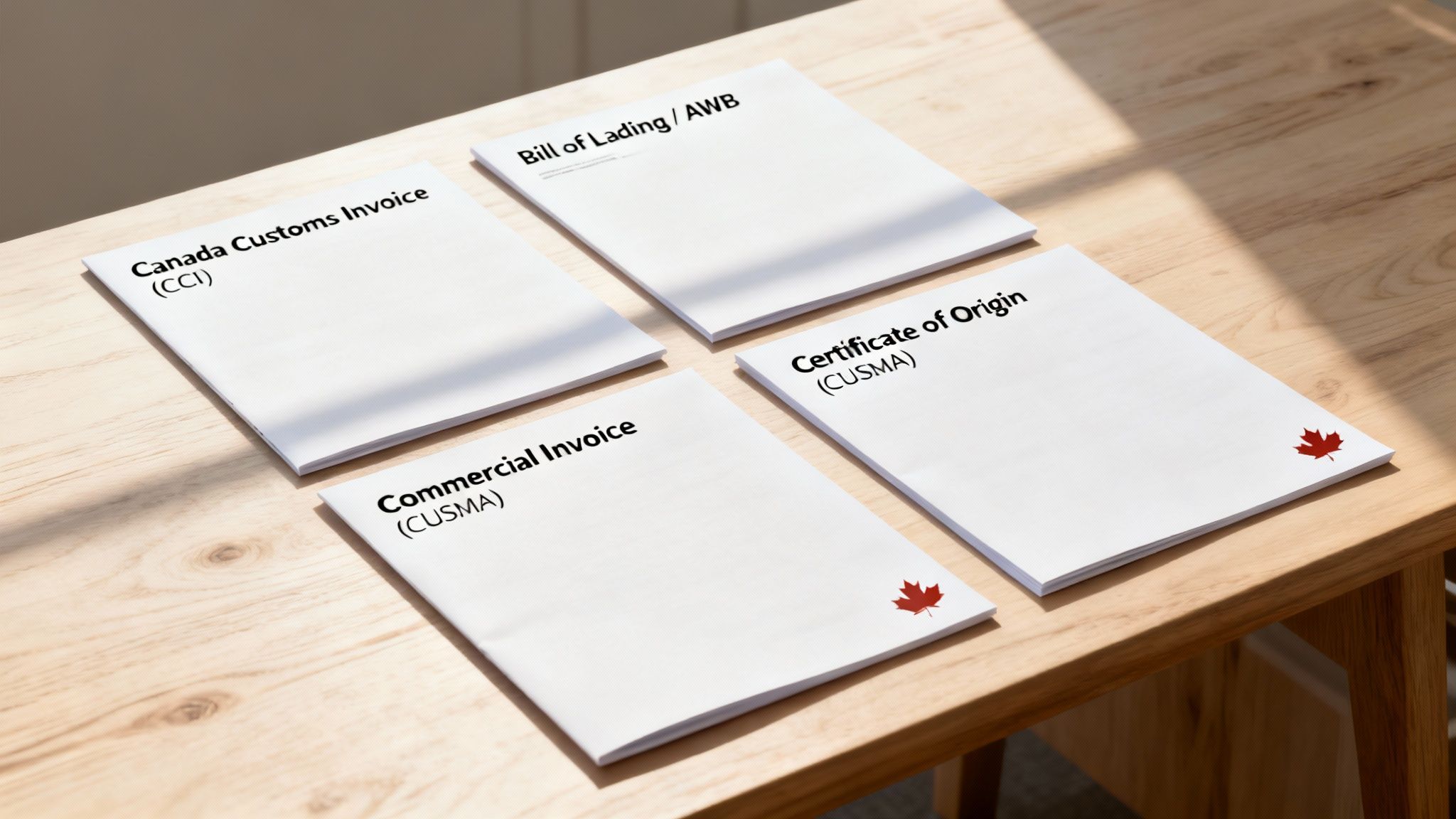
If your shipment had a wallet, these four documents would be its ID, credit card, and proof of address all rolled into one. Getting these right isn't just about ticking boxes; it's about speaking the border's language to ensure your goods get across smoothly and quickly. Let's break down the essential paperwork you'll need for almost every commercial import into Canada.
The Canada Customs Invoice (CCI)
The Canada Customs Invoice (CCI) is the undisputed champion of customs paperwork. It’s a specific form designed by the CBSA to capture every detail needed to clear your goods, calculate duties, and confirm everything is above board. Think of it as the ultimate cheat sheet for a border officer.
While a detailed commercial invoice can sometimes stand in for a CCI, using the official form is your safest bet. It ensures you don't accidentally leave out one of the 25 required data fields—an easy mistake to make with a standard invoice template.
The shipper or exporter fills out the CCI, providing critical details like:
- The full names and addresses of the shipper, consignee, and importer.
- A detailed description of every item in the shipment.
- The quantity, unit price, and total value of the goods.
- The country of origin for each product.
A common trip-up is giving a vague description like "machine parts" instead of "100x stainless steel M8 bolts for automotive assembly." When it comes to customs, more detail is always better. For a deeper look, you can learn more about what to include in our detailed guide on the Canada Customs Invoice (CCI).
The Commercial Invoice
"Wait," you might be thinking, "didn't we just talk about this?" Not quite. While the CCI is for the government, the Commercial Invoice is first and foremost a bill of sale between you (the importer) and your supplier (the exporter). It details the transaction, lays out payment terms, and acts as a formal record of what was bought and sold.
Every international shipment needs a Commercial Invoice. It’s the foundational document that proves the price paid for the goods, which is what duties and taxes are based on. The details on this invoice must perfectly match what’s on your CCI and other shipping documents. Any discrepancy, no matter how small, is a red flag for CBSA and can trigger an audit.
The Bill of Lading (B/L) or Air Waybill (AWB)
This document is your shipment's official travel ticket. It’s a legally binding contract between the shipper and the carrier—whether that's a trucking company, shipping line, or airline. It serves three main functions:
- A Receipt: It confirms the carrier has your goods and they were received in good condition.
- A Contract: It outlines the terms and conditions for transportation.
- A Document of Title: For ocean freight, the Bill of Lading acts as the title to the goods. Whoever holds the original B/L has the right to claim the cargo at its destination.
The carrier creates this document, which includes info like shipper and consignee details, ports of loading and discharge, and a description of the cargo. Without it, your shipment is essentially a passenger trying to board a plane without a ticket.
The Bill of Lading is more than just a receipt; it’s the legal proof of who owns the goods while they are in transit. Ensuring the "Consignee" field is accurate is crucial for a smooth release from the carrier's possession once it arrives in Canada.
Certificate of Origin (COO)
Last but certainly not least is the Certificate of Origin. This document officially certifies the country where your goods were manufactured, produced, or grown. This isn't just a fun fact about your product's heritage—it's a critical tool for saving money.
Canada has free trade agreements (FTAs) with numerous countries, with the most well-known being the Canada-United States-Mexico Agreement (CUSMA). If your goods qualify under an FTA, a valid Certificate of Origin allows you to pay a reduced or even zero rate of duty. Forgetting this form is like leaving a winning lottery ticket on the table. While the exporter provides it, it's your responsibility as the importer to make sure you have it before the goods are declared to CBSA.
Diving Deeper: Special and Supporting Documents
So, you’ve got the core four customs documents lined up. That’s a great start, but don’t close the folder just yet. Sometimes, a shipment needs a little something extra—think of it like a permission slip for a school field trip. Forgetting these supporting documents can bring your entire import process to a grinding halt right at the border.
The main customs forms get your shipment to the Canadian border. This next set of paperwork is what actually gets it through the door, especially if you’re importing regulated goods. These are the items that fall under the watchful eye of what are known as Other Government Departments, or OGDs.
The Role of Permits, Licenses, and Certificates
If you’re importing anything from cheese and wine to car seats and cosmetics, you’ll almost certainly need a green light from an OGD. Each of these departments has a specific job to do, focused on protecting Canadian health, safety, and the environment.
A permit, license, or certificate from one of these agencies is your proof that the goods meet Canada's strict standards. For example:
- The Canadian Food Inspection Agency (CFIA) is the gatekeeper for all food, plants, and animal products. Bringing in a shipment of organic avocados? You'll need the right CFIA certification.
- Health Canada has a wide reach, regulating everything from pharmaceuticals and medical devices to consumer electronics that emit radiation.
- Global Affairs Canada steps in to control the import of specific goods like steel, textiles, and firearms through a tightly managed permit system.
Failing to get these approvals before your shipment arrives is a rookie mistake with serious consequences. The CBSA acts on behalf of these OGDs and will not release your goods without their explicit sign-off. This isn't a "we'll sort it out later" kind of problem; it's a "your goods are staying right here until you do" reality.
The Underestimated Power of a Packing List
A Packing List might seem basic next to a detailed commercial invoice, but its value is immense. While the invoice tells customs the value of what’s inside, the packing list tells them exactly how it’s organized.
It gives a clear breakdown of each box, carton, or pallet, detailing its specific contents, weight, and dimensions. For a CBSA officer, this document is an invaluable roadmap. If they decide to conduct a physical inspection, a clear packing list lets them target one specific box instead of tearing apart your entire shipment. That one piece of paper can be the difference between a quick five-minute spot-check and a lengthy, labour-intensive examination that takes hours.
Providing a detailed Packing List is a sign of a well-organized shipper. It builds confidence with border officials and can significantly speed up inspections by showing them you have nothing to hide and have made their job easier.
Accounting for It All With the B3-3 Form
Finally, we get to the Form B3-3, Canada Customs Coding Form. This is the ultimate accounting document for your import. Once your goods have arrived, your customs broker pulls together information from all the other documents—the invoice, permits, and bill of lading—to complete the B3-3.
This form is the official declaration to the CBSA. It classifies your goods with the correct HS codes and calculates the precise duties and taxes you owe. It’s the final, formal step that moves your goods from "arrived at the border" to "cleared" and legally entered into Canadian commerce.
While your customs broker will handle the complex task of filing the B3-3, knowing its purpose is key. It’s the culmination of all your careful preparation, turning that stack of supporting documents into a single, official declaration. For added peace of mind on high-value shipments, many importers also learn more about what a customs bond is and how it can secure their financial obligations with the CBSA.
How to File Forms in the Digital Age
The days of carbon paper, couriers, and hoping your customs forms for Canada don’t get lost in transit are thankfully behind us. Filing today is a digital affair, a shift that has dramatically sped things up and improved accuracy. This move away from paper isn't just about convenience; it's a fundamental change in how the CBSA manages the flow of goods.
Getting comfortable in this digital ecosystem is crucial for staying compliant and competitive. Instead of separate, disjointed submissions, systems now "talk" to each other, creating a more cohesive and transparent process from start to finish.
Introducing CARM: The Importer's Portal
The heart of this digital shift is the CBSA Assessment and Revenue Management (CARM) portal. Think of it as your company's secure online banking portal, but specifically for all your Canadian customs activities. It's a massive leap forward, giving importers direct control and visibility over their own accounts.
Gone are the days when all financial transactions had to flow through your broker. With CARM, you can:
- Manage Your Account Directly: View your transaction history, statements of account, and outstanding balances in real-time.
- Post Your Own Security: Secure the necessary bonds for programs like Release Prior to Payment (RPP) directly within the portal.
- Make Direct Payments: Pay duties and taxes straight to the CBSA, making financial reconciliation much smoother.
This screenshot shows the main login page for the CARM portal, the central hub for modern importers.
Having direct access empowers businesses to take greater ownership of their compliance and financial management. To get fully up to speed, you can learn everything an importer needs to know about CARM in our comprehensive guide.
Advance Information for Smoother Clearance
Another critical piece of the digital puzzle is the Advance Commercial Information (ACI) program. Its core component, eManifest, requires carriers to electronically send detailed cargo and conveyance data to the CBSA before a shipment even reaches the border.
This isn't just about giving CBSA a heads-up. It's about risk assessment. By getting this data in advance, officers can identify low-risk shipments and flag them for expedited clearance, while focusing their attention on shipments that might need a closer look.
The ACI/eManifest system acts as a digital pre-screening for your goods. When your carrier's data is accurate and submitted on time, it dramatically increases the odds of your shipment sailing through customs without a single hiccup.
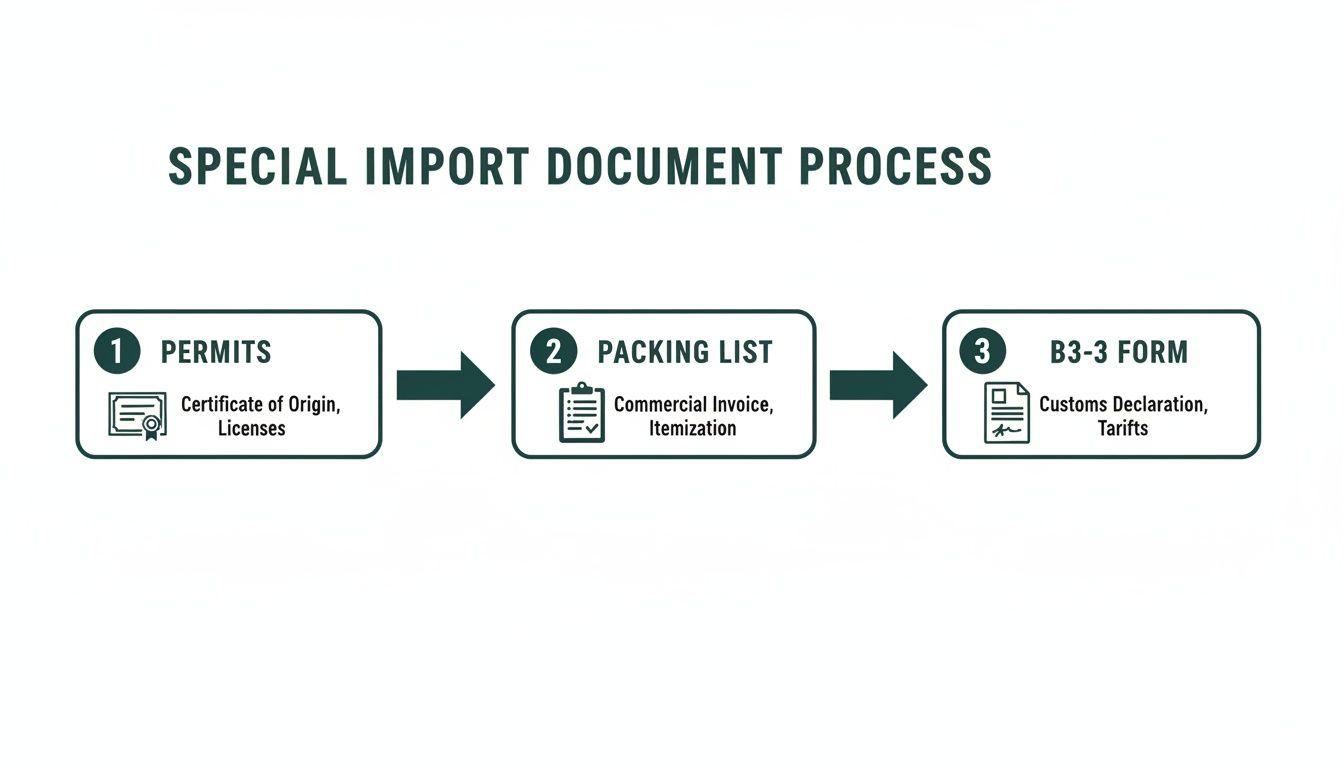
This infographic shows how documents like permits and packing lists feed into the final customs accounting.
Each document plays a specific role, culminating in the official B3-3 form used for accounting with the CBSA.
The Single Window Initiative
So, how do CARM, ACI, and all those other government department permits we discussed earlier work together? The answer is the Single Window Initiative (SWI). Instead of sending separate paperwork to multiple government departments, the SWI lets importers and brokers submit all required information electronically through one single point of entry.
This integrated system automatically shares the data with the CBSA and any other relevant government departments, like the CFIA or Health Canada. This "tell us once" approach eliminates redundant paperwork and significantly cuts down on the administrative burden.
To streamline the often complex process of submitting customs forms in the digital age, exploring various document automation software platforms can significantly enhance efficiency and accuracy. By connecting all the dots, the SWI makes filing customs forms for Canada faster, smarter, and far less prone to error.
Putting Customs Forms into Practice
Theory is one thing, but let's look at how this plays out in the real world. The stack of customs forms you actually need isn't a one-size-fits-all deal. It shifts based on what you’re importing, where it’s from, and even your business model.
To make it tangible, we’ll walk through three common scenarios importers run into every day. This is where knowing your forms moves from a simple checklist item to a real competitive edge, making sure your goods don’t get stuck in bureaucratic limbo.
Scenario 1: The E-commerce Retailer
Picture an online store owner in Toronto. She imports consumer electronics—drones, smart speakers, you name it—directly from a supplier in the United States. Her business lives and breathes speed and efficiency, often relying on couriers to get orders to customers fast. For her, the name of the game is streamlined clearance.
Since she’s dealing with high-volume, low-value shipments, the data she gives the courier is everything. The courier uses this info to clear the goods under the Courier Low Value Shipment (CLVS) Program, a system that demands precise electronic data to work.
Essential Documents Checklist:
- Commercial Invoice: This is her most critical document. It has to be detailed, accurate, and digitally available to the courier, listing the exact product, its HS code, value, and country of origin.
- Proof of Origin (CUSMA Certificate): Want to get duty-free treatment under the Canada-United-States-Mexico Agreement? The CUSMA Certificate of Origin is a must. This simple form can save thousands of dollars in duties over a year.
- Accurate Product Descriptions: Vague descriptions like "electronics" are a direct invitation for delays. "Miniature Quadcopter Drone, Model X2, 3.7V Battery" is the level of detail that keeps packages moving.
Scenario 2: The Canadian Manufacturer
Now, let’s switch gears to a manufacturer in Alberta importing massive quantities of raw steel coils from Asia via ocean freight. Their priorities are different. They aren't just focused on speed; they're managing a complex supply chain, clearing enormous shipments correctly, and accounting for huge duty and tax payments. Their shipments are big, slow, and expensive—so mistakes are costly.
Here, the focus is on the legal and logistical documents that govern ocean freight. The Bill of Lading is king, as it literally represents the title to the goods. And getting the HS classification right is non-negotiable for calculating the correct tariffs on tonnes of steel.
Essential Documents Checklist:
- Ocean Bill of Lading (B/L): This is the legal document of title. The manufacturer needs the original B/L (or a telex release) just to claim their cargo from the shipping line once it arrives in Vancouver.
- Canada Customs Invoice (CCI): For a large, complex shipment like this, a CCI is the gold standard. It gives the CBSA every single detail they need in the exact format they prefer.
- Packing List: With dozens of steel coils in a single shipment, a detailed packing list is vital. It confirms the weight and specifications of each unit, which helps the CBSA verify the cargo without having to inspect the entire container.
For manufacturers, precise HS classification on the B3-3 form isn't just about compliance—it's about cost control. A single digit off in an HS code for a bulk commodity like steel can result in tens of thousands of dollars in overpaid duties.
Scenario 3: The Non-Resident Importer
Finally, think about a U.S.-based apparel company that sells directly to Canadian customers from its American website. They act as the Non-Resident Importer (NRI), which means they are on the hook for the entire import process, including paying Canadian duties and taxes. Their goal is to create a seamless, "local" buying experience for their Canadian clientele, with no surprise fees at the door.
Being an NRI comes with unique duties. They must be registered with the Canadian government, have a Canadian Business Number, and handle all customs formalities just as if they were a Canadian company.
Essential Documents Checklist:
- Proof of NRI Status: All their paperwork must list the U.S. company as the importer of record and include their Canadian Business Number (BN).
- Commercial Invoice: The invoice needs to clearly show that the U.S. seller is covering all duties and taxes. You'll often see this noted with shipping terms like Delivered Duty Paid (DDP).
- Customs Bond: As an NRI, they have to post security with the CBSA to get Release Prior to Payment (RPP) privileges. This allows their goods to be released before duties are paid and is typically managed in the CARM portal.
Document Checklist by Importer Type
The paperwork trail for each importer is unique, shaped by their business model, shipping methods, and supply chain. This table provides a quick side-by-side look at the typical forms required for our three scenarios.
| Document | E-commerce Retailer | Manufacturer | Non-Resident Importer |
|---|---|---|---|
| Commercial Invoice | ✓ (Crucial for courier data) | ✓ (Often part of a larger doc set) | ✓ (Must show DDP terms) |
| Canada Customs Invoice (CCI) | No (Usually not needed) | ✓ (Gold standard for complex shipments) | No (Commercial Invoice is sufficient) |
| Proof of Origin (e.g., CUSMA) | ✓ (Key for duty savings) | ✓ (Important for cost reduction) | ✓ (Essential for competitive pricing) |
| Bill of Lading / Air Waybill | ✓ (Courier-generated Air Waybill) | ✓ (Ocean Bill of Lading is vital) | ✓ (Courier-generated Air Waybill) |
| Packing List | No (Details are on the invoice) | ✓ (Critical for large, bulk shipments) | No (Not typically needed) |
| Customs Bond / RPP Security | No (Handled by courier) | ✓ (Needed for frequent, high-value imports) | ✓ (Required for NRI status) |
Notice how some documents, like the Commercial Invoice, are universal, but their details and importance change with the context. For others, like the Ocean Bill of Lading, they are only relevant for a specific type of logistics. Understanding these nuances is key to keeping your goods moving smoothly across the border.
Common Customs Form Mistakes to Avoid
Even the most buttoned-up importers can slip up on their customs forms. In the world of cross-border trade, though, a small error can quickly snowball into a big problem. A simple typo or an overlooked detail is all it takes to trigger inspections, fines, or costly delays that send ripples through your entire supply chain.
Let's walk through the most common blunders we see and how to sidestep them. Most issues the CBSA flags aren’t complex schemes; they're simple human errors. But the automated systems and sharp-eyed officers at the border are trained to spot them. Getting ahead of these common tripwires is the best way to keep your goods moving and your reputation with the CBSA intact.
The Peril of Vague Product Descriptions
One of the easiest mistakes to make—and to avoid—is using lazy or generic product descriptions. When a customs officer sees a line item like "promotional items" or "machine parts," they have no choice but to pull your shipment for a closer look. They need to know exactly what's crossing the border.
Vagueness is an open invitation for scrutiny. Be hyper-specific. Instead of "clothing," write "150 units of men's 100% cotton t-shirts, blue, size large." That level of detail answers questions before they’re even asked, which builds trust and speeds up the whole process.
Pro Tip: Write your descriptions like you're explaining the item to someone who has never seen it before. Always include the material, its purpose, and the model number if it has one.
Mismatched Values and Inconsistent Invoices
Here’s a classic red flag for the CBSA: the value on the Commercial Invoice doesn't line up with the value on the Canada Customs Invoice or other documents. Even a tiny discrepancy suggests something is off, and it can trigger an immediate audit or a reassessment of duties.
This often happens by accident—maybe from using different currency conversion rates or pulling from an outdated price list. To a customs officer, however, it can look like an attempt to undervalue goods to pay less duty. Make sure all your documents tell the exact same financial story.
Your paperwork creates a narrative for your shipment. If the Commercial Invoice says an item is worth $100 and another form says $98, the story falls apart. Consistency across all customs forms for Canada is non-negotiable.
HS Code Typos and Classification Errors
The Harmonized System (HS) code is the universal language of global trade, but a single misplaced digit can completely change the duty rate you pay. Mistyping a code or classifying a product incorrectly is an expensive mistake. You could end up paying too much duty for years without realizing it or, even worse, underpaying and facing hefty penalties when an audit comes around.
For example, classifying a simple plastic phone case under a general "plastics" code instead of the more specific "accessories for cellular telephones" code will lead to the wrong duty calculation. Don't guess. If you're not 100% sure, talk to your customs broker—that's what we're here for.
Forgetting the Country of Origin
Finally, leaving out or getting the country of origin wrong is like throwing money away. This detail is absolutely critical for claiming preferential tariff treatment under free trade agreements like CUSMA. Without it, your goods will be charged the standard (and much higher) Most-Favoured-Nation duty rate.
Simply stating where the goods shipped from isn't good enough. You have to declare where they were actually manufactured. Forgetting this simple but crucial piece of information nullifies any duty-free benefits you were entitled to, a costly oversight for any business.
Got Questions? We've Got Answers
We’ve untangled a lot of the paperwork involved in Canadian customs, but it's completely normal for a few questions to still be floating around. Here are some of the most common ones we hear from importers, answered in plain language.
What's The Real Difference Between A Commercial Invoice And A Canada Customs Invoice (CCI)?
Think of a Commercial Invoice as the standard bill of sale you get from your seller. It lists what you bought and how much you paid. A Canada Customs Invoice (CCI), on the other hand, is a specific form the CBSA wants. It demands extra details they need for clearance, like the country of origin and who the official importer of record is.
Sure, a super-detailed Commercial Invoice can sometimes stand in for a CCI, but only if it includes every single piece of information the CCI form requires. The best way to avoid a headache at the border? Just use the official CCI form. It’s what customs officers expect to see.
Do I Really Need A Customs Broker To File These Forms?
Legally, no. You are allowed to self-clear your commercial goods. But in practice? It's a bit like trying to do your own corporate tax return without being an accountant. It’s possible, but the chances of making a small, expensive mistake are incredibly high.
A licensed customs broker isn’t just a paper-pusher. They have the expertise, the specialized software, and a direct line to the CBSA. Their job is to nail the tariff classifications and make sense of dense regulations, which drastically cuts your risk of facing fines, audits, and shipment delays.
How Long Do I Have To Keep My Customs Paperwork?
In Canada, the rule is crystal clear: you must keep all records related to your imports for six years after the year of importation. This isn't just the big forms like the CCI or B3-3. It includes every invoice, shipping document, permit, and proof of payment.
These documents need to be accessible. If the CBSA decides to audit you, they'll expect you to produce them quickly. "I can't find it" isn't an excuse, so a reliable filing system—whether digital or physical—is non-negotiable.
Feeling like you're drowning in forms? You don't have to navigate this alone. The team at J.W. Smith Customs Brokers Ltd. has been turning complex customs requirements into smooth, hassle-free clearances for over 50 years. Let us handle the details so you can get back to what you do best: growing your business. Contact us today for a seamless import experience.
Need Help with Customs?
J.W. Smith Customs Brokers has over 50 years of experience helping Canadian businesses navigate imports with confidence. Our team of licensed customs brokers is ready to assist with your import and export needs.