Let's be honest, the terms dumping and antidumping sound like they belong in a dusty economics textbook, not your daily business plan. But for a Canadian importer, ignoring them is like ignoring a giant pothole on the highway—it can wreck your finances fast.
So, what’s the big deal? In simple terms, a foreign company is “dumping” when it sells products in Canada for less than it charges back home. Antidumping is how Canada pushes back, using specific rules to protect our local industries from being steamrolled by unfairly cheap imports.
What Is Dumping and Why It Matters for Importers
Imagine you own a small furniture workshop in Ontario. You’ve carefully priced your tables based on the cost of wood, labour, and finishing. Suddenly, a huge overseas manufacturer starts selling nearly identical tables in Canada for a price that’s somehow less than what you pay for raw lumber. How is that possible?
That’s the essence of dumping. It's not a competitive sale; it's an aggressive pricing strategy that creates a completely uneven playing field. It can drive Canadian producers out of business simply because they can't compete with artificially low prices.
The Official Rulebook: SIMA
To keep trade fair, the Canadian government created the Special Import Measures Act (SIMA). Think of SIMA as the referee for international trade. Its main job is to investigate complaints about dumping and another sneaky practice called subsidizing (when a foreign government gives its exporters an unfair financial leg-up).
If the Canada Border Services Agency (CBSA) finds that dumping is happening, and the Canadian International Trade Tribunal (CITT) agrees it’s hurting Canadian businesses, they can impose special tariffs known as antidumping duties.
Real-World Consequences for Your Bottom Line
This is where it gets personal for you as an importer. Ignoring SIMA isn’t just risky—it's financially devastating. Here’s how it can hit your business right where it hurts:
- Sudden, Sky-High Duties: Antidumping duties aren't your typical tariffs. They can be incredibly steep, sometimes climbing over 25% of your product's value. A duty that high can instantly vaporize any profit you hoped to make.
- Frustrating Shipment Delays: If your goods are flagged for a potential dumping issue, don’t expect them to clear customs quickly. The CBSA can hold your shipment while they investigate, throwing your supply chain into chaos and leaving customers waiting.
- Unexpected Bills from the Past: In some cases, these duties can be applied retroactively. That means you could get a surprise bill for goods you imported months ago, creating a serious and completely unplanned financial mess.
Understanding these rules isn't just about ticking a compliance box. It's about managing risk and protecting your business from hidden costs that can derail your entire operation.
Understanding Canada’s Special Import Measures Act
If international trade is a massive hockey game, then Canada’s Special Import Measures Act (SIMA) is the official rulebook. It's the primary tool the Canada Border Services Agency (CBSA) uses to keep the game fair for the home team. Its entire purpose is to blow the whistle on unfair trade practices that could injure Canadian businesses.
SIMA focuses on two specific penalties: dumping and subsidizing. We’ve covered dumping—when goods are sold in Canada for less than they sell for back home. Subsidizing is when a foreign government gives its exporters a financial leg-up, like grants or tax breaks, letting them sell products here at artificially low prices.
Think of it this way: dumping is like a foreign player slashing prices on their own, while subsidizing is like their coach handing them a better hockey stick for free. The result is the same—an unfair advantage. SIMA levels the playing field by imposing duties to offset these advantages. You can learn more about the agency enforcing these rules in our guide explaining what the CBSA is and what it does.
A Long History of Protecting Canadian Industry
This isn't a new concept. The Special Import Measures Act came into play on December 1, 1984, and it's been a cornerstone of Canadian trade policy ever since.
The numbers show just how seriously Canada takes this. Today, there are 148 SIMA measures in force, covering everything from steel pipes to refined sugar. This history makes one thing crystal clear for importers: SIMA is not a regulation you can afford to ignore. You can discover more about the history of these measures on the Government of Canada's website.
The core purpose of SIMA is to ensure that price is determined by fair market competition, not by unfair trade practices. It protects Canadian producers from injury and preserves a stable economic environment.
Why SIMA Is More Relevant Than Ever
In today's fast-paced global market, a new investigation can be launched at any time, potentially targeting products you've been importing without a hitch for years. Vigilance isn't just a good idea—it's essential for survival.
- Your Sourcing Strategy is at Risk: A supplier offering a "too good to be true" price might be exposing you to massive future antidumping duties.
- Compliance is Continuous: Staying compliant isn't a one-and-done task. You need to stay on top of ongoing SIMA investigations and rulings that could affect your product lines at any moment.
- Financial Planning is Crucial: The possibility of sudden duties means you have to account for this risk in your landed cost calculations. A surprise duty can wipe out your profit margin overnight.
Ultimately, understanding SIMA is fundamental to building a resilient import business. Staying informed and compliant is the best way to ensure your goods keep moving smoothly across the border without costly surprises.
How a Dumping Investigation Actually Works
If you've ever watched a courtroom drama, you know there’s a process—an accusation, an investigation, and then a verdict. A dumping investigation follows a similar script, just with more paperwork and less dramatic music. The process is designed to answer two key questions: are goods being dumped, and is this practice harming Canadian businesses?
The whole thing kicks off when a Canadian producer files a formal complaint. They need to bring solid evidence suggesting that specific imported goods are being sold at unfairly low prices and that this is causing real financial injury—like lost sales, shrinking profits, or layoffs.
The Two Key Players: The CBSA and CITT
Once a complaint is deemed worthy of investigation, two main agencies step into the spotlight. Think of them as partners—one is the detective gathering evidence, and the other is the judge assessing the damages.
- The Canada Border Services Agency (CBSA): The CBSA acts as the detective. Their job is to investigate the "dumping" part of the equation. They dig into the numbers, comparing the export price of the goods with their normal value in the home market to figure out if dumping is happening and by how much.
- The Canadian International Trade Tribunal (CITT): The CITT plays the role of the judge. They determine if the dumping identified by the CBSA is actually hurting the Canadian industry. It’s not enough for dumping to exist; it must also be causing, or threatening to cause, material harm to domestic producers.
These two investigations happen at the same time but are completely separate. The CBSA focuses on the pricing, while the CITT assesses the real-world economic impact.
This diagram gives you a high-level look at how issues are identified under the Special Import Measures Act (SIMA).
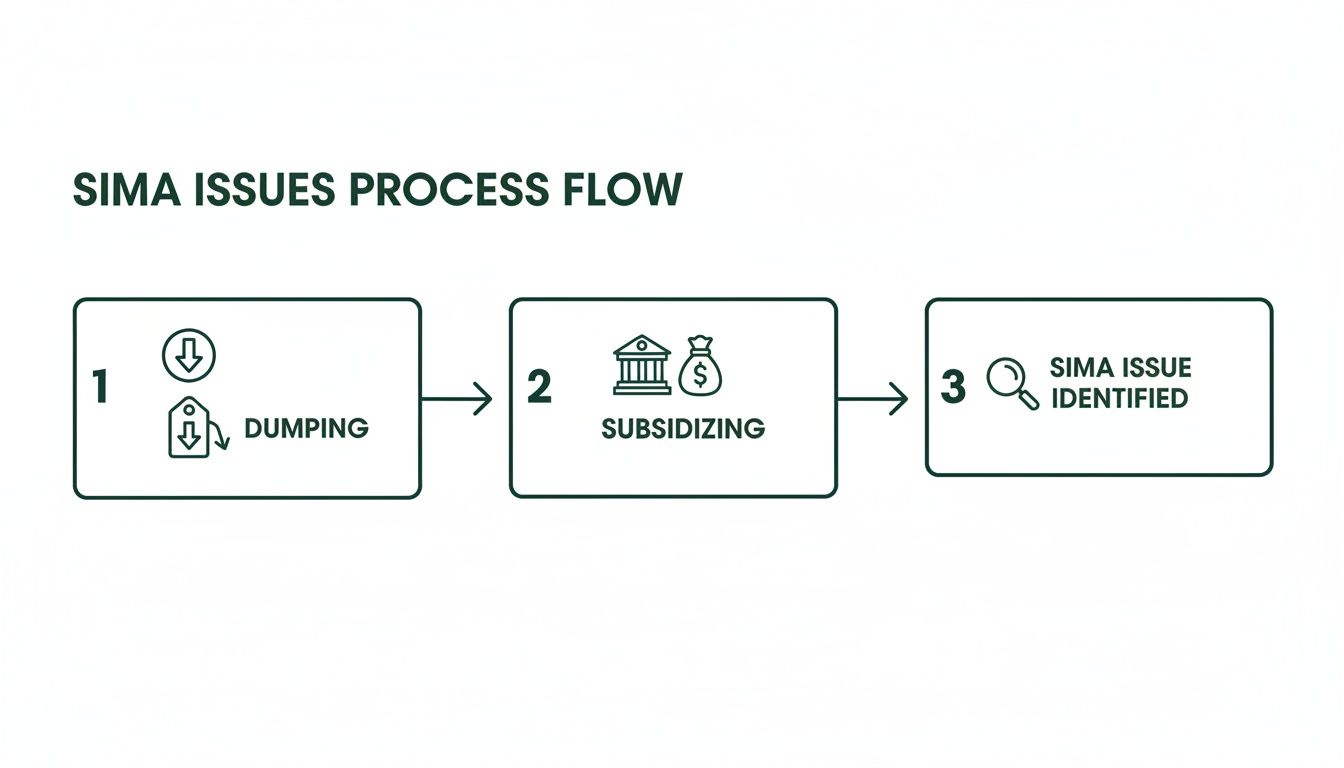
As the flow shows, both dumping and subsidizing are treated as distinct issues that can trigger a formal investigation and lead to protective duties.
The Investigation Roadmap: From Complaint to Final Ruling
The entire process follows a strict timeline. Knowing these key milestones helps demystify what’s happening and when, so you're not left guessing what’s coming next.
Below is a simplified look at the investigation process.
The CBSA and CITT Investigation Timeline
| Phase | Lead Agency | Key Action | Typical Duration |
|---|---|---|---|
| Initiation | CBSA & CITT | Complaint accepted; investigation officially begins. | Day 0 |
| Preliminary Investigation | CBSA & CITT | Initial data collection; CBSA makes a preliminary determination of dumping. CITT makes a preliminary injury inquiry. | 90 Days |
| Provisional Period | CBSA | If dumping & injury are found, provisional duties are collected on new imports. | Starts Day 90 |
| Final Investigation | CBSA | In-depth verification of data from exporters/importers. | Another 90 Days |
| Final Determination | CBSA | Issues a final decision on whether dumping occurred and the final margins. | By Day 180 |
| Final Injury Inquiry | CITT | Issues a final ruling on whether dumping has caused material injury. | Another 30 Days |
| Final Ruling | CBSA & CITT | If both rule "yes," antidumping duties are imposed for 5 years. | By Day 210 |
Here’s a breakdown of what those stages mean in practice:
1. The Launch (Day 0): The investigation officially begins. This is the starting gun.
2. Preliminary Investigation Phase (First 90 Days): This is a critical period. If the CBSA finds reasonable evidence of both dumping and injury, things get serious fast. Provisional duties—a type of temporary tariff—can be applied to all subsequent imports of the goods while the investigation continues.
3. Final Investigation Phase (Another 90 Days): The CBSA continues its deep dive, verifying all the data collected and issuing a final determination.
4. The CITT’s Final Ruling (Another 30 Days): The CITT concludes its own inquiry and issues a final ruling on whether the dumping has caused material injury.
If both the CBSA and CITT give a final "yes," then antidumping duties are officially put in place, typically for five years. This is the moment a temporary headache becomes a long-term business reality.
One of the most nerve-wracking parts for an importer is the threat of retroactive duties. If a final duty is imposed, it can be applied back to all goods imported since the date of the preliminary decision—the 90-day mark. This means you could suddenly owe a significant amount of money on shipments that have already cleared customs. Understanding this timeline isn't just academic; it's essential for managing your financial risk.
The Real Financial Impact of Antidumping Duties
Antidumping duties aren't just another line item on a customs invoice. Think of them less as a tax and more as a financial torpedo aimed squarely at your profit margins. They have the power to turn a profitable import strategy into a catastrophic loss overnight.
When the CBSA imposes these duties, they can be steep. We’re not talking about a few percentage points. Duties often climb into the double digits, sometimes soaring past 25% or even 50% of a product's value. A shipment that looked incredibly profitable on paper can suddenly become a massive liability.
How Duties Are Calculated and Why It Hurts
The size of the duty is directly tied to the margin of dumping—the gap between a product's normal value in its home market and the lower price it’s being sold for in Canada. The bigger that gap, the higher the duty.
Let's walk through a quick example. Say you import widgets for $70 each, but they sell for $100 back in their home country. The CBSA could peg the margin of dumping at $30, which works out to a staggering 42.8% duty rate. Just like that, your cost for each widget jumps from $70 to over $100, completely wiping out your profit.
The real sting of antidumping duties comes from their ability to appear suddenly and apply retroactively. You could be on the hook for duties on goods you imported and sold months ago.
This retroactive power is one of the biggest risks. If an investigation leads to a preliminary finding of dumping after 90 days, duties can be collected on all goods imported from that day forward. If the final ruling confirms the dumping, that bill becomes permanent.
Real-World Cases with Real Consequences
This isn't just theory. The Canada-U.S. softwood lumber dispute is a classic case. In one instance, the U.S. slapped combined antidumping and subsidy rates of 27.22% on Canadian lumber. We've seen similar stories with products like steel pipes, where dumping margins for some companies shot up as high as 38.78%, dramatically altering the cost for Canadian importers.
When you're trying to understand the potential financial fallout, it becomes absolutely essential to calculate your true landed cost, which must account for all customs duties and hidden fees. These duties aren't temporary headaches, either. Once imposed, SIMA measures typically stick around for five years and can be renewed, fundamentally changing the economics of sourcing from certain countries.
The Long-Term Strategic Shift
Facing a new antidumping duty forces tough decisions. Do you absorb the cost and watch your profits evaporate? Pass it on to your customers and risk losing them? Or do you overhaul your entire supply chain to find a new, compliant source?
None of these are easy choices. An unexpected antidumping order can make a once-reliable supplier completely unviable. This is precisely why staying informed about ongoing SIMA investigations is so critical. You can keep an eye on official government bulletins or check for regular updates on new tariffs and trade measures to avoid getting blindsided.
Ultimately, a proactive approach is the only way to shield your business from these financially crippling duties.
Your Proactive Importer Compliance Checklist
Understanding the risks of dumping is one thing; actively protecting your business is another. The best defence is a good offence. Instead of reacting to a costly surprise from the CBSA, you can take practical steps right now to build a more resilient and compliant supply chain.
Think of this as your pre-flight checklist before your goods ever leave the supplier. A little diligence upfront can save you from catastrophic financial headaches down the road.
Know Your Suppliers and Their Pricing
Your first line of defence is a solid understanding of your supplier’s pricing. Let's be honest: a price that seems too good to be true probably is. It's on you to ask the right questions before signing a purchase order.
- Ask About Home Market Pricing: Be direct. Inquire about the price your supplier charges for the exact same goods in their own domestic market. A massive gap between their home price and your export price is a huge red flag.
- Document Everything: Keep detailed records of all conversations about pricing. If the CBSA ever comes knocking, these records can prove you acted in good faith to verify the price was fair.
- Watch Out for Sudden Price Drops: If a supplier suddenly offers you a steep, unexplained discount, it's time to investigate. A dramatic price cut could be their attempt to offload excess inventory at dumped prices—and you'll be the one paying the price.
A healthy dose of professional skepticism is your best friend here. If a supplier gets cagey about discussing their domestic pricing, it might be a sign to find a more transparent partner.
Master Your Documentation and Classification
Meticulous records and accurate HS classification are the bedrock of customs compliance. In a dumping investigation, these details aren't just formalities—they are your primary evidence.
The Harmonized System (HS) code you assign to your products determines which tariffs apply. An incorrect classification can lead you to pay the wrong duty rate, and if that product is under a SIMA measure, the mistake can be incredibly costly. Steel dumping, for instance, has been a persistent issue. When the trade remedy system was beefed up in 2018, it gave the CBSA more power to investigate dumping, especially where misclassifications were common. You can read the full report on these trade remedy enhancements right from the Government of Canada.
Stay Informed and Prepared
The world of international trade is always moving. New SIMA investigations are launched all the time. Sitting back and hoping for the best is not an option.
Here’s how you can stay ahead of the curve:
- Actively Monitor CBSA Notices: The CBSA publishes all new SIMA investigations and rulings online. Make it a regular habit to check their website for updates that could affect your products.
- Manage Your CARM Profile: The CBSA Assessment and Revenue Management (CARM) portal is the centre of your importing universe. Ensure your financial security is correctly posted to cover potential duties, including unexpected provisional SIMA duties.
- Partner with a Customs Broker: An experienced customs broker does more than just file paperwork. They are your strategic advisor, helping with accurate HS classification and keeping you in the loop on regulatory changes.
By taking these concrete steps, you shift from a reactive, vulnerable position to one of control, shielding your business from the severe financial fallout of dumping duties.
Navigating SIMA With an Expert Customs Broker

Trying to manage the complexities of SIMA on your own is like trying to do your own dental work—you could try, but it's probably not going to end well. Partnering with a skilled customs broker shifts your entire approach from defence to offence. They don’t just react to problems; they help you see them coming and plan accordingly.
Think of an expert broker as an extension of your team. They are your eyes and ears on the ground, keeping track of regulatory changes and offering advice before a small issue spirals into a five-figure problem.
More Than Just a Filer
A seasoned broker offers specialized services that are critical for navigating the maze of dumping and antidumping rules. They handle the intricate details that can easily trip up even the most diligent importers.
Here are a few key advantages they bring to the table:
- Precise HS Classification: Misclassifying your product is one of the fastest ways to get unwanted attention from the CBSA. A broker ensures your goods have the correct HS code from the start, preventing costly errors.
- Proactive CARM Management: Your CARM account isn't a "set it and forget it" tool. A broker actively manages your financial security, making sure it’s sufficient to cover potential provisional duties from a new SIMA investigation.
- Consolidated Data View: Juggling information from multiple carriers gets messy. Your broker gives you a single, clear view of all your import data, making it far easier to manage compliance and respond to CBSA inquiries.
Partnering with a broker isn’t an admission of defeat; it’s a smart business decision. You’re delegating the complex, high-stakes world of customs regulations to a specialist so you can focus on what you do best—growing your business.
A good broker provides peace of mind. Instead of spending your time trying to decipher dense CBSA notices, you get clear, actionable advice tailored to your business. If you want to learn more about their role, check out our detailed article explaining what a customs broker does for your business.
A Few Common Questions About Dumping and Antidumping
Getting a handle on dumping and antidumping can feel like trying to solve a puzzle with half the pieces missing. To help you see the full picture, we’ve answered some of the most common questions from importers.
How Do I Check if My Goods Are Subject to Duties?
The most direct way is to check the CBSA’s official list of current Special Import Measures Act (SIMA) measures. This is your go-to source for every product currently facing antidumping or countervailing duties in Canada.
But just looking at the list isn’t enough.
Your first step is to ensure your products have the correct Harmonized System (HS) classification code. SIMA measures are tied to specific HS codes, so an error can lead you to mistakenly think your goods are exempt, or worse, fail to pay the duties you owe. Correct classification is non-negotiable.
What Is the Difference Between Antidumping and Countervailing Duties?
It’s easy to mix these two up, but they target very different unfair trade practices.
Think of it this way:
Antidumping duties are a reaction to a company's actions. They're applied when a foreign exporter sells goods in Canada for less than they charge back home.
Countervailing duties are a reaction to a government's actions. These target foreign governments that give unfair financial support (subsidies) to their own exporters, allowing them to sell goods at artificially low prices.
While both scenarios result in extra duties for you, the root cause is different. The CBSA investigates both, but they are treated as separate issues.
Can I Appeal a Duty Assessment?
Yes, an appeal is an option. If you believe the CBSA has incorrectly applied SIMA duties to your goods, you have the right to challenge the decision. The process usually starts with the Canadian International Trade Tribunal (CITT) and can sometimes be escalated to the Federal Court of Appeal.
Be warned, though: an appeal is often a long, complicated, and expensive journey with no guarantee of a win. A much better strategy is proactive compliance. Making sure your supplier pricing is fair and your HS codes are spot-on from the beginning is infinitely less painful than fighting a duty assessment after the fact.
Do These Rules Apply to My Small Business?
Absolutely. SIMA applies to every commercial importer in Canada, no matter how big or small. There's no "small business exemption" when it comes to dumping and antidumping regulations.
In fact, the financial shock of an unexpected duty assessment can hit a smaller company with tight cash flow even harder. A sudden duty of 25% or more can instantly wipe out the profit from an entire product line. Vigilance is just as critical for a growing e-commerce store as it is for a massive corporation.
Navigating SIMA's complexities requires expertise and proactive management. At J.W. Smith Customs Brokers Ltd., we provide the clarity and guidance you need to keep your supply chain moving smoothly and compliantly. Let our team handle the details so you can focus on growing your business. Contact us today to ensure your shipments are future-proofed against costly surprises.
Need Help with Customs?
J.W. Smith Customs Brokers has over 50 years of experience helping Canadian businesses navigate imports with confidence. Our team of licensed customs brokers is ready to assist with your import and export needs.