Ready to take your Canadian business global? It's a fantastic way to grow, but success starts with a solid understanding of Canada's export requirements long before your product leaves the warehouse. The core of exporting is all about compliance and documentation.
Think of it this way: to meet the export requirements Canada sets out, you need to classify your product with the right HS code, double-check for any export controls, and get your paperwork in order—especially the commercial invoice. For most international shipments, you'll also have to file an export declaration with the Canada Border Services Agency (CBSA). Nailing these foundational steps is what keeps your goods moving smoothly and avoids costly delays at the border.
Your First Steps to Successful Canadian Exports
Stepping into global markets is much more manageable when you break it down into clear, actionable stages. A well-structured export plan is your roadmap to success, ensuring every step is compliant with CBSA regulations.
Let's imagine a real-world scenario. A specialty auto parts manufacturer in Ontario is gearing up for its first big shipment to a new distributor in Germany. Before they pack a single box, they need a solid export plan. This starts with answering a few critical questions.
This initial planning phase is all about due diligence. The team has to find the correct Harmonized System (HS) code for their components, which will determine tariffs and regulations in Germany. They also need to check if their advanced parts are on Canada’s Export Control List, which would mean applying for a permit. Finally, they start preparing the essential paperwork, beginning with a highly detailed commercial invoice.
The Canadian Export Process At a Glance
Every shipment, whether headed to Germany or across the border to the U.S., follows a similar structured path. Knowing this roadmap helps you anticipate what's needed at each turn, preventing last-minute surprises that can derail a delivery and sour a new client relationship.
While the specifics might change, the core stages don't. Given that a significant portion of Canadian goods exports traditionally go to the United States, understanding our bilateral trade dynamics is key for tariff planning and compliance. But the fundamental export steps apply no matter where your goods are going.
To give you a high-level overview of the journey ahead, we've summarized the key stages of the Canadian export process in the table below.
| Stage | Key Objective | Critical Task Example |
|---|---|---|
| Preparation | Ensure product and business readiness for export. | Classify goods with the correct HS Code. |
| Compliance Check | Verify if any permits or licenses are required. | Check the Export Control List (ECL). |
| Documentation | Create accurate paperwork for customs clearance. | Complete a detailed Commercial Invoice. |
| Declaration | Report the shipment to the CBSA as required. | File an Export Declaration via the CERS portal. |
| Logistics | Arrange physical transportation of the goods. | Select an appropriate carrier and Incoterms. |
| Final Delivery | Ensure goods clear customs at the destination. | Work with an importer's broker for clearance. |
Navigating these stages successfully often requires a depth of expertise that not every business has in-house. Partnering with a knowledgeable Canadian customs brokerage can make all the difference in managing these complexities smoothly.
Of course, getting your product there is only half the battle. To truly succeed, you need to connect with your new market. For example, learning how to translate videos and reach a global audience can be a powerful way to introduce your brand effectively. This guide will walk you through each of these critical areas in detail, so let's dive in.
Getting Your Goods Ready for Export
Before your products cross the border, you need to lay a solid foundation of compliance. This isn't just paperwork; it's about proactively meeting Canada’s export requirements to ensure a smooth journey for your goods. Getting this part right is the single best way to prevent costly delays, fines, and headaches down the road.
The absolute first thing on your list has to be classifying your product with the correct Harmonized System (HS) code. Think of this 10-digit number as the universal language of trade. It tells customs authorities everywhere what your product is, which dictates duties, taxes, and whether it’s even allowed into the destination country.
An incorrect HS code is one of the most common—and expensive—mistakes. It’s a legal declaration. If you get it wrong, customs in the importing country can reclassify your goods, hitting your buyer with unexpected tariffs and holding up the entire shipment.
Do You Need an Export Permit?
Once you’ve nailed down your HS code, the next critical check is figuring out if your goods are 'controlled' or 'restricted' by the Canadian government. This isn't just for military equipment; a surprising number of commercial goods fall under these rules.
To find out, you must consult Canada's Export Control List (ECL). This list, managed by Global Affairs Canada, details all specific goods and technologies that require a permit before you can legally ship them out. The ECL covers everything from dual-use items (commercial products with potential military applications) to specific forestry products and agricultural goods.
Let’s look at a real-world example. A tech firm in Waterloo exports advanced sensors for commercial drones. While their intended use is harmless, their high precision means they could theoretically be used in defence guidance systems. This dual-use potential lands them squarely on the ECL, meaning the company must apply for and receive an export permit before that shipment can leave Canada.
Key Takeaway: Never assume your product isn't controlled. Always check your goods against the latest version of the Export Control List. Failing to get a required permit can lead to severe penalties, including seizure of your products and legal action.
Why Exporters Need to Be on the CARM Portal
Many people think the CBSA Assessment and Revenue Management (CARM) portal is just for importers, but it’s an essential tool for exporters, too. Registering your business in the CARM Client Portal is a critical step in building a clean and accurate compliance history with the Canada Border Services Agency (CBSA).
Think of your CARM account as the central hub for all your trade activities. When you file an export declaration, it gets linked to your business number (BN) in the portal. This builds a complete record of your export history, proving your commitment to doing things by the book.
Having an active CARM profile makes every interaction with the CBSA more efficient and transparent. It's a foundational piece of modern exporting from Canada, showing regulators you're a diligent and trustworthy business.
Mastering Your Export Documentation and Declarations
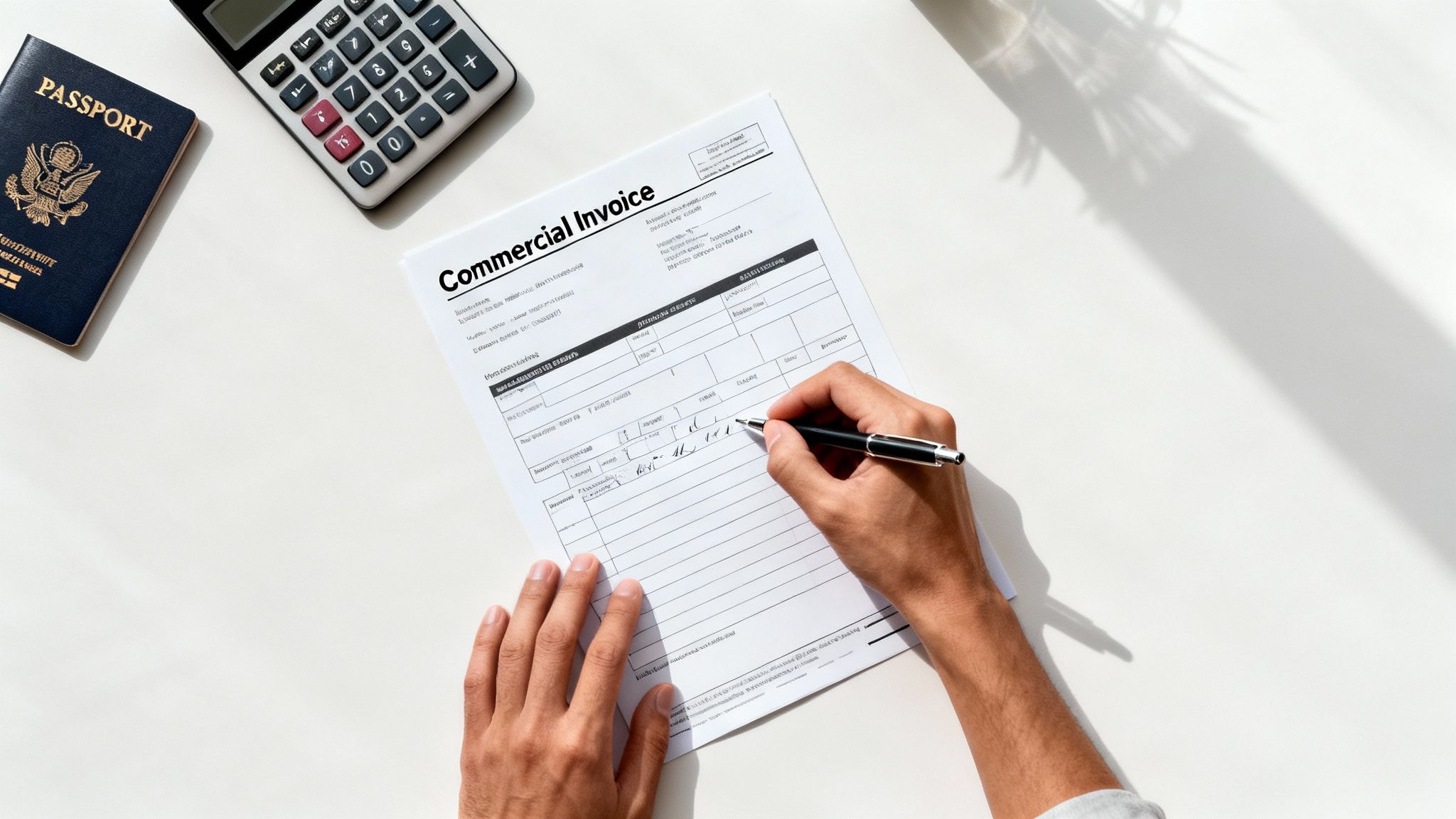
Once your goods are classified and you’ve cleared all compliance checks, it’s time to tackle the paperwork. This isn’t just a formality—accurate and detailed documentation is the engine of a successful export. It’s the official instruction manual that tells customs everything they need to know, ensuring your shipment moves smoothly.
Think of your export documents as your product's passport. Without them, your goods aren't going anywhere. The Canada Border Services Agency (CBSA) has strict requirements, and even a small mistake can lead to delays, inspections, fines, or having your entire shipment sent back.
The Commercial Invoice: Your Shipment's Foundation
Every single export shipment is built on the foundation of a commercial invoice. It’s much more than a simple bill; it’s the primary legal document for customs clearance worldwide, providing a complete record of the transaction between you and your buyer.
Getting this document perfect is non-negotiable. Every field has a purpose, and customs officers are trained to spot incomplete or vague invoices instantly.
What to Include on a Commercial Invoice:
Exporter/Consignor Information: Your full legal business name, address, and business number (BN).
Importer/Consignee Information: Your buyer’s full legal name and address.
Detailed Description of Goods: Be incredibly specific. "Auto parts" is a red flag. "Automotive steel brake rotors for 2023 Ford F-150" is what they need. Include quantities and units (e.g., pieces, kilograms).
HS Code: The correct 10-digit Harmonized System code for each item.
Country of Origin: Where the goods were actually manufactured, not just the shipping point.
Value and Currency: The unit price and total value for each item, with the currency clearly stated (e.g., CAD, USD).
To make sure you’re hitting all the right points, you can find a range of Canada customs forms and templates online. Using a proven format is one of the easiest ways to avoid leaving out critical information.
Filing Your Export Declaration Through CERS
Next up is the export declaration, your official notice to the CBSA about what’s leaving the country. According to CBSA rules, an export declaration is mandatory for all commercial goods valued at CAD $2,000 or more that are headed to any country other than the United States, Puerto Rico, or the U.S. Virgin Islands. It is also required for all controlled, regulated or prohibited goods, regardless of value or destination.
You must file this declaration electronically through the Canadian Export Reporting System (CERS) portal. CERS is the government's single, official system for submitting export data, replacing the old paper-based B13A form.
The law requires you to file your CERS declaration within specific timeframes before the goods are exported:
Air: At least two hours before the goods are loaded onto the aircraft.
Marine: At least forty-eight hours before the goods are loaded onto the vessel.
Rail: At least two hours before the rail car is assembled to form part of a train.
Mail: At least two hours before the goods are brought to a Canada Post outlet.
Highway: Immediately before the goods leave Canada.
Expert Insight: Don't wait until the last minute to file your CERS declaration. Border officials have real-time access to the system. If your truck shows up at the border and there's no declaration on file, it will be stopped and turned around—guaranteed. File early to avoid a very stressful and expensive situation.
Using Trade Agreements with a Certificate of Origin
For certain shipments, one more document can give your business a huge competitive advantage: the Certificate of Origin. This document certifies that your goods were produced or manufactured in Canada, qualifying them for preferential tariff treatment under a free trade agreement (FTA).
The most common FTA for Canadian exporters is the Canada-United States-Mexico Agreement (CUSMA). By giving your U.S. or Mexican buyer a valid CUSMA Certification of Origin, you prove the product meets the agreement's "rules of origin." This allows them to import your goods with reduced or even zero tariffs, making your products much more affordable and appealing than those from non-CUSMA countries.
Let's look at a real-world example from a furniture maker in Quebec.
Scenario 1 (Shipment to the U.S.): A truckload of oak tables is heading to a retailer in New York. The exporter provides a commercial invoice and a CUSMA Certification of Origin. No export declaration is required since the destination is the U.S. and the goods are not controlled. That CUSMA certificate ensures the U.S. buyer pays no import duty.
Scenario 2 (Shipment to Germany): A container of the same tables is going to Hamburg. The exporter must provide a commercial invoice and file an export declaration via CERS because the destination is outside the U.S. and the value exceeds $2,000.
In both situations, accurate documents are essential, but the specific requirements change with the destination. Mastering these details is fundamental to exporting from Canada efficiently and profitably.
Navigating Logistics From Your Door to the Global Market
Once your compliance and paperwork are buttoned up, it's time to get your goods on the move. This is where the theory of exporting meets the real-world grit of trucks, ports, and international borders. The journey from your warehouse to your customer’s hands involves a chain of critical handoffs, and getting this right is what separates a smooth delivery from a costly headache.
At the centre of this whole process is your customs broker. A great broker does a lot more than just file documents; they're the logistical quarterback for your shipment. They coordinate with carriers, manage border crossings, and make sure everyone in the supply chain has what they need to keep your freight moving on time.
Choosing Your Incoterms: Who’s Responsible for What?
Before a single box leaves your dock, you and your buyer need to agree on the Incoterms that will govern the sale. These are internationally recognized rules that clearly define who is responsible for the goods—and who pays for what—at every step of the journey. Getting this wrong is a surefire way to end up in a dispute with unexpected costs.
For example, choosing FOB (Free On Board) means your responsibility ends once the goods are loaded onto a vessel at a Canadian port. On the other hand, DDP (Delivered Duty Paid) puts you on the hook for the entire journey, including transport, insurance, and all import duties and taxes at the destination. The right choice really depends on your business model and your buyer's capabilities.
To help you decide, we've broken down some of the most common pricing models you'll encounter.
Common Exporting Pricing Models and Responsibilities
Understanding Incoterms is crucial because they directly impact your pricing, risk, and logistical workload. This table compares a few common options to give you a clearer picture of what each entails.
| Incoterm | Seller's Responsibility | Buyer's Responsibility | Best For... |
|---|---|---|---|
| EXW (Ex Works) | Make goods available at your facility. | Arrange and pay for all transport, insurance, and customs. | Buyers with strong logistical networks who want full control. |
| FOB (Free On Board) | Deliver goods to the port and load them onto the ship. | Manage the main sea freight, insurance, and import clearance. | Experienced exporters and buyers who can manage ocean freight. |
| CIF (Cost, Insurance, Freight) | Arrange and pay for transport and insurance to the destination port. | Handle import clearance, duties, and final delivery. | Sellers who want to provide a more inclusive service to the port. |
| DDP (Delivered Duty Paid) | Manage and pay for the entire journey to the buyer's door. | Unload the goods at their final destination. | Sellers providing a complete "door-to-door" service, often in e-commerce. |
Choosing the right Incoterm sets clear expectations from the start, preventing confusion and surprise bills down the road.
Tracing a Shipment: From BC to California
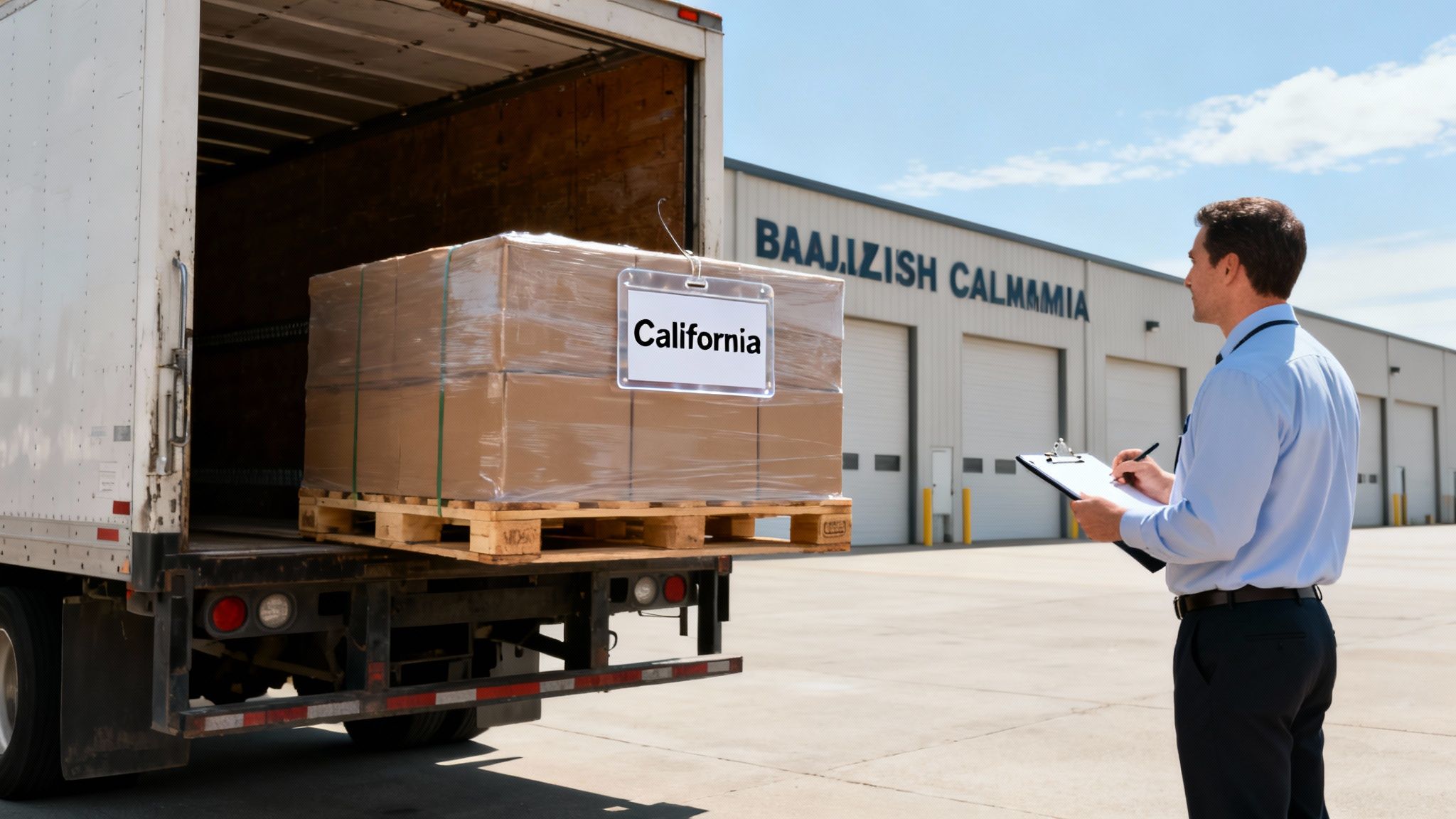
So, how does this all fit together in practice? Let's trace the journey of a single pallet of goods from a manufacturer in Kelowna, British Columbia, shipping specialized machinery parts to a buyer in Los Angeles, California.
Pickup and Prep: Back in Kelowna, the manufacturer securely packs and labels the pallet. Their Canadian customs broker lines up a local trucking company to grab the shipment right from their warehouse.
The Border Crossing: The trucker heads south to the Pacific Highway crossing. But before the truck even gets there, the Canadian broker has already electronically sent all the commercial invoice data to their trusted U.S. customs broker partner. This allows the U.S. broker to prepare and file the U.S. Customs entry in advance.
U.S. Customs Clearance: When the truck pulls up to the U.S. border, the entry is already in the system. U.S. Customs and Border Protection (CBP) scans the shipment's barcode, matches it to the pre-filed entry, and waves the truck through. This whole process can take less than an hour.
The Final Mile: Once cleared, the truck continues down the I-5 straight to the buyer's facility in Los Angeles, completing the door-to-door delivery.
Key Insight: The secret to a smooth border crossing is coordination. That handoff of information between the Canadian and U.S. brokers before the truck arrives is what prevents long, expensive delays. A single point of contact managing both sides makes this seamless.
Drayage, Handoffs, and Keeping Your Cargo Safe
For shipments moving by sea or rail, another crucial step comes into play: drayage. This is the term for the short-haul transport of your container, usually from a port or rail yard to a nearby warehouse. Your broker or freight forwarder is essential for coordinating these moves to avoid delays and eye-watering demurrage fees.
As your goods make their way across the globe, robust physical security for the container is non-negotiable. It's well worth your time to explore comprehensive container security measures to protect your assets from theft or tampering.
Ultimately, successful logistics is all about flawless coordination. Working with a partner who understands the intricacies of freight delivery ensures your goods don't just clear customs but also arrive at their final destination on time and on budget.
Avoiding Common Pitfalls for a Smooth Export Process
Even the sharpest exporters can hit a snag that grinds a shipment to a halt. Successfully exporting from Canada isn’t just about knowing the right steps; it’s about knowing which traps to avoid. Getting the small details wrong can lead to costly border delays, financial penalties, and—worst of all—a damaged relationship with your international client.
The consequences of simple errors are bigger than you might think. A misclassified HS code, for instance, isn't just a typo. To customs, it's a legal misdeclaration. This can force customs officials in the destination country to re-evaluate your goods, creating unexpected duties for your buyer and holding up their entire supply chain.
Similarly, an incomplete commercial invoice or a failure to file a required export declaration isn't a minor oversight. These are immediate red flags for the Canada Border Services Agency (CBSA) that can trigger inspections, fines under the Administrative Monetary Penalty System (AMPS), and even a refusal to let your goods leave the country.
Timing is Everything: Engage Your Broker Early
One of the most common—and completely avoidable—pitfalls is waiting until the last second to bring your customs broker into the loop. Too many businesses treat their broker like an afterthought, only calling when the truck is packed and ready to roll. This approach leaves zero room to fix errors, turning a minor issue into a full-blown crisis.
Think of engaging your broker early as a strategic move, not just another task. A good broker will review your documentation before the shipment is booked. They're trained to catch potential problems with HS codes, valuation, or country of origin. This proactive check gives you time to make corrections, find missing information, and ensure your paperwork is perfect long before a deadline is breathing down your neck.
The screenshot below shows the main menu of the Canadian Export Reporting System (CERS), the official portal for filing export declarations.
This is where all the critical data for your shipment is submitted. Having every detail correct ahead of time is what makes this a smooth, compliant process instead of a frantic scramble.
"The biggest mistake I see is when a client calls me with a truck at the border and a missing export declaration. At that point, it's not a logistics problem—it's an emergency. We can fix it, but that shipment is going to be late, and it will cost them. A five-minute call a week earlier could have prevented it all."
Critical Checks for Every Export
To standardize your process and steer clear of these common traps, treat every shipment like a pre-flight checklist. Before your goods are even scheduled to move, run through these critical verification steps. It’s the best way to make sure you’ve covered all your bases.
Your Pre-Export Checklist:
HS Code Verification: Have you confirmed the correct 10-digit HS code for every single item? Does it align with the tariff schedule of the destination country?
Commercial Invoice Accuracy: Is every field on your invoice complete and accurate? Does the description of goods give a customs officer enough detail to understand exactly what you're shipping?
Export Declaration Requirements: Is your shipment valued over CAD $2,000 and heading somewhere other than the U.S.? Or does it contain controlled goods? If so, has your export declaration been filed through CERS within the legally required timeframe?
Permit and License Check: Have you checked your goods against Canada's Export Control List? You need to be certain whether an export permit from Global Affairs Canada is required.
Trade Agreement Documentation: If you're shipping under an agreement like CUSMA, do you have a valid Certificate of Origin ready? Your buyer needs it to benefit from reduced tariffs, and they'll be expecting it.
Following a consistent checklist for every shipment transforms compliance from a stressful, last-minute scramble into a predictable routine. This discipline is the foundation of any successful, scalable export operation.
Common Questions About Exporting From Canada
Getting your goods across the border raises a lot of questions. Here are some straight answers to the things Canadian businesses ask us most often, based on decades of hands-on experience and the latest CBSA regulations.
Do I Always Need an Export Permit?
No, the vast majority of commercial goods shipped from Canada do not require an export permit.
Permits are only mandatory for goods on Canada's Export Control List (ECL). This list covers goods with national security implications, strategic technologies, certain natural resources, and military-grade equipment. It's critical to check the ECL before you arrange shipment. If your product is on that list, you must obtain a permit from Global Affairs Canada before exporting. For most everyday commercial shipments, especially to the U.S., a permit is not required.
What Is the Difference Between a Freight Forwarder and a Customs Broker?
This one trips a lot of people up, but it's simple when you break it down.
A freight forwarder is your logistics coordinator. Think of them as a travel agent for your cargo. They arrange the physical movement of your goods—booking space on a truck, reserving a spot on a container ship, or scheduling air freight. Their job is to get your product from point A to point B.
A customs broker, on the other hand, handles the legal side of crossing the border. We are specialists in customs law and regulations. We prepare and submit all required documentation, ensure your shipment complies with CBSA export rules and the import rules of the destination country, and we are licensed to represent you before government agencies.
Key Distinction: A freight forwarder handles the movement of your goods, while a customs broker handles the customs clearance and legal compliance required to cross the border. You often need both to get the job done right.
How Does CUSMA Affect My Exports to the USA and Mexico?
The Canada-United States-Mexico Agreement (CUSMA) is a massive advantage for Canadian exporters. If your product "originates" in Canada (meaning it's made or substantially transformed here), it could be eligible for duty-free entry into the United States and Mexico.
This is a huge deal. It makes your products more competitively priced and attractive to American and Mexican buyers. To claim this benefit, you need to provide your customer with a valid Certification of Origin, which proves your product meets the CUSMA "rules of origin."
A good customs broker can analyze your products to determine if they qualify and help you prepare the certification correctly. Getting this right can save your customer a lot of money and make you a preferred supplier.
Navigating the complexities of how to export from Canada demands precision, expertise, and a partner you can trust. J.W. Smith Customs Brokers Ltd. has spent over 50 years helping Canadian businesses like yours get it right, from the first piece of documentation to the final delivery. Let our team provide the clarity and confidence you need to expand your business globally. Get in touch with us today to future-proof your trade operations.
Need Help with Customs?
J.W. Smith Customs Brokers has over 50 years of experience helping Canadian businesses navigate imports with confidence. Our team of licensed customs brokers is ready to assist with your import and export needs.