How to Get a Business Number in Canada for Importers

Before you import goods into Canada, your business must be officially recognized by the government. This process starts with obtaining a Business Number (BN). This isn't just administrative paperwork; it's the mandatory first step that enables you to legally operate as an importer in Canada.
To get your BN, you must register with the Canada Revenue Agency (CRA). You can do this online, by phone, or by mail. This unique nine-digit identifier is the absolute foundation for your importing activities. Without it, you cannot open the required import-export (RM) account with the Canada Border Services Agency (CBSA). Without an RM account, your goods will be stopped at the border, leading to costly delays and fees.
Your Business Number Is the Key to Importing
Think of your Business Number as your company's official identifier for all interactions with the Canadian government. It is a unique nine-digit number that serves as the root for various program accounts you will need. While many entrepreneurs associate it solely with taxes, for an importer, its role is far more critical.
The BN is the foundation for several essential government program accounts, each identified by a two-letter code and a four-digit reference number appended to your BN. For anyone bringing commercial goods into Canada, the most important one is the import-export (RM) account. This account is non-negotiable; the CBSA requires it to process your shipments and track your customs compliance.
Why This Is a Non-Negotiable First Step
Without an active BN and a properly linked RM account, your importing operations will halt before they begin. Any commercial shipment arriving at a Canadian port of entry without this registration will be held by the CBSA. This is not a warning; it is a certainty.
This triggers a cascade of costly problems that can severely impact your business:
- Costly Delays: Your goods will be detained in a bonded warehouse, unable to clear customs until your registration is complete and verified in the CBSA system.
- Mounting Fees: You will be liable for daily storage (demurrage) and other administrative fees, which can quickly escalate into thousands of dollars.
- Supply Chain Disruption: Production schedules are missed, and customer delivery commitments are broken, causing significant damage to your business's reputation and finances.
The BN and its associated RM account are not just administrative details—they are your legal authorization to operate as an importer in Canada.
Your Business Number is more than just a tax ID—it's the central hub that connects your business to every critical federal program you'll interact with as an importer, from customs clearance to GST/HST remittance.
The Foundation of Your CBSA Relationship
Beyond enabling basic customs clearance, the BN is your entry point into Canada's modern customs system. It is required for registering on the CARM Client Portal, a mandatory online platform for all commercial importers. Through CARM, you will manage payments for duties and taxes, post financial security, and delegate authority to essential partners like your customs broker.
In Canada, obtaining a Business Number is the primary step for any business dealing with federal government programs. The CRA issues the BN at no charge, and you have multiple ways to register. This same number will be used for your GST/HST, payroll, and corporate income tax accounts, right alongside your essential import-export (RM) account.
Navigating these requirements is where professional guidance is invaluable. Understanding the role of a customs broker is key, as they do more than just file paperwork. A qualified broker ensures your registration is completed correctly from the start, helping you avoid common errors that lead to frustrating and expensive border delays. Securing your BN is the first, most critical move toward building a compliant and efficient importing business.
Organizing Your Information Before You Register
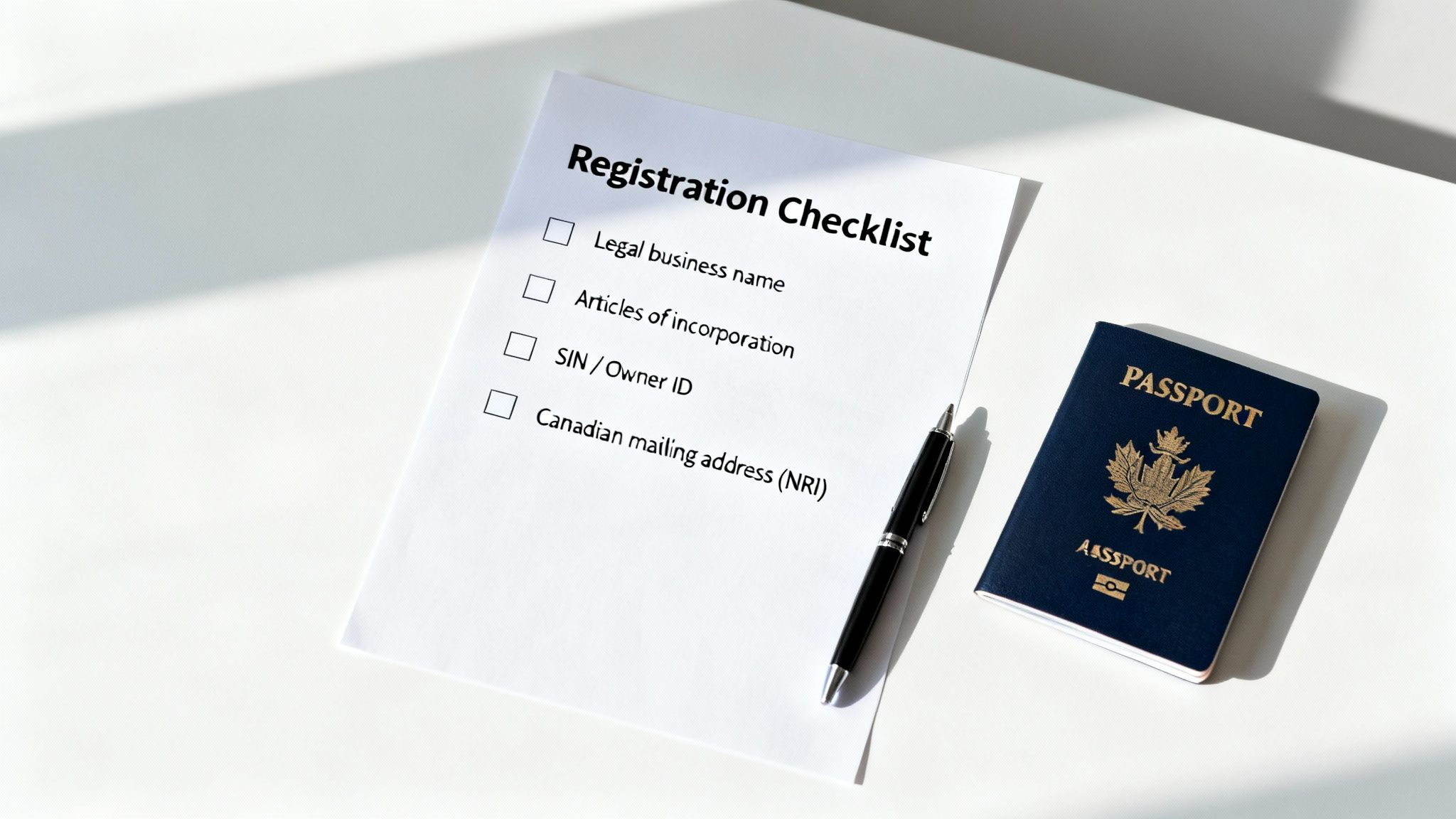
Before beginning the application process with the Canada Revenue Agency (CRA), it is crucial to gather and organize all required information. Inaccurate or incomplete information is the primary reason for application rejections and delays.
Think of it like preparing customs documentation: accuracy and completeness upfront prevent significant issues later. You are providing an official record of your business to the government. Any inconsistency, such as a mismatch between your registered legal name and your operating name, can flag your application for a manual review, slowing down the entire process.
Key Information for All Business Types
Regardless of your company’s structure, the CRA requires specific foundational details. Having these items prepared will streamline the registration.
Ensure you have the following information readily available:
- Legal Business Name: This must be the exact name registered with the relevant provincial, territorial, or federal authority. It is not your trade name or "doing business as" name unless that is also your legally registered name.
- Business Address: This is the physical location where your business operates. A P.O. box is not acceptable for the physical address, though it can be used for your mailing address.
- Mailing Address: All official correspondence from the CRA and CBSA will be sent here. If it differs from your physical address, it must be specified.
- Description of Business Activities: Be prepared to provide a concise summary of your business operations. For importers, this includes describing the general types of goods you plan to import into Canada. This detail is essential when adding your import-export account. For guidance on classifying goods, our guide on what HS codes are can be a helpful resource.
Required Information by Business Type
The specific documents and identification numbers required depend entirely on your business's legal structure. A sole proprietorship has different requirements than a corporation.
The table below outlines the necessary information based on your business type.
| Information Required | Sole Proprietor | Partnership | Corporation | Non-Resident Importer |
|---|---|---|---|---|
| Legal Business Name | Yes | Yes | Yes | Yes |
| Business Address | Yes | Yes | Yes | Yes |
| Canadian Mailing Address | Yes | Yes | Yes | Yes (Crucial) |
| Owner/Partner SIN | Your SIN | SIN of each partner | N/A | N/A |
| Articles of Incorporation | N/A | N/A | Yes (Date, jurisdiction) | Yes (If applicable) |
| Description of Activities | Yes | Yes | Yes | Yes |
As shown, while some information is universal, key identifiers like a Social Insurance Number (SIN) or Articles of Incorporation are specific to your business structure. Having the correct documents ready is essential for a smooth registration.
Key Takeaway for Importers: Ensure the legal business name you register with the CRA perfectly matches the name you will use on all commercial invoices and customs documentation. Discrepancies here are a frequent cause for shipment inspections and delays at the border.
Special Considerations for Non-Resident Importers
If your business is a Non-Resident Importer (NRI), your preparation must be particularly thorough. The CRA and CBSA have specific requirements to ensure they can communicate with and hold foreign entities accountable.
The most critical piece of information for an NRI is a valid Canadian mailing address. This is a mandatory requirement. All official documents, including your Business Number confirmation and critical notices from the CBSA, will be sent to this address. Using an international address can result in lost mail and missed deadlines, putting your shipments and compliance at risk.
A customs broker can provide significant value in this area. A firm like J.W. Smith can act as your official mailing address in Canada for customs purposes, ensuring all vital correspondence is received, processed, and communicated to you promptly. This service prevents critical documents from being lost, keeping your Canadian operations compliant and efficient.
Three Ways to Register Your Business Number
Got your documents sorted out? Great. The next big decision is how to actually get your Business Number (BN) from the Canada Revenue Agency (CRA).
The CRA provides several registration methods. The best choice depends on your business structure, comfort with technology, and how quickly you need to begin importing. For an importer, this decision is strategic, as it impacts how fast your RM account can be activated so your products can cross the border.
The Online Route: The Business Registration Online Service
For the fastest results, the CRA’s Business Registration Online (BRO) service is the recommended option. It is the most direct method, especially for Canadian-based businesses with straightforward structures like sole proprietorships or corporations.
If all your information is accurate, you can often receive your nine-digit BN almost instantly upon submission. This is ideal for importers who need the number quickly to apply for their import-export (RM) program account.
However, the BRO service's speed can be a drawback. If you are uncertain about any information required, there is no one to ask for clarification. A small mistake during online registration can lead to significant compliance issues later.
The Phone Method: Direct Access to a CRA Agent
Registering by phone provides a key advantage: a direct conversation with a CRA agent. When you call the CRA's Business Enquiries line, an agent will guide you through the application question by question.
This method is highly beneficial in several situations:
- Complex Structures: For partnerships or corporations with intricate ownership, an agent can clarify requirements on the spot.
- Non-Resident Importers (NRI): NRI applications often involve additional verification steps. A CRA agent can explain these nuances and ensure you provide the correct information from the start.
- First-Time Registrants: If you are new to this process, an agent can help you understand terminology and requirements, providing immediate confidence that your application is correct.
While you will not receive your BN instantly, this method significantly reduces the risk of errors that could delay your application.
Expert Tip: Before you dial, lay out all your documents in front of you. This keeps the call moving efficiently and ensures the agent has everything they need to process your registration in one go.
The Mail-In Option: Traditional and Reliable
The slowest method is to mail a completed Form RC1, Request for a Business Number and Certain Program Accounts. This is a reliable option if you cannot use online or phone services or prefer a physical paper trail.
The major disadvantage is the timeline. You are subject to mail delivery times and the CRA's manual processing queues, which can extend the wait from days to weeks. For an importer with a shipment already in transit, this delay is not a viable option.
The Fourth Option: Engaging a Customs Broker
For most importers, especially NRIs, the most efficient registration method involves engaging a professional. A customs broker like J.W. Smith can manage the entire process on your behalf.
An experienced broker handles everything from the initial BN registration to adding the critical RM account. We understand precisely what the CRA and CBSA require and can anticipate the verification hurdles an NRI will likely face. This proactive approach ensures every detail is correct from the start, preventing compliance issues that could halt your shipments.
Before you start any of this, you absolutely need to have your company's legal framework sorted out. The information you provide depends entirely on your business structure. Knowing the difference between a corporation and other entities is fundamental, and understanding common Canadian business structures like the equivalent of an LLC can provide crucial clarity. Your customs broker will then work with your established structure to ensure a seamless registration.
The timeline to obtain a BN and activate the necessary program accounts can vary significantly. A simple online registration for a Canadian business might take less than 30 minutes. However, for an importer needing an RM account and CARM enrollment, the full process can stretch over several weeks, especially if financial security like a customs bond is required. For this reason, using an expert to manage the process is a strategic advantage that gets your supply chain moving without costly delays.
Activating Your Import-Export RM Account
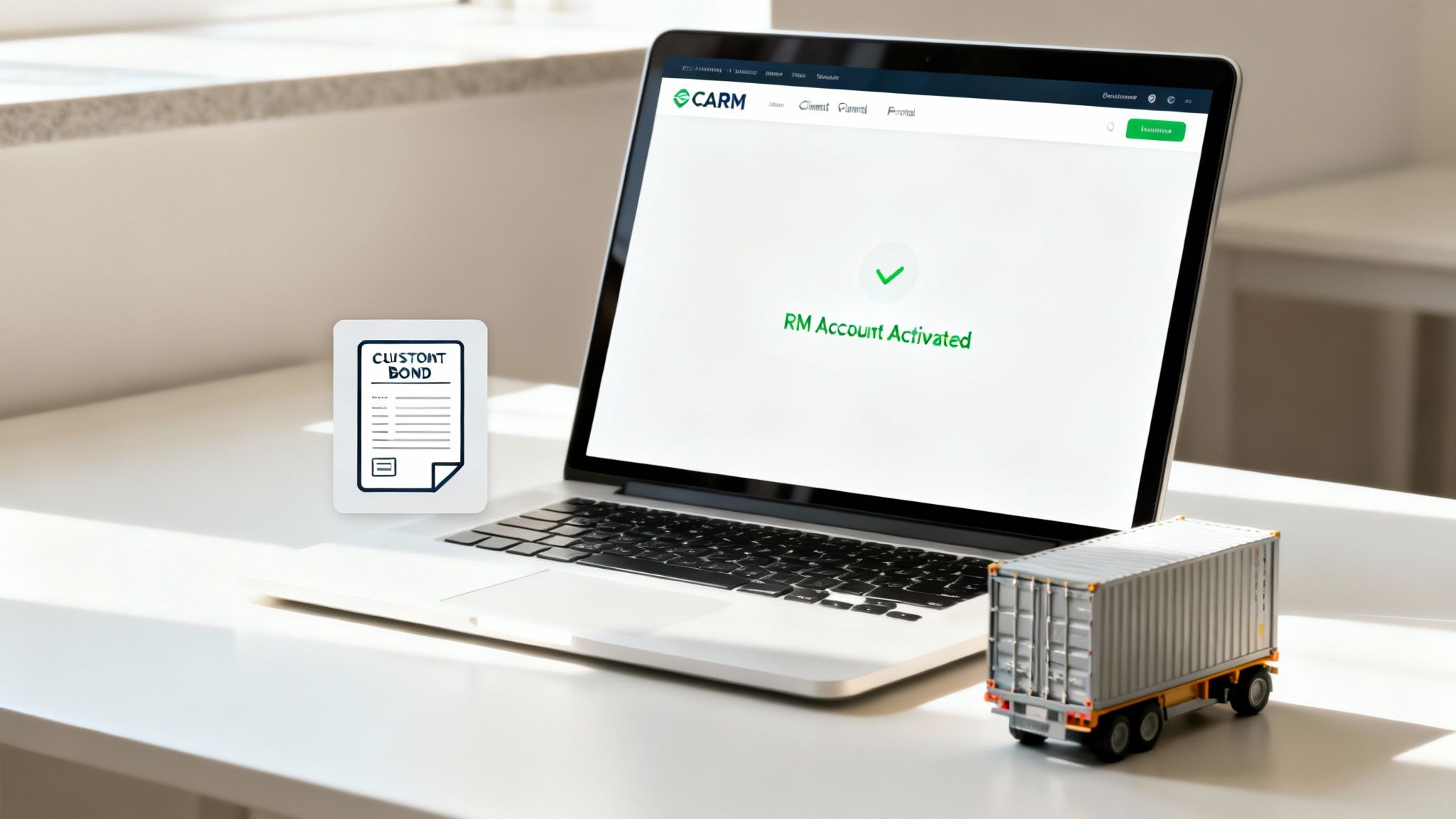
Obtaining your nine-digit Business Number (BN) is a critical milestone, but it is only the first step for an importer. The BN serves as the foundation. The key to legally clearing goods through Canadian customs is the import-export (RM) program account.
Your BN identifies your business to the government, while your RM account specifically authorizes you to engage in international trade. Without an active RM account linked to your BN, your shipments will be rejected by the Canada Border Services Agency (CBSA), regardless of the accuracy of your other documentation. This is the crucial second step that officially registers you as a recognized importer with the CBSA.
From BN to RM: The Critical Link
Once you have your nine-digit BN, your immediate next step is to request an RM program account. This is not an automatic process; you must specifically request that the Canada Revenue Agency (CRA) open one for you.
When making this request, you will need to provide information specific to your importing activities. The CRA and CBSA require these details to understand your business operations and ensure compliance.
Be prepared to provide:
- Types of Goods: A general description of the products you plan to import (e.g., textiles, electronics, automotive parts).
- Estimated Annual Value: A forecast of the total value of goods you expect to import over a year.
- Business Address: Confirmation of your physical and mailing addresses.
This information helps the government build a profile of your importing business. It is essential that these details are consistent with the information used to register your BN.
Crucial Insight: An RM account is not just a formality. It’s your unique identifier with the CBSA. Every customs declaration, duty payment, and compliance action will be tied directly to your specific RM account number, which will look something like this: 123456789RM0001.
The Gateway to CARM and Financial Security
Your active RM account is your entry point into Canada's modern customs framework, managed through the CBSA Assessment and Revenue Management (CARM) portal. Registering on the CARM Client Portal is mandatory for all commercial importers, and this process cannot begin without a valid RM account.
The CARM portal is the digital hub where you will:
- Manage and pay duties and taxes directly to the CBSA.
- Delegate authority to your service providers, such as your customs broker.
- View your transaction history and statements of account.
- Post and manage your required financial security.
That last point is critical. To gain full importing privileges, including the ability to have goods released before duties and taxes are paid (Release Prior to Payment), you must post financial security with the CBSA. For nearly all importers, this takes the form of a customs bond.
Securing Your Customs Bond
Obtaining a customs bond is a mandatory step to activate your RM account's full functionality within CARM. This bond serves as a financial guarantee to the CBSA that you will pay all applicable duties and taxes. Without it, your shipments will be held at the border until every fee is paid in full, preventing a fluid supply chain.
The bond amount is based on your expected monthly duty and tax liabilities, with a minimum of $25,000 being common. A customs broker is essential in this process. They work with surety companies to secure the correct bond for your business, ensuring it meets all CBSA requirements and is properly linked to your RM account in the CARM system.
This entire sequence—adding the RM account, securing a bond, and registering on the CARM portal—is interconnected. An error in one step can cause a domino effect that halts your importing operations. For a detailed walkthrough, our guide to registering your business for CARM provides the clarity you need.
Why Expert Guidance Makes the Difference
The value of an experienced customs broker is most evident during this setup phase. While it is technically possible to manage the RM activation and CARM setup independently, the process is complex, and the potential for costly errors is high.
A broker like J.W. Smith manages these steps as a single, coordinated workflow. We ensure your RM account is opened with the correct information, handle the process of acquiring your customs bond, and guide you through CARM portal registration and delegation. This prevents the common scenario where an importer obtains a BN but fails to activate the RM account, only discovering the error when their first shipment is detained at the border. By handling these critical setup stages, we ensure your business is ready to trade from day one, without any expensive surprises.
Common Registration Mistakes and How to Avoid Them
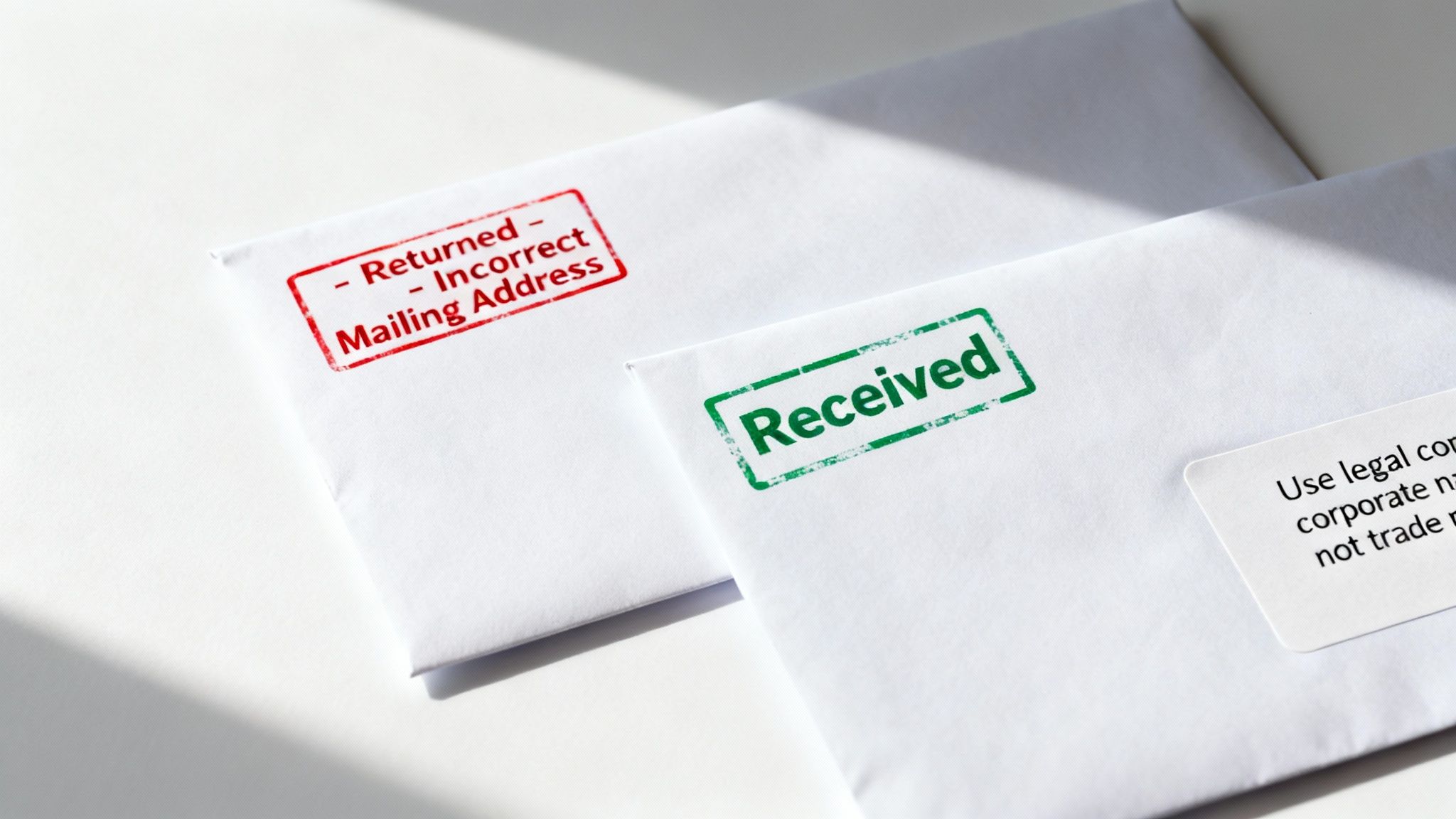
Simple, avoidable mistakes are the leading cause of costly border delays. Obtaining your Business Number (BN) and RM account is not just paperwork; it is the foundation of your Canadian supply chain. A minor error can create a significant ripple effect, turning a smooth customs clearance into a logistical and financial problem.
Here are the most common pitfalls and how to avoid them to protect your business from day one.
Using a Trade Name Instead of the Legal Name
This is one of the most frequent errors. While you may operate under a "doing business as" (DBA) or trade name, the Canada Revenue Agency (CRA) and the Canada Border Services Agency (CBSA) require your legal name only.
Your business number application must use the exact legal name that appears on your articles of incorporation or other official registration documents. Any discrepancy will cause a system mismatch, leading to a rejected application or shipments being held for verification.
How to get it right: Before starting the application, refer to your official registration documents. The name you provide must be identical, including punctuation (e.g., "Inc." vs. "Incorporated"). This legal name must then be used consistently across all commercial invoices and customs declarations.
Providing an Incorrect Mailing Address
This may seem basic, but the consequences of an incorrect address are severe, particularly for Non-Resident Importers (NRIs). The CRA and CBSA send critical documents by mail, including your official BN confirmation and time-sensitive compliance notices.
If you provide an incorrect or incomplete address, these documents will be returned, and you may be unaware of a problem until a shipment is detained. For an NRI, failing to provide a valid Canadian mailing address can halt the registration process entirely.
How to get it right: Double- and triple-check your Canadian mailing address for accuracy. If you are an NRI without a physical presence in Canada, the most reliable solution is to use your customs broker’s address as your official mailing address for customs purposes. This ensures all vital correspondence is received and handled promptly.
Assuming the BN Is Ready for Imports Immediately
Obtaining your nine-digit BN is a crucial first step, but it does not mean you are ready to import. This misunderstanding catches many new importers off guard. Your BN is only the root identifier; you still need an active import-export (RM) program account linked to it.
We have seen this scenario many times: an importer's first shipment arrives, only for them to learn their RM account was never activated. The goods are held by the CBSA, and daily storage fees accumulate. What should be an exciting business milestone becomes a costly lesson in compliance.
How to get it right: Treat the activation of the RM account as a separate and mandatory second step. After receiving your BN, confirm with the CRA that the RM account has been successfully added. A more effective approach is to have your customs broker manage the entire sequence to ensure both the BN and RM accounts are fully active and compliant in the CBSA system before your goods are shipped.
Expert Takeaway: Think of your Business Number as your house address, but your RM account is the key to the front door. You absolutely need both to get inside. Never schedule a shipment until you have confirmation that your RM account is fully active and linked in the CBSA system.
The financial risks of procedural errors are significant. While the Canada Revenue Agency issues the Business Number free of charge, the linked accounts have serious financial implications. An RM account requires a customs bond as financial security, and errors in reporting duties can result in penalties ranging from 10% to 50% or more of the original duty owed. Data on business compliance costs from Innovation, Science and Economic Development Canada highlights these financial burdens. Professional management of your BN and RM accounts is a sound investment to mitigate risk and ensure efficient customs clearance.
Common Questions We Hear from Importers
Navigating the business number registration process often raises many questions for new importers. Clear answers are essential for ensuring compliance and preventing supply chain disruptions. Here are some of the most practical questions we address for importers every day.
How Long Does It Take to Get an Active RM Account?
This is a critical timeline for importers. The nine-digit Business Number (BN) can often be issued almost instantly via online application. However, the BN alone does not authorize you to import.
The timeline that truly matters is for activating your import-export (RM) account. This is the specific account required to clear goods through customs. The entire process—from registering the BN to having a fully active RM account with financial security (like a customs bond) in place—can take anywhere from a few business days to several weeks.
Factors that influence this timeline include:
- Business Structure: A non-resident importer (NRI) application always requires additional verification by the CRA and CBSA, extending the timeline.
- Registration Method: Applying by mail is the slowest option. Online and phone registrations are significantly faster.
- Application Accuracy: Any errors or missing information will flag your application for a manual review, causing significant delays.
Given these variables, we strongly advise initiating the registration process well before your first shipment is scheduled. Waiting until goods are in transit is a common mistake that leads to expensive border delays.
Do I Need a New Business Number for Imports?
No, you do not need a new Business Number if your company already has one for other programs, such as GST/HST or payroll. A business has only one nine-digit BN, which serves as its master identifier for all interactions with the Canadian government.
If you are already registered, your task is simpler: you just need to add the import-export (RM) program account to your existing BN. You can do this by contacting the CRA, but the most efficient method is to have your customs broker manage it. A broker will ensure the RM account is linked correctly and that all necessary information for the CBSA is on file, preparing you for international shipping without administrative burdens.
Our Take: Imagine your BN is the main filing cabinet for your business. The RM, GST/HST (RT), and Payroll (RP) accounts are just different drawers inside that same cabinet. Each serves a unique purpose, but they all fall under one central identifier.
Can a Non-Resident Get a Business Number?
Yes, absolutely. In fact, a non-resident business must obtain a Business Number with a linked RM account to legally act as the Importer of Record (IOR) in Canada. This is known as operating as a Non-Resident Importer (NRI). For answers to common queries about business registration and other related topics, you may find their comprehensive Tax Buddies' Frequently Asked Questions (FAQ) section helpful.
The registration process for an NRI is more involved. A key requirement is a Canadian mailing address for all official correspondence from the CRA and CBSA. This is a primary area where a customs broker provides immense value. A broker can serve as your Canadian address and guide you through specific NRI compliance steps, such as securing a customs bond and setting up your CARM Client Portal, ensuring you can import legally and efficiently.
Navigating BN and RM registration is the foundational step to a successful import strategy. At J.W. Smith Customs Brokers Ltd., we ensure your business is set up correctly from day one, preventing costly delays and keeping your supply chain moving. Let's build your compliant foundation together.
Need Help with Customs?
J.W. Smith Customs Brokers has over 50 years of experience helping Canadian businesses navigate imports with confidence. Our team of licensed customs brokers is ready to assist with your import and export needs.