An importing tax calculator helps you estimate the total landed cost of bringing goods into Canada. It crunches the numbers on your shipment's value, origin, and HS code to give you a solid preview of the duties and GST/HST you'll owe. The goal? No more nasty surprises at the border.
Your No-Nonsense Guide To Calculating Import Costs
Let's be honest, the phrase "importing tax calculator" sounds both incredibly useful and slightly intimidating. You just want a number, right? This guide is your roadmap to getting that number without the usual headaches. We’ll skip the dense jargon and get straight to what you need to do to accurately estimate your duties and taxes.
Think of this as the straightforward breakdown you wish you had from the start. We're going to cover the core pieces of the puzzle that determine your final bill from the Canada Border Services Agency (CBSA).
The Key Ingredients for Your Calculation
Before you can calculate anything, you need to lock down three critical pieces of information. Getting these right is non-negotiable. Any mistake here will throw off your entire estimate, leaving you with a number that's anything but accurate.
To get a reliable estimate, you absolutely must have the following details sorted out first. This table breaks down what you need and why it's so important.
Core Components of Your Import Cost Calculation
| Component | What It Is | Why It Matters for Your Calculation |
|---|---|---|
| HS Code | A universal product classification code. | Tells customs officials exactly what you're importing, which determines the duty rate. |
| Value for Duty (VFD) | The total value used by the CBSA. | This isn't just the price you paid; it can include shipping and insurance, forming the base for duty calculations. |
| Country of Origin | Where the goods were actually manufactured. | Crucial for identifying if your goods qualify for reduced or zero duty under a free trade agreement. |
Each component directly impacts your final costs. Ignoring any one of these is like trying to bake a cake without flour—the result just won't work.
An accurate import cost estimate is more than a budgeting tool; it's a strategic advantage. Knowing your landed cost upfront lets you price your products competitively and protect your profit margins from day one.
Why Ballpark Figures Are a Costly Mistake
Relying on a vague "ballpark" figure is one of the most common—and expensive—mistakes an importer can make. I’ve seen it happen time and again: a business thinks they have a handle on their costs, only to have their profit margin vaporized by unexpected fees at the border.
The whole point of this process, whether you use a calculator or do it by hand, is to move from a wild guess to an informed projection. This puts you in control of your finances and helps you avoid those dreaded surprise bills from the CBSA.
For a deeper dive into all the potential costs you might encounter, this comprehensive guide to cross-border e-commerce is a great resource. It covers the various fees and regulations that can affect your bottom line.
Finding Your HS Code Without Losing Your Mind
Every single item that crosses the Canadian border needs a specific 10-digit number to get in. This is its Harmonized System (HS) code, and it’s the absolute linchpin of your entire import calculation.
Get it right, and your shipment sails through customs. Get it wrong, and you’re looking at costly delays, potential fines, and a surprise duty rate that can completely wreck your profit margins.
Think of the HS code as your product's universal passport. It tells customs officials in precise, standardized terms exactly what you're importing. This isn’t just paperwork; it's the code that directly determines the duty rate you’ll pay.
Decoding Your Product for the Customs Tariff
Finding the correct HS code can feel like a hunt, but your map is the Canadian Customs Tariff. To use it properly, you need to think like a customs officer. Forget your clever marketing terms; strip your product down to its most basic identity.
Start by asking these core questions:
- What is its primary function? What is the one thing this product is fundamentally designed to do?
- What is it made of? Is it plastic, steel, wood, or a mix of materials? The dominant material often points you to the right chapter.
- What is its current form? Are you importing raw materials, a component for assembly, or a finished consumer good?
These answers give you the keywords you need to start your search in the official tariff schedule. It's a much more reliable method than just taking a wild guess.
The Smartwatch vs. Wristwatch Dilemma
Let’s walk through a real-world example that trips up importers all the time: classifying a modern wearable device.
A simple, battery-powered "wristwatch" that just tells time likely falls under heading 9102. But what about a "smartwatch"? It connects to a phone, tracks your steps, and pushes notifications. Its primary function is no longer just telling time—it’s now about data processing and telecommunication.
That critical difference pushes it into an entirely different chapter, likely under heading 8517 for telecommunications equipment. The two codes carry completely different duty rates. This one small detail could be the difference between paying 0% duty and paying 6% duty.
Getting the classification wrong isn't a simple mistake; it's a compliance error. The CBSA can audit your shipments years after the fact and issue penalties for misclassification. It truly pays to be precise from day one.
When your product seems to fit into multiple categories, you must follow the General Interpretative Rules (GIRs). These rules provide a clear hierarchy for classification, usually prioritizing a product's "essential character" or its most specific description.
For a deeper dive into the system, our complete guide on what are HS codes can give you more clarity. If you find yourself stuck between two codes, take it as a sign to dig deeper or consult an expert. This isn’t the place to flip a coin.
Determining The Correct Value For Duty
What are your goods really worth? This might sound like a philosophical question, but to the Canada Border Services Agency (CBSA), it’s a matter of cold, hard numbers. The price on your commercial invoice is just the starting point. The official figure used for your import calculations is the Value for Duty (VFD), and getting it right is non-negotiable.
Think of the VFD as the bedrock of your entire import cost calculation. A mistake here doesn't just throw off your duty payment; it creates a domino effect that will also alter the GST/HST you owe.
More Than Just the Price Tag
While there are six official methods for customs valuation, over 95% of the time, importers use the first one: the Transaction Value Method. In simple terms, this is the price paid or payable for the goods when they were sold for export to Canada, plus a few specific additions.
It’s those additions that often catch inexperienced importers off guard. The CBSA requires you to include certain costs in your VFD that might not be on the commercial invoice itself.
Common costs you must add to the VFD include:
- Certain shipping and transportation costs to the point of direct shipment to Canada.
- Royalties and licence fees related to the goods.
- The value of any "assists," like providing moulds, dies, or materials to your foreign manufacturer for free or at a reduced cost.
A clear understanding of what to include is essential for compliance. For a more detailed breakdown, check out our article on what to include on a Canada Customs Invoice.
Currency Conversion and Its Critical Role
Another crucial piece of the puzzle is the currency exchange. You must convert the foreign currency value of your goods into Canadian dollars using the official Bank of Canada exchange rate on the date of direct shipment. Using the rate from the day you paid or the day the goods arrived will lead to an incorrect VFD—and a potential compliance issue.
For example, you're importing furniture from Vietnam with an invoice of 235,000,000 VND. If the exchange rate on the shipment date is 0.000053, your VFD in Canadian dollars would be $12,455 CAD. A slightly different rate could easily change this value by hundreds of dollars, directly impacting your final duty and tax bill.
The CBSA isn't looking for a "close enough" number. The VFD must be calculated precisely according to their regulations. Accuracy here protects you from potential penalties and audits down the road.
The scale of this is massive. Canada's import landscape is vast, with total imports recently reaching $351.186 billion for the year, and the CBSA collecting $47.5 billion in duties and taxes. This really highlights why getting the Value for Duty calculation right is so critical for both importers and the government.
Putting It All Together to Calculate Duties And Taxes
Okay, this is where it all comes together. You've done the hard work of finding your HS code and calculating the correct Value for Duty (VFD). Now it's time to crunch the numbers and see what your import costs will actually look like.
Getting the math right here is what separates a smooth, predictable import from a nasty surprise when the bill arrives.
The calculation itself isn't rocket science, but it absolutely must be done in a specific order set by the CBSA. It's a two-step process: first, you calculate the customs duty. Then, you calculate the taxes on top of that. One number builds directly on the next, so you can't skip ahead.
This graphic gives you a quick visual breakdown of how the key pieces fit together to form your dutiable value.
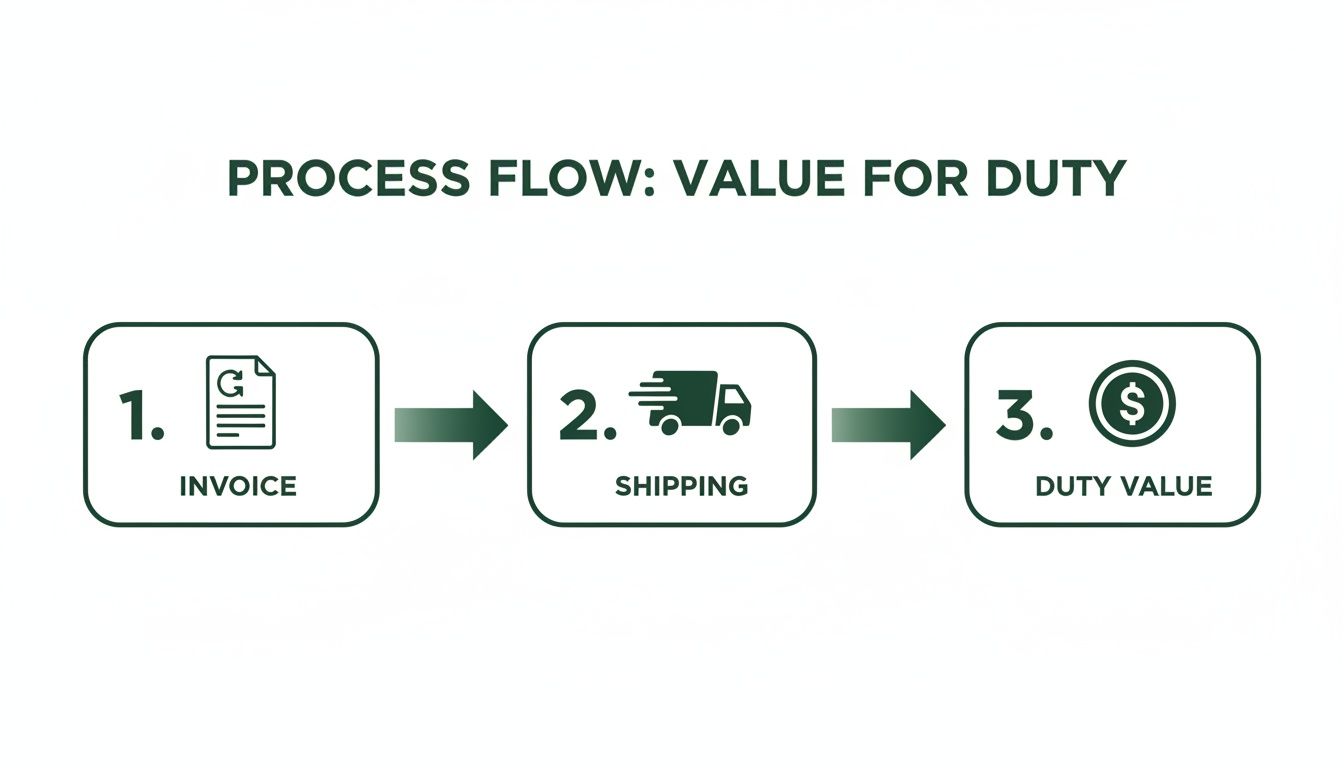
As you can see, your Value for Duty is more than just the price tag on the goods. It's a combination of the product's cost and other related expenses that you have to account for.
Step 1: Calculating the Customs Duty
First, apply the duty rate for your product's 10-digit HS code directly to your Value for Duty.
Let’s say your VFD is $10,000 CAD and the duty rate for your specific HS code is 8%. The calculation is simple multiplication:
$10,000 (VFD) x 0.08 (Duty Rate) = $800 in Customs Duty
That $800 is the first piece of the puzzle. But you're not done yet. Next up are the taxes, and this is where many importers trip up.
Step 2: Calculating GST, HST, and PST
Here’s the critical part: the Goods and Services Tax (GST) is not calculated on your original VFD. Instead, it’s levied on the VFD plus the customs duty you just figured out.
Let's stick with our example:
- Value for Duty: $10,000
- Customs Duty: $800
- Total Value for Tax: $10,800
If your goods are headed to a province with only GST, like Alberta, you would calculate the 5% GST on this new, higher total:
$10,800 (Value for Tax) x 0.05 (GST Rate) = $540 in GST
But what if the shipment is destined for a province with Harmonized Sales Tax (HST), like Ontario? You'd use the HST rate instead. In Ontario, that's 13%.
$10,800 (Value for Tax) x 0.13 (HST Rate) = $1,404 in HST
This one calculation covers both the federal and provincial portions of the tax. For provinces with a separate Provincial Sales Tax (PST), the PST is usually calculated on the VFD plus duty, but the rules can get a little tricky. It's always a good idea to double-check the specific requirements for your destination province.
A Real-World Example: Leather Handbags from Italy
Let's walk through a scenario from start to finish. Imagine you're importing a shipment of leather handbags from Italy, and they're landing in Ontario.
- Value for Duty (VFD): $10,000 CAD
- HS Code & Duty Rate: The code for these handbags is 4202.21.00.00. Under the Most-Favoured-Nation (MFN) tariff, this carries an 8% duty rate.
- Destination Province: Ontario (which has a 13% HST)
Here's the calculation:
- Customs Duty: $10,000 VFD x 8% = $800
- Value for Tax: $10,000 VFD + $800 Duty = $10,800
- HST Payable: $10,800 x 13% = $1,404
- Total Duties & Taxes: $800 + $1,404 = $2,204
In this case, the total government charges you'd owe at the border would be $2,204. This figure doesn't include brokerage fees or other carrier charges, but it gives you a precise number for what the CBSA will assess.
The scale of these calculations across the country is massive. In a single year, the CBSA processed 30.7 million commercial releases, collecting $47.5 billion in duties and taxes. To get a better sense of the sheer volume of Canadian trade, you can explore some of the fascinating global affairs reports.
How Trade Agreements And Origin Impact Your Bottom Line
Where your goods come from can be a complete game-changer for your final bill, thanks to Canada's network of free trade agreements (FTAs).
The Country of Origin isn't just a fun fact for the label; it’s a critical piece of information that can dramatically slash your import costs. Agreements like CUSMA (the new NAFTA) or CETA (with the European Union) act like special discount programs for importers. If your products qualify, you could see your customs duty drop all the way down to zero. That’s a massive saving that goes straight to your bottom line.
The Golden Rule of Origin
Here’s the catch many new importers miss: the country of origin isn't just where the goods shipped from. It’s about where they were substantially manufactured or transformed. This is the core principle behind the Rules of Origin, and it’s a common stumbling block.
For instance, imagine you’re importing a t-shirt assembled in Vietnam using cotton fabric woven in the United States. Even if the final product ships to you from a warehouse in Mexico, the core material is American. This seemingly small detail could mean the t-shirt does not qualify for duty-free treatment under CUSMA.
Proper documentation, like a Certificate of Origin, is your golden ticket in these scenarios. It's the official proof you need to claim preferential treatment and avoid paying the standard duty rate. Without it, you’re leaving money on the table.
Navigating a Changing Trade Landscape
Understanding these nuances is more important than ever. The global supply chain is constantly shifting, and savvy Canadian importers are diversifying where they source their goods. For a detailed breakdown of the HS codes that underpin these duty rates, check out our in-depth guide to the Canadian Customs Tariff.
This trend has huge implications. In a recent November, for example, imports from the United States fell by 5.4%, while imports from other countries surged by 7.8% to a record high. As importers source from a wider range of nations, determining the correct origin and its trade agreement eligibility becomes a critical step in managing costs effectively. You can discover more about these trade shifts and what they mean for the market.
Ultimately, smart importers don't just find great products; they find great products from countries that offer a competitive advantage through FTAs. Leveraging these agreements isn’t a loophole—it’s just plain good business strategy.
Common Questions About Calculating Import Tax
Even with the best plan, questions pop up. Here are answers to some of the most common things importers ask when trying to get a handle on their costs.
Can I Trust an Online Importing Tax Calculator?
Online calculators are great for getting a quick, ballpark estimate, but they can't account for the specific nuances of your product or complex valuation scenarios. They’re a fantastic starting point for budgeting, but that’s it.
Most of these tools miss opportunities for duty relief under trade agreements or fail to factor in unique product characteristics. For a final, compliant declaration, the detailed process we've outlined is the only way to avoid costly errors. A simple online tool can't replace a thorough understanding of your goods.
What Happens If I Declare the Wrong HS Code or Value?
Getting the HS code or customs value wrong can lead to serious headaches, including significant penalties under the Administrative Monetary Penalty System (AMPS). The CBSA is incredibly diligent and often conducts post-release audits. If they find a mistake, they'll issue a Detailed Adjustment Statement (DAS) for any duties and taxes you owe.
You'll be on the hook for the difference, plus interest and potential financial penalties. Repeated non-compliance can also flag your business for more frequent and intensive inspections on future shipments, which means more delays. It’s always better to be thorough upfront.
Do I Have to Pay Duty on Personal Goods?
It depends. Canada has personal exemption limits for residents returning from trips abroad. But for goods you order online or have shipped to you that exceed certain value thresholds—the de minimis threshold is around $20 CAD for postal shipments—duties and taxes will apply. The rules can also differ for goods imported by mail versus those sent by a courier.
It's also worth remembering that every jurisdiction has its own web of complex regulations. For businesses importing chemicals or products containing them into the EU, for example, complying with regulations like the REACH Directive SVHC List is a critical factor in calculating the true cost of importing. Every destination has unique compliance hurdles that a basic calculator won't even begin to address.
When the questions get complicated and the stakes are high, you don't have to go it alone. The team at J.W. Smith Customs Brokers Ltd. has seen it all and can provide the clarity you need to import with confidence. Let us help you get it right from the start.
Need Help with Customs?
J.W. Smith Customs Brokers has over 50 years of experience helping Canadian businesses navigate imports with confidence. Our team of licensed customs brokers is ready to assist with your import and export needs.