A Complete Guide to the Importer of Record in Canada
Let's be blunt: when goods cross the Canadian border, someone has to be legally on the hook for everything. That's the Importer of Record (IOR). Think of them as the captain of the ship—the one person or company legally responsible for the entire import journey, from accurate customs declarations and duty payments to making sure the products comply with every last Canadian law. This isn't just a name on a form; it's a role with serious legal and financial weight.
Who Is The Importer Of Record And Why It Matters
Simply put, the Canada Border Services Agency (CBSA) needs one party to hold accountable for every shipment. That party is the Importer of Record. Usually, this role falls to the owner or purchaser of the goods, or in some specific cases, the consignee in Canada.
You might assume your shipping company or freight forwarder has this covered. That's a common—and potentially very expensive—misconception. While they move your goods, they can't legally take on the responsibilities of the IOR. The buck stops with you, the importer.
Understanding this distinction is the single most important first step for any business looking to import into Canada successfully. Getting it wrong can lead to costly border delays, unexpected fines, and legal headaches you’d much rather avoid.
The Financial Stakes Are Real
The financial obligations of an IOR are significant and non-negotiable. This isn't just about paying for the products themselves; it's about paying the Canadian government correctly and on time. Any misstep can disrupt your entire cash flow and quickly damage your reputation with the CBSA.
As Canada's import market grows, so does the level of scrutiny. For instance, in one recent October, Canada recorded goods imports totaling $66.2 billion, a jump of 3.4% from the previous month. With total goods and services imports hitting $85.7 billion in that period, you can see why importers of record must be meticulous. You can dive deeper into these Canadian import trends on Trading Economics.
The CBSA doesn’t care about the terms you negotiated with your supplier. Legally, the Importer of Record is the one on the hook for all duties and taxes, period. It's your name on the customs declaration, and it's your responsibility to pay.
Core Responsibilities Of The Importer Of Record
To put it into perspective, here's a quick look at the primary duties you take on when you become the Importer of Record. Each of these areas carries its own set of detailed rules and potential penalties if you get things wrong.
| Responsibility Area | Key IOR Obligations |
|---|---|
| Financial Accountability | Accurate calculation and timely payment of all duties, GST/HST, and other applicable taxes or fees. |
| Legal Compliance | Ensuring all imported goods meet Canadian laws, regulations, and standards (e.g., product safety, labelling). |
| Documentation & Record-Keeping | Guaranteeing the accuracy of all information on commercial invoices, permits, and HS code classifications. |
| Liability for Penalties | Assuming full responsibility for any fines or penalties issued by the CBSA for non-compliance. |
| Record Retention | Maintaining all import-related records for a period of six years as required by law. |
This table just scratches the surface, but it highlights the key pillars of the IOR role. It's about much more than just paying a bill; it's about total accountability for everything related to that shipment.
The Three Pillars of IOR Responsibility
When you step into the role of the Importer of Record, you’re taking on a set of duties that the Canada Border Services Agency (CBSA) takes very seriously. It’s not just one big job; it’s a collection of distinct responsibilities. To make it digestible, let’s break it down into three core pillars: financial, legal, and documentation.
Think of these pillars as the legs of a stool. If any one of them is wobbly, the whole operation becomes unstable, and you’re likely to take a tumble—often at the worst possible time. Mastering each area is fundamental to ensuring your goods flow smoothly across the Canadian border.
The Financial Pillar: Paying Your Dues
First and foremost, being the Importer of Record means you are the designated wallet. The CBSA expects you to accurately calculate and promptly pay all duties, taxes (like the Goods and Services Tax/Harmonized Sales Tax or GST/HST), and any other applicable fees. This responsibility is absolute and cannot be delegated.
Your supplier might be lovely, and your freight forwarder might be efficient, but when it comes to payment, the CBSA only has eyes for you. This is a crucial point many new importers miss. The payment of tariffs is legally tied to the IOR at the moment the goods enter Canada, regardless of what your purchase agreement says.
A witty customs officer once remarked, "'Close enough' on your declared value is the fastest way to get your shipment flagged for a full inspection." This highlights the need for precision; the CBSA isn't a fan of guesswork when it comes to their revenue.
This financial accountability is direct. Any errors in valuation or calculation can lead to penalties, interest charges on underpayments, and a much closer look at all your future shipments.
The Legal Pillar: Following the Rules
Next up is the legal pillar. As the Importer of Record, you are accountable for ensuring the goods themselves comply with all Canadian laws and regulations. This extends far beyond just paying taxes; it’s about what you’re physically bringing into the country.
Your products must meet all Canadian safety standards, bilingual labelling requirements, and import restrictions. Are you importing electronics? They need the proper certifications. Bringing in food products? They must meet the standards of the Canadian Food Inspection Agency (CFIA).
Ignorance of the law is no excuse at the border. It is your job to know what you can and can’t import and to secure any required permits or licenses before the shipment arrives. A failure here doesn't just cause delays; it can lead to the seizure and destruction of your goods at your expense.
To foster a culture of adherence and minimize these risks, robust regulatory compliance training for your team is essential. Keeping everyone informed is a powerful strategy for avoiding preventable mistakes.
The Documentation Pillar: Perfecting the Paperwork
Finally, we arrive at the documentation pillar. This is where the details truly matter. As the IOR, you guarantee the accuracy of every piece of paper (or digital file) submitted to the CBSA. Flawless paperwork is the oil that keeps the gears of customs clearance turning smoothly.
This includes providing a complete and accurate set of documents for every single shipment. The core documents are:
Commercial Invoice: This must detail the seller, buyer, country of origin, price, and a clear description of the goods.
Packing List: This document itemizes the contents, weight, and dimensions of each package in the shipment.
HS Code Classification: You are responsible for assigning the correct Harmonized System (HS) code to each product, which determines the duty rate.
An error on any of these can bring the entire process to a halt. A typo in the value, a vague product description, or an incorrect HS code can trigger inspections, lead to fines, and damage your credibility with the CBSA. In customs, the paperwork isn’t just administrative; it’s a legal declaration of facts.
Becoming A Non-Resident Importer In Canada
Selling to Canadian customers from outside the country used to mean one thing: your customer was on the hook for surprise duties, taxes, and brokerage fees when their package arrived. It’s a surefire way to kill repeat business and rack up negative reviews.
Thankfully, there’s a much smarter way to operate.
The Non-Resident Importer (NRI) program is a game-changer for international businesses, especially those in the U.S. It lets a foreign company act as its own importer of record in Canada, even without a physical office or warehouse on Canadian soil. This strategic move puts you in the driver's seat of the entire customs process.
By becoming an NRI, you completely transform the customer experience. Instead of your buyer getting a nasty surprise bill from the courier, you handle all the customs formalities upfront. This lets you offer a seamless, "landed cost" price, making a purchase from you feel just as easy as buying from a local Canadian company.
The Power Of Taking Control
The real advantage of the NRI model is creating a predictable and professional experience for your Canadian clients. You control the customs clearance, pay the duties and taxes directly, and guarantee no unexpected costs get passed on to your customers. This isn't just a logistical tweak; it's a powerful competitive edge.
When you manage the import, you get to choose your own customs broker—one who works for you. This partnership is key to optimizing your cross-border strategy, ensuring compliance, and keeping your supply chain humming. You're no longer at the mercy of a carrier's brokerage, which often prioritizes its own speed over your accuracy and costs.
Becoming a Non-Resident Importer essentially means you are taking ownership of the "last mile" of your international sale. You are telling your Canadian customers, "Don't worry about the border; we've got it handled."
This level of control also gives you clear visibility into your total shipping costs, which means more accurate pricing and better financial planning. You can learn more about how we facilitate this process in our guide to Non-Resident Importing services.
Key Steps to Becoming an NRI
Getting set up as a Non-Resident Importer involves a few straightforward but critical steps. The process is designed to register your foreign business with the Canadian government, making you a recognized entity for all customs purposes.
Your journey starts with the Canada Revenue Agency (CRA). Here’s what you need to do:
Obtain a Business Number (BN): This is your unique nine-digit account number with the Canadian government. It's the foundation of your NRI status.
Register for an Import/Export Program Account (RM): Once you have a BN, you need to open an RM account, which is specifically for importing or exporting goods. This account gets linked directly to your BN.
Register for GST/HST (If Applicable): Depending on your sales volume in Canada, you may need to register for, collect, and remit the Goods and Services Tax/Harmonized Sales Tax (GST/HST). The upside? This allows you to potentially claim back the GST you pay on your imports.
Navigating these registrations ensures you’re fully compliant and can operate smoothly from day one. This structure is essential, especially given the massive trade volume between Canada and the U.S. Recent figures show U.S. goods imports from Canada reached $411.9 billion, with Canadian imports from the U.S. hitting $38.4 billion in a single month. For U.S. exporters, the NRI rules are critical for tapping into this market effectively, as explained in these insights on trade dynamics.
Working with an expert who understands these requirements is the best way to ensure your setup is done right from the start.
Navigating CARM And Financial Security Bonds
If you're importing into Canada, you've probably heard about the CARM initiative. It stands for the CBSA Assessment and Revenue Management project, and it's not just another piece of government paperwork—it's a fundamental shift in how Canada manages duties and taxes on imported goods.
This new system puts a lot more responsibility directly onto you, the Importer of Record. Trying to ignore it simply isn't an option anymore. Getting to grips with CARM is now a core requirement for bringing goods into the country.
At the very center of this change is the need for a financial guarantee. Think of it like a security deposit your landlord asks for. The Canada Border Services Agency (CBSA) needs to be sure that importers will pay what they owe, and this guarantee is how they get that peace of mind. It’s called a financial security bond, and without one, your goods won't be released from customs ahead of payment.
The Role Of The Financial Security Bond
Most importers rely on the Release Prior to Payment (RPP) program. It’s what allows the CBSA to release your goods before you’ve officially paid the duties and taxes, which is crucial for keeping supply chains from grinding to a halt. To keep using this program under CARM, every single Importer of Record must have their own financial security bond.
This bond is a straightforward agreement between you (the IOR), a surety company that issues the bond, and the CBSA. It’s a promise: if you can't pay your duties and taxes for whatever reason, the surety company will step in and cover the cost. The rule is simple: no bond, no release prior to payment.
This isn't just bureaucratic red tape; it's a structural shift in liability. Before CARM, importers could often use their customs broker's bond. Now, the responsibility is squarely on your shoulders—the bond must be yours.
This change gives the CBSA a direct financial guarantee from every importer, which secures government revenue and makes the IOR directly accountable. For a deeper dive, you can learn everything importers need to know about CARM in our detailed guide.
Securing Your Bond And Integrating With CARM
So, who really needs a bond? Any business that acts as the Importer of Record and wants to keep using the Release Prior to Payment program. This applies to everyone, whether you're a resident Canadian business or a Non-Resident Importer. If you bring commercial goods into Canada, this is for you.
Getting your bond isn't a single action but a process that’s tied directly to the new online CARM Client Portal (CCP). Here’s what it looks like in a nutshell:
Register on the CARM Client Portal: First things first, you need to create a business account on the CCP. This online portal will be your new command centre for all customs activities, from making payments to managing your compliance profile.
Figure Out Your Bond Amount: The bond needs to cover at least 50% of your highest monthly amount owed to the CBSA over the last 12 months. The absolute minimum bond required is $25,000. Your customs broker is the best person to help you calculate the exact figure you’ll need.
Get the Bond: You’ll need to partner with a surety company licensed to issue customs bonds in Canada. Again, a customs broker can make this easy by connecting you with trusted providers they work with regularly.
Post the Bond in the Portal: Once you have the bond, the details have to be uploaded and managed within your CARM Client Portal account.
If you don't get this process done correctly, your shipments will be held up at the border until every last cent of duties and taxes is paid. That can cause serious delays, rack up storage fees, and throw your entire operation into chaos. Working with a customs broker is the smartest way to make sure your bond is in place and your business is CARM-ready, so your goods keep moving smoothly.
Your IOR Pre-Shipment Compliance Checklist
Theory is great, but a practical game plan is better. To steer clear of nasty surprises at the border, you need a consistent, compliant process for every single shipment. This checklist breaks down the essential steps you must take as an Importer of the Record before your goods even think about leaving the warehouse.
Think of this as your pre-flight check. Sure, skipping a step might seem to save a few minutes, but it massively increases the risk of a very bumpy landing with the Canada Border Services Agency (CBSA).
The Foundational Steps
Before you can even consider shipping, your business has to be properly set up to act as an Importer of Record. This is the bedrock of your entire import operation.
Here's what you need to do:
Get Your Business Number (BN): This unique identifier from the Canada Revenue Agency (CRA) is non-negotiable. You simply cannot commercially import into Canada without one. It’s your official handshake with the Canadian government. If you're a Non-Resident Importer (NRI), this is your absolute first move—don't arrange anything until this number is active.
Open an Import/Export (RM) Account: This specific program account is attached to your BN and officially flags your business as an importer. It's a simple registration, but it's mandatory for all customs activities.
IOR Pre-Shipment Compliance Checklist
Once the foundations are laid, you can move on to the shipment-specific details. Use this table as your guide to ensure nothing gets missed before your goods arrive at the border.
| Step | Action Required | Pro Tip |
|---|---|---|
| 1. Business Registration | Obtain a Business Number (BN) and open an Import/Export (RM) Account with the CRA. | For NRIs, this is the first and most critical step. Do not proceed until these accounts are confirmed. |
| 2. Product Verification | Confirm your goods meet all Canadian regulations, including safety standards, labelling laws (e.g., bilingual), and any required permits. | Don’t just take your supplier’s word for it. Independently verify the requirements for your specific products. |
| 3. HS Code Classification | Assign the correct 10-digit Harmonized System (HS) code to every single item in your shipment. This code dictates the duty rate. | An incorrect HS code is one of the most common and costly mistakes. It can lead to penalties and audits. |
| 4. CARM Bond Security | Secure your CARM financial security bond to qualify for Release Prior to Payment (RPP). This is now mandatory. | Don’t wait until your goods are in transit. Securing a bond takes time, so arrange it well in advance to prevent delays. |
| 5. Documentation Prep | Prepare a complete and accurate commercial invoice, packing list, bill of lading, and any required certificates of origin or permits. | Create a standardized document checklist for your team to use for every shipment. Consistency prevents errors. |
Following these steps methodically turns a complex process into a manageable routine, protecting your business from costly delays and penalties.
Shipment-Specific Actions
With your business accounts ready, it's time to zero in on the details of the shipment itself. Getting this part right is what separates smooth sailing from a customs nightmare.
Verify Product Compliance
First, confirm your goods meet all Canadian regulations. This goes beyond just the product itself and includes things like safety standards, specific labelling laws (like bilingual requirements), and any special permits from other government departments, such as the CFIA for food products.
Classify Your Goods with HS Codes
Next, you need to assign the correct 10-digit Harmonized System (HS) code to every single item. This code is what determines the rate of duty you’ll pay. A simple error here is one of the most frequent—and expensive—mistakes an Importer of the Record can make.
Getting your HS codes right isn't just a suggestion; it's a legal declaration. An incorrect code can be interpreted as an attempt to evade duties, leading to significant fines under the Administrative Monetary Penalty System (AMPS).
Secure Your CARM Financial Security Bond
To get your goods released before duties and taxes are paid (a program called Release Prior to Payment), you must have financial security in place. This is now a mandatory requirement under CARM.
This quick guide shows the core steps for getting your CARM bond set up—a key piece of your pre-shipment prep.
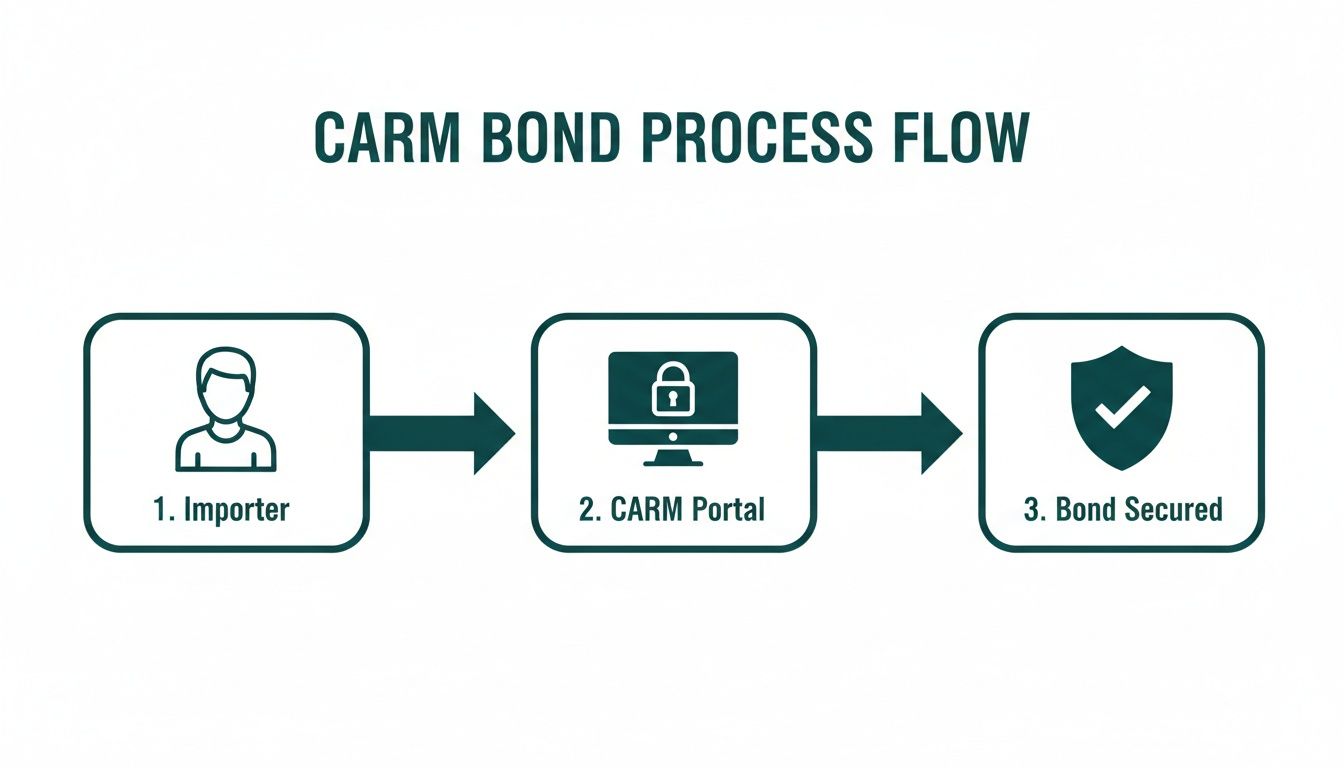
As you can see, the path flows directly from you, the importer, through the CARM Client Portal to secure that bond. The responsibility lands squarely on your shoulders. Don't wait until your shipment is on the water; arrange your bond well in advance so your cargo doesn't get stuck at the border.
How A Customs Broker Simplifies The IOR Role

Feeling a bit overwhelmed by the responsibilities of the Importer of Record? That’s perfectly normal. The good news is you don't have to navigate this complex world alone. Partnering with a licensed Canadian Customs Broker is the single most effective way to manage your IOR duties with confidence.
Let's clear up a common point of confusion right away: a customs broker cannot legally be the Importer of the Record. That ultimate responsibility always rests with you—the owner, purchaser, or consignee.
Instead, think of a broker as your expert agent, your professional representative at the border. It's like hiring a specialized accountant to handle your corporate taxes. You’re still legally responsible for the information, but you have a seasoned expert in your corner making sure everything is calculated, filed, and paid correctly.
Your Strategic Partner In Compliance
A good customs broker does much more than just submit paperwork. They act as a crucial part of your supply chain team, translating confusing customs rules into a clear action plan. Their entire business is built on mastering the details that can cause importers endless headaches.
By partnering with a broker, you’re not just outsourcing tasks; you’re gaining a strategic advantage. You can learn more about the specifics of what a customs broker does in our detailed guide. This partnership is an investment in speed, accuracy, and most importantly, peace of mind.
A customs broker’s job is to make sure your only surprise is how smoothly your shipment cleared the border. They handle the complexity so you can focus on running your business.
Their expertise becomes invaluable when dealing with the fine print of customs regulations. They ensure your business stays on the right side of the CBSA, preventing costly mistakes before they even happen.
Core Services That Make Your Life Easier
When you appoint a customs broker, you give them the authority to act on your behalf, turning a mountain of IOR tasks into a manageable process. They become your direct line to the CBSA, handling critical functions that keep your goods moving.
Here are the key responsibilities a broker manages for you:
Accurate HS Classification: Brokers have deep expertise in the Harmonized System, ensuring your products are classified correctly to apply the right duty rates. This isn't guesswork; it's a science.
Customs Documentation: They’ll review your commercial invoices, packing lists, and other documents for accuracy and completeness before anything is submitted.
CARM Management: Your broker helps you navigate the CARM Client Portal, manage your financial security bond, and handle payments to the CBSA. It’s a new system, and they’ve done the homework for you.
Duty & Tax Calculation: They precisely calculate all duties and taxes owed, ensuring you pay the correct amount every single time.
Liaison with CBSA: If the CBSA has questions or requires more information, your broker is the one on the phone handling that communication for you.
Ultimately, a broker transforms the role of Importer of Record from a source of stress into a streamlined, compliant function of your business operations.
We've covered a lot of ground, but you probably still have a few specific questions buzzing around. Let's tackle the most common ones we hear from new importers and U.S. businesses. Here are some straight answers to help you navigate these scenarios with confidence.
Can My Freight Forwarder Be The Importer of Record?
In a word: no. A freight forwarder’s job is to arrange the transportation of your goods—they’re logistics experts, not legal importers. In Canada, the Importer of Record must be the actual owner, purchaser, or consignee of the goods.
You, as the importer, have to assume that role. However, you can (and definitely should) appoint a customs broker to act as your agent. They can manage the entire customs process on your behalf, taking the complexity off your plate.
What Happens If I Declare The Wrong Value For My Goods?
Declaring an incorrect value for your goods is a serious compliance issue with the CBSA, and it's not something you can just fix later without consequences. "Close enough" is not a defense at the border.
Mistakes in valuation can quickly lead to:
Administrative Monetary Penalties (AMPs): These are financial penalties that can be pretty substantial.
Back-payment of Duties and Taxes: You'll have to pay what you originally owed, plus interest.
Increased Scrutiny: Your future shipments will likely be flagged for more frequent and detailed inspections, causing delays down the road.
Accuracy isn't just a good idea; it's non-negotiable. A good customs broker ensures your valuation methods are correct and compliant right from the start.
As A U.S. E-commerce Seller, Do I Need To Be An NRI?
While it’s not legally mandatory, becoming a Non-Resident Importer (NRI) gives you a massive competitive advantage. If you don't, your Canadian customer becomes the default IOR. This means they get hit with surprise duties, taxes, and brokerage fees upon delivery—a guaranteed way to ruin their experience and kill any chance of repeat business.
By becoming an NRI, you handle all customs formalities and costs upfront. This allows you to offer a seamless ‘delivered duty paid’ (DDP) experience, which is exactly what modern Canadian online shoppers expect. It’s the difference between a one-time sale and a loyal customer.
How Long Do I Need To Keep My Import Records?
The CBSA requires the Importer of Record to maintain all import-related records for six years following the year of importation. This isn't just the big stuff; it includes commercial invoices, customs documentation, proof of payment, and any relevant permits or certificates.
These records must be readily available to the CBSA upon request for potential audits, so keep them organized and accessible.
Navigating the responsibilities of an Importer of Record can feel complex, but you don't have to do it alone. The expert team at J.W. Smith Customs Brokers Ltd. is here to simplify the entire process, ensuring your goods cross the border smoothly and compliantly every time. Let's keep your supply chain moving.
Need Help with Customs?
J.W. Smith Customs Brokers has over 50 years of experience helping Canadian businesses navigate imports with confidence. Our team of licensed customs brokers is ready to assist with your import and export needs.