As a Canadian importer, navigating the complexities of international shipping requires a clear understanding of your responsibilities. The key to this clarity is mastering Incoterms. These rules are the globally recognized language of trade, defining precisely who is responsible for a shipment, who pays for each stage of the journey, and when the risk for the goods transfers from the seller to you.
Understanding these terms is not just about logistics; it's a critical business decision that directly impacts your total landed costs, supply chain efficiency, and compliance with the Canada Border Services Agency (CBSA).
What Are Incoterms and Why Do They Matter?
Think of an international shipment as a relay race. For the race to succeed, the baton pass must be precise. Incoterms define that exact handover point. They specify the moment that risk and responsibility for your goods—the baton—pass from your supplier to you, the importer.
This definition is crucial for your bottom line and for ensuring smooth passage through Canadian customs.
The Core Purpose of Incoterms
Incoterms are designed to eliminate ambiguity in international sales contracts. By providing a standardized global framework, they answer three fundamental questions for every shipment:
- Who pays for what? This clarifies obligations for freight, insurance, terminal handling charges, and other transport-related costs.
- Who handles the tasks? This specifies which party is responsible for arranging transportation, loading and unloading goods, and managing export and import customs clearance.
- When does risk transfer? This identifies the precise point in the journey where liability for lost or damaged goods shifts from the seller to you.
By clearly defining these obligations, Incoterms prevent costly misunderstandings and unexpected charges that can disrupt your supply chain and damage supplier relationships. A properly chosen term ensures both parties know their exact responsibilities.
Why This Matters for Canadian Importers
For any business importing into Canada, your chosen Incoterm is a cornerstone of compliance and cost management. It directly determines your total landed cost by defining which freight and insurance fees you are responsible for. It also plays a critical role in your customs declarations. The CBSA requires an accurate Value for Duty, and the costs outlined in your Incoterm are an essential component of this calculation.
An incorrect Incoterm choice can lead to border delays, financial penalties under the Administrative Monetary Penalty System (AMPS), or even the seizure of your goods. Understanding these terms is the first step toward mastering cross-border trade and ensuring your shipments clear customs efficiently. For a closer look at the professionals who manage these complexities, read our guide on what is a customs broker.
Incoterms have been integral to global trade since 1936, with the current standard being Incoterms 2020. For Canadian businesses, particularly those engaged in CUSMA trade with the U.S., selecting the right term is non-negotiable. You can discover more insights about Incoterm usage in Canada to see how it impacts local importers.
Breaking Down the 11 Incoterms Rules
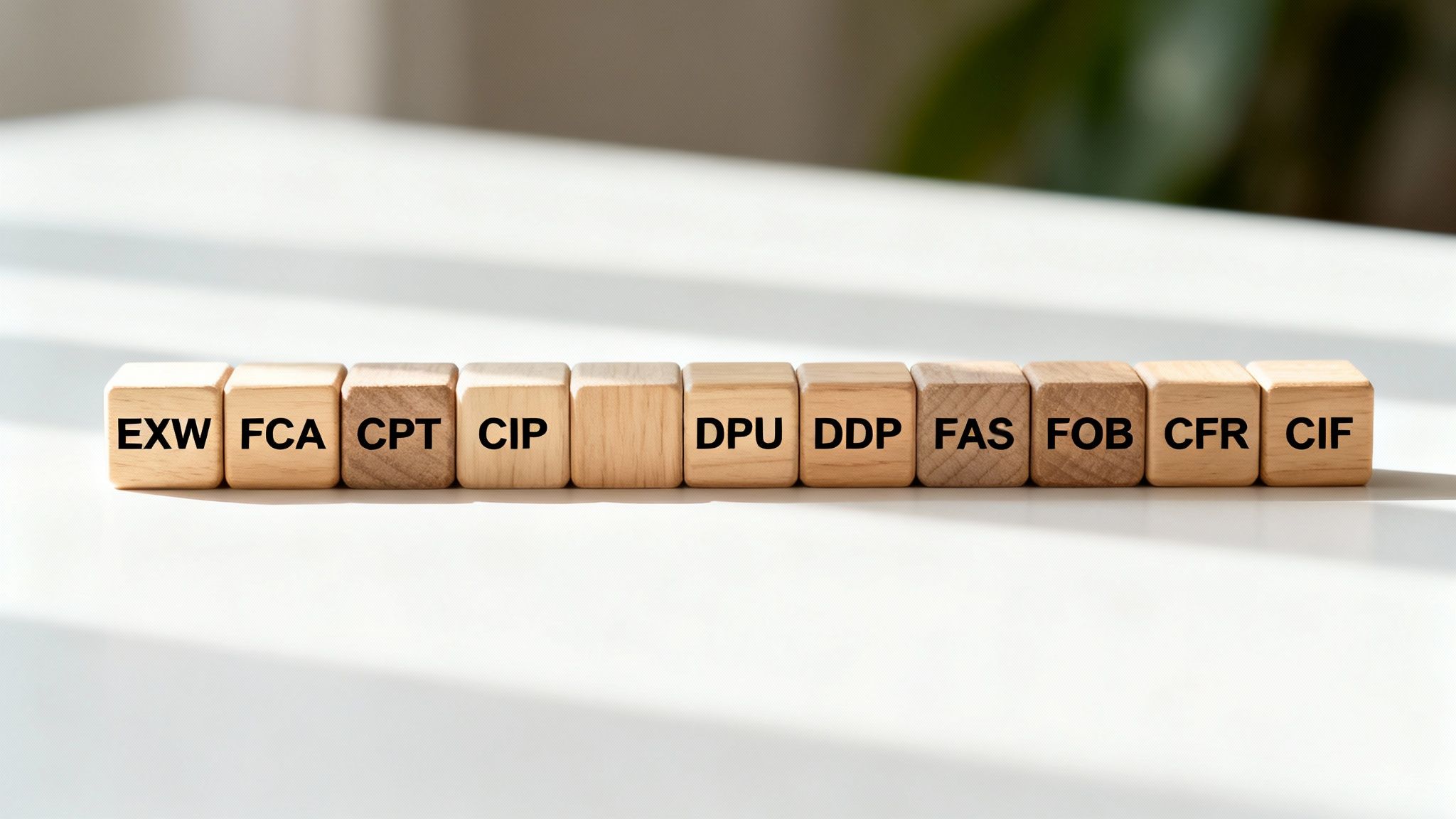
The 11 official Incoterms can be simplified by dividing them into two groups based on the mode of transport. This distinction is critical for importers; using a sea-only term for an air freight shipment is a common and costly error that can create significant gaps in liability and insurance coverage.
Let's break down each group from the perspective of a Canadian importer, focusing on your responsibilities, costs, and risk.
Rules for Any Mode of Transport
These seven versatile Incoterms are suitable for any mode of transport, including air, road, rail, or multimodal shipments. Their flexibility makes them the standard for most modern trade, especially for goods moving within North America.
EXW – Ex Works
- Seller’s Role: The seller’s only obligation is to make the goods available for pickup at their location (e.g., factory or warehouse). This term represents the minimum responsibility for the seller.
- Your Role (as the Importer): You assume all responsibilities and risks from the seller's door. This includes loading the goods, arranging all transportation, handling both export and import customs clearance, and paying all duties and taxes.
- Actionable Insight: Avoid EXW unless you have a strong presence or a reliable agent in the seller's country. As the importer, you would be responsible for completing export documentation in a foreign country, a task your supplier is better equipped to handle.
FCA – Free Carrier
- Seller’s Role: The seller delivers the goods to your nominated carrier at a named place and is responsible for completing export customs clearance.
- Your Role (as the Importer): Risk and cost transfer to you once your carrier takes possession of the goods. You are responsible for the main international transport, insurance, and import clearance into Canada.
- Actionable Insight: FCA is often the most advantageous term for importers. It gives you control over the international freight, allowing you to choose your preferred carrier and negotiate rates, while leaving the complexities of export clearance with the seller.
Importer's Insight: The key difference between EXW and FCA is the responsibility for export clearance. Under FCA, the seller handles this crucial step in their own country. This simple distinction prevents you from having to navigate foreign customs regulations, saving you significant time and potential compliance headaches.
CPT – Carriage Paid To
- Seller’s Role: The seller arranges and pays for carriage to a named destination (e.g., "CPT Vancouver").
- Your Role (as the Importer): The critical point here is that risk transfers to you once the seller hands the goods to the first carrier at the origin, not when they arrive at the destination. You are responsible for insuring the goods for the main transit and handling import clearance.
CIP – Carriage and Insurance Paid To
- Seller’s Role: Similar to CPT, the seller arranges and pays for carriage. However, under CIP, the seller must also purchase comprehensive "all-risk" insurance coverage for the goods during transit in your name.
- Your Role (as the Importer): Risk still transfers to you when the goods are handed to the first carrier, but you have the security of knowing the seller has arranged insurance coverage. You handle import clearance upon arrival.
The "D" Group: Seller Assumes More Responsibility
The "D" group terms (DAP, DPU, and DDP) shift the majority of the risk and responsibility to the seller until the goods reach their destination in Canada.
- DAP – Delivered at Place: The seller is responsible for delivering the goods to your named destination (e.g., your warehouse in Calgary). You, the importer, are responsible for unloading the goods and for all Canadian customs clearance procedures, including paying duties and taxes. You are the Importer of Record.
- DPU – Delivered at Place Unloaded: This is the only Incoterm where the seller is responsible for unloading the goods at the destination. Once the goods are unloaded, the risk transfers to you, and you handle the import customs clearance.
- DDP – Delivered Duty Paid: This term represents the maximum obligation for the seller. They manage everything: transport, insurance, and both export and import customs clearance. The seller acts as the Importer of Record and pays all Canadian duties and taxes.
Rules for Sea and Inland Waterway Transport
These four legacy terms are designed exclusively for non-containerized sea freight, such as bulk cargo (e.g., grain, ore) or oversized items. It is a common mistake to use them for standard container shipments, which can create gaps in responsibility and insurance coverage.
FAS – Free Alongside Ship
- Seller’s Role: The seller's responsibility ends when they place the goods alongside the vessel you have nominated at the port of shipment.
- Your Role (as the Importer): From that point, you assume all costs and risks, including loading the goods onto the ship, main ocean freight, insurance, and import clearance in Canada.
FOB – Free On Board
- Seller’s Role: The seller is responsible for delivering the goods and loading them on board the vessel at the named port of shipment. They also handle export clearance.
- Your Role (as the Importer): Risk transfers to you once the goods are on board the vessel. You are responsible for the ocean freight, insurance, and all subsequent costs and tasks to import the goods into Canada.
CFR – Cost and Freight
- Seller’s Role: The seller pays for the freight to bring the goods to your destination port. However, risk transfers to you once the goods are loaded on board the vessel at the origin port.
- Your Role (as the Importer): Although the seller pays for freight, you bear the risk for the entire ocean voyage. It is your responsibility to secure insurance and manage import clearance.
CIF – Cost, Insurance, and Freight
- Seller’s Role: Like CFR, the seller pays for cost and freight. They must also purchase a minimum level of insurance for the voyage in your name.
- Your Role (as the Importer): Risk still transfers when the goods are loaded on board. Actionable Insight: The minimum insurance required under CIF (Institute Cargo Clauses C) is very basic. For valuable goods, you should arrange additional insurance coverage to protect your financial interests.
Incoterms 2020 Responsibility at a Glance
This table summarizes key responsibilities for common Incoterms, helping you see the critical differences at a glance.
| Incoterm | Seller's Key Responsibilities | Buyer's Key Responsibilities | Risk Transfer Point |
|---|---|---|---|
| EXW | Make goods available at their premises. | Load goods, arrange all transport, clear export/import customs, pay duties. | When goods are collected at the seller's premises. |
| FCA | Deliver goods to the buyer's carrier and clear for export. | Arrange main carriage, insurance, and import clearance; pay duties. | When the seller delivers goods to the buyer's carrier. |
| DAP | Deliver goods to the named destination, ready for unloading. | Unload the goods and handle import customs clearance; pay duties. | When goods arrive at the destination, ready for unloading. |
| DDP | Deliver goods to the destination, cleared for import, and duties paid. | Unload the goods. | When goods arrive at the destination, cleared for import. |
| FOB | Deliver goods on board the vessel and clear for export. | Pay for main sea freight, insurance, and import clearance. | Once the goods are loaded on board the vessel. |
| CIF | Pay for sea freight and minimum insurance to the destination port. | Arrange import clearance and assume risk during the main voyage. | Once the goods are loaded on board the vessel. |
Understanding these terms is the first step. The next is ensuring the corresponding documentation is accurate. To learn more, see our guide on how to prepare shipping documents for smooth customs.
How to Choose the Right Incoterm for Your Shipments
Choosing an Incoterm is a strategic decision that defines your control, cost, and risk over your supply chain. Instead of defaulting to a familiar term, a Canadian importer should evaluate which rule best aligns with their business capabilities and objectives.
The optimal choice balances four key factors: the level of control you require, your tolerance for risk, your negotiating power with suppliers, and your ability to achieve cost efficiencies.
Assess Your Control and Experience Level
Be realistic about your company's logistics expertise. Do you have an established network of freight forwarders and customs brokers, or are you new to importing? Your answer will guide you toward different Incoterms.
Key Insight: The fundamental choice is between control and convenience. Taking on more control (e.g., managing freight) involves more responsibility and risk but can lead to significant cost savings. Ceding control to your supplier offers convenience but often at a higher price and with less visibility.
A new importer might find DDP (Delivered Duty Paid) appealing. Your supplier manages the entire process, delivering the goods to your door with all duties and taxes paid. It is the most hands-off option.
Conversely, an experienced importer will likely prefer FCA (Free Carrier). This term allows them to select their own freight forwarder, negotiate competitive shipping rates, and directly manage the customs clearance process with their broker. This control provides cost savings and greater supply chain visibility. For a full walkthrough of the import process, consult our step-by-step guide on how to import goods to Canada.
Balance Risk Against Cost Savings
Each Incoterm defines a specific point where the risk of loss or damage to your goods transfers from the seller to you. Your willingness to accept this risk at different stages of the journey is a critical factor in your decision.
- Low Risk Tolerance: If you want the seller to retain risk for as long as possible, the "D" group terms like DAP or DPU are suitable. The seller is liable for the goods until they arrive at your named destination in Canada.
- Higher Risk Tolerance for Greater Control: If you are comfortable managing risk to reduce costs, terms like FCA or FOB are excellent choices. You accept the risk earlier—as soon as the goods are with your carrier or on the vessel—but you gain control over the main, and often most expensive, leg of the transport.
Consider a truck shipment from the US. Using FCA, you assume risk once your designated truck picks up the goods from the supplier. This means the cross-border transit is your responsibility, but it also empowers you to choose a trusted carrier and optimize your freight costs.
Focus on North American Trade Realities
While there are 11 official Incoterms, trade within North America, especially between Canada and the U.S., is dominated by a select few. Over 80% of transactions use one of five terms: EXW, FCA, CPT, CIP, and DAP.
This concentration means Canadian importers should develop a deep understanding of these five rules. For example, knowing the crucial difference between DAP and DDP is vital for CBSA compliance. Under DAP, you are the Importer of Record and responsible for customs clearance. Under DDP, the seller is the Importer of Record. Misunderstanding this can lead to customs penalties and delays.
A Practical Scenario Comparison
Let's apply this to a real-world scenario. Imagine you are importing automotive parts from a supplier in Ohio to your facility in Ontario.
- The Default Choice (DDP): You could request DDP Windsor. This is simple; the supplier gives you an all-in price. However, you have no control over the carrier, the border crossing chosen, or the customs clearance process, and you are likely paying a premium for this convenience.
- The Strategic Choice (FCA): You could negotiate FCA Columbus, Ohio. You then hire your preferred Canadian trucking company to manage the pickup and cross-border transport. You control the freight cost, select the most efficient border crossing, and your customs broker handles the clearance. You take on more responsibility but gain significant control and cost-efficiency.
By strategically evaluating control, risk, and cost, you can leverage Incoterms as a tool to build a more resilient and cost-effective supply chain for your Canadian business.
How Incoterms Affect Customs Value and CBSA Compliance
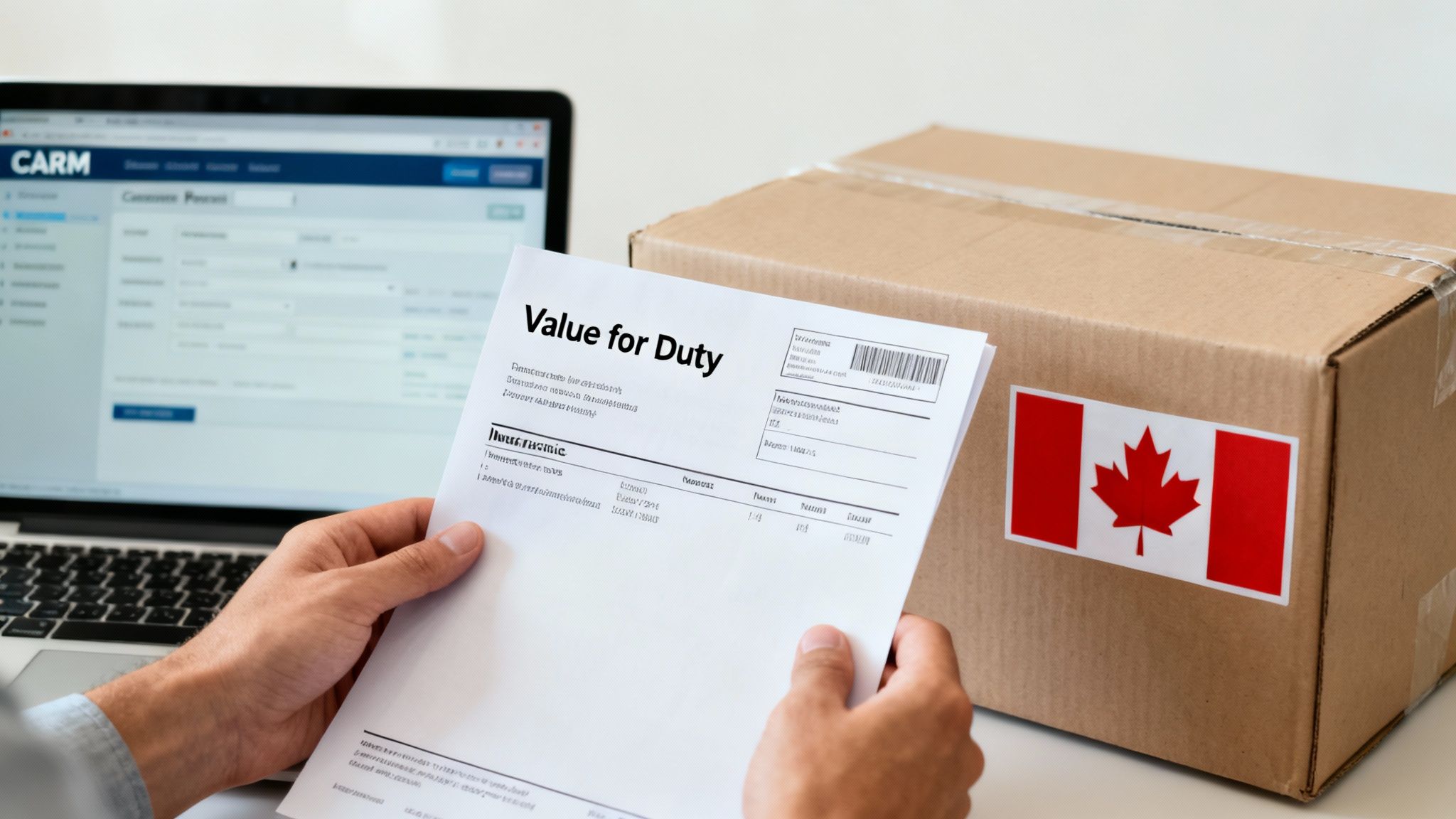
Your chosen Incoterm is a critical piece of information for the Canada Border Services Agency (CBSA), as it directly impacts the calculation of your shipment's Value for Duty (VFD). An incorrect declaration can lead to financial penalties, audits, and significant border delays.
The VFD is the total value used by the CBSA to assess duties and taxes (including GST/HST). It is not simply the price on the commercial invoice. The CBSA requires importers to add certain costs, such as freight and insurance, to the price of the goods to arrive at the correct dutiable value. Your Incoterm dictates which of these costs are your responsibility and must be declared.
The Direct Link Between Incoterms and Your Value for Duty
Your commercial invoice is the starting point for determining the VFD. Your Incoterm provides the necessary context, clarifying what additional costs must be included in your customs declaration.
For example, if you purchase goods on FOB (Free On Board) terms, the invoice price from your supplier only covers the goods up to the point they are loaded on the vessel. As the importer, you are responsible for the subsequent international freight and insurance. You must declare these costs to the CBSA and add them to the invoice price to determine the correct VFD.
Crucial Compliance Takeaway: The Incoterm is fundamental to establishing the correct "transaction value" for your goods as required by the CBSA. Failure to account for all costs assigned to you by the Incoterm results in a non-compliant declaration and can lead to penalties under the Administrative Monetary Penalty System (AMPS).
Common Incoterms and Their Impact on VFD Calculation
Here is a practical breakdown of how common Incoterms affect your VFD declaration to the CBSA:
- FCA (Free Carrier): The seller's invoice covers the cost of goods delivered to your carrier. As the importer, you are responsible for the main international freight and insurance. You must add these costs to the invoice price when calculating your VFD.
- DAP (Delivered at Place): The seller's invoice price includes the cost of freight to your named destination in Canada. Since this freight cost is already included in the price, you typically do not add it again. However, you are the Importer of Record and must pay duties and taxes on this full delivered value.
- DDP (Delivered Duty Paid): The seller's price includes all costs, including freight, insurance, and all Canadian duties and taxes. For CBSA valuation, the duties and taxes must be deducted from the total DDP price to arrive at the correct VFD, upon which the duties and taxes will then be calculated and assessed.
It's also essential to understand how your goods are classified for shipping, as Incoterms allocate responsibilities for these details. For a deeper dive, you can refer to the relevant transport classification guidelines.
Connecting Incoterms to CARM and Bond Management
The CBSA Assessment and Revenue Management (CARM) portal amplifies the importance of correct Incoterm usage. Under CARM, importers are required to post their own financial security—a Release Prior to Payment (RPP) bond—to cover duties and taxes. The amount of this bond is based on your history of duties and taxes payable.
Your Incoterm determines who is the Importer of Record (IOR). If you are the IOR (as is the case with EXW, FCA, and DAP), all duties and taxes are your liability and are secured by your RPP bond. A misunderstood Incoterm leading to an incorrect VFD can cause several problems:
- Underestimated Bond Amount: Consistently under-declaring shipment values can result in an RPP bond that is insufficient to cover your liabilities, leading to compliance actions from the CBSA.
- Payment Discrepancies: Incorrect declarations in CARM create reconciliation issues and can be a red flag for a CBSA audit.
- Delayed Shipments: If your bond is deemed insufficient or your declarations are flagged for review, the CBSA may hold your shipments until the issues are resolved.
Using the correct Incoterm ensures clarity on the IOR, enabling accurate bond management and smooth financial transactions within CARM, thereby preventing costly disruptions to your supply chain.
Avoiding Common and Costly Incoterm Mistakes
Even experienced Canadian importers can make mistakes with Incoterms, leading to unexpected costs, border delays, and compliance issues with the Canada Border Services Agency (CBSA).
Recognizing these common pitfalls is the first step toward protecting your business and ensuring your supply chain operates efficiently. These are not minor administrative errors; they represent significant financial and operational risks.
The Pitfall of Ambiguous Locations
One of the most frequent mistakes is failing to be specific. A contract that states "FCA Factory" or "DAP Toronto" is an open invitation for disputes. Does "factory" mean the seller's loading dock or a nearby warehouse? Does "Toronto" refer to the port, a specific terminal, or your company's front door?
This ambiguity creates confusion over who is responsible for costs such as terminal handling charges or inland transportation.
Actionable Insight: Always define the named place with absolute precision in your commercial agreements. Instead of "FOB Shanghai," specify "FOB Shanghai Port, Container Terminal 7, Incoterms 2020." This level of detail eliminates ambiguity and prevents unexpected charges.
Using the Wrong Term for the Transport Mode
A classic error is applying sea-only Incoterms—FOB (Free On Board), CIF (Cost, Insurance, and Freight), and CFR (Cost and Freight)—to air freight or containerized ocean shipments. These terms were designed for non-containerized bulk cargo.
Using them for containerized goods creates a dangerous gap in risk coverage. The correct term for containerized freight is often FCA (Free Carrier). Under FCA, risk transfers when the goods are handed to the carrier, which typically occurs at an inland terminal before the container is loaded onto a ship. If you use FOB, you may be uninsured for any loss or damage that occurs at the port terminal before your container is loaded onto the vessel.
Misunderstanding DDP in a Canadian Context
Many importers are drawn to DDP (Delivered Duty Paid) because it appears to be the simplest, all-inclusive option. While the seller is responsible for paying Canadian duties and taxes, they may not be properly equipped to act as the Importer of Record in Canada. For example, the seller may not be registered as a Non-Resident Importer (NRI) or possess the necessary permits for regulated goods.
If the CBSA flags the shipment because the foreign seller is non-compliant, your goods will be delayed. Although the responsibility is technically the seller's, the operational disruption and associated costs become your problem.
For Canadian importers, selecting the right Incoterm is a strategic decision that directly impacts your bottom line. A regular review of your terms can help mitigate rising freight costs and tariffs. Choosing a term like FCA over DDP can often lead to significant savings on duties, taxes, and freight. This proactive approach is essential for protecting your margins and ensuring efficient, CBSA-compliant operations.
Your Incoterms Questions, Answered
Applying Incoterms to real-world shipments often raises practical questions. Here are answers to some of the most common queries from Canadian importers.
Do Incoterms Determine Who Owns the Goods?
No, this is a critical and common misconception. Incoterms deal exclusively with the transfer of risk and the division of logistical costs and responsibilities between the buyer and seller.
The transfer of title, or legal ownership of the goods, is a separate legal matter that must be explicitly defined in your commercial sales agreement. Relying on an Incoterm to define ownership can lead to complex legal disputes if goods are lost or damaged in transit.
What Is the Best Incoterm for a Canadian Importer?
There is no single "best" Incoterm. The right choice depends on your company's logistics expertise, negotiating power, and desired level of supply chain control.
- For Maximum Control: FCA (Free Carrier) is often the preferred term for experienced importers. It allows you to select your own freight forwarder, negotiate rates, and control the entire shipping process from the moment the goods leave the supplier.
- For Maximum Simplicity: DDP (Delivered Duty Paid) offers a hands-off experience where the seller manages everything. However, this convenience comes at a premium price and a loss of control and visibility.
Carefully evaluate the needs of each transaction to select the term that best aligns with your business strategy.
Can I Still Use Incoterms 2010?
Yes, it is possible to use an older version like Incoterms 2010, but only if both the buyer and seller explicitly agree to it in the sales contract. However, this is not recommended.
Best Practice: Always use the current version, Incoterms 2020, to avoid confusion and benefit from the latest updates. To ensure clarity, always specify the version in your documentation, for example: "FCA Mississauga, ON Incoterms 2020."
How Does My Incoterm Affect My CARM Security Bond?
Your Incoterm is directly linked to your CARM obligations because it determines the Importer of Record (IOR)—the party legally responsible for customs compliance and payment of duties and taxes.
If your Incoterm makes you the IOR (e.g., EXW, FCA, DAP), it is your Release Prior to Payment (RPP) bond that must secure the duties and taxes. If the Incoterm is DDP, the seller is the IOR, and the liability falls on their bond. A misunderstanding can lead to an incorrectly sized bond, compliance issues with the CBSA, and costly delays at the border.
Navigating the fine points of Incoterms, CARM, and CBSA compliance is what we do every day. The team at J.W. Smith Customs Brokers Ltd. provides the clarity and support you need to keep your shipments moving smoothly across the border. Learn how we can simplify your cross-border trade today.
Need Help with Customs?
J.W. Smith Customs Brokers has over 50 years of experience helping Canadian businesses navigate imports with confidence. Our team of licensed customs brokers is ready to assist with your import and export needs.