A Commercial Importer's Guide to Canada's Luxury Vehicle Tax

If you're in the business of importing high-end vehicles into Canada, there's a critical checkpoint you can't afford to miss: the Select Luxury Items Tax. Think of it as a special toll on the import highway, reserved for cars, SUVs, and vans with a dutiable value north of $100,000.
This isn't just a minor surcharge; for commercial importers, it’s a major financial factor that must be baked into your landed cost calculations right from the start. Getting it wrong can turn a profitable import into a customs nightmare.
What is the Luxury Vehicle Tax?
Navigating Canada's import regulations requires precision, and that's especially true when you’re dealing with high-value goods. The luxury vehicle tax is a federal tax that targets premium items, and as a commercial importer, you're on the front line for calculating and remitting it.
This tax applies to specific "subject vehicles," which are typically new passenger vehicles priced or valued above the $100,000 threshold. The category is pretty broad and includes:
- Sedans and coupes
- Sports cars
- SUVs
- Passenger vans and minivans with a capacity of 10 or fewer passengers
Basically, if it’s designed to carry people on public roads and it crosses that six-figure line, it’s on the Canada Revenue Agency’s (CRA) radar. Understanding this is a critical part of the financial puzzle you’ll need to solve, which fits into the broader picture of the five steps for importing a vehicle into Canada.
To help break it down, here’s a quick overview of what importers need to know.
Luxury Vehicle Tax at a Glance
| Component | Key Detail for Importers |
|---|---|
| Effective Date | September 1, 2022 |
| Governing Law | Select Luxury Items Tax Act |
| Threshold | Applies to vehicles with a retail sale price or dutiable value over $100,000 |
| Applicable Goods | New passenger vehicles, including cars, SUVs, and passenger vans |
| Your Role | As the importer of record, you are generally responsible for calculating, collecting, and remitting the tax at the time of import. |
This table zeroes in on the essentials.
The Rationale Behind the Tax
The Select Luxury Items Tax Act, which came into effect on September 1, 2022, was designed to have affluent consumers contribute a bit more when purchasing high-end goods. For importers and their customs brokers, this policy is now a fundamental part of the cross-border equation. You can dive deeper into the official scope of subject vehicles on Canada.ca.
For commercial importers, the luxury vehicle tax acts as a critical reminder: the declared value of your shipment directly impacts your bottom line. Underestimating its importance can lead to costly customs adjustments and delays.
Getting these fundamentals right is the first step toward ensuring your high-value shipments clear customs without unexpected expenses or frustrating hold-ups. It transforms the tax from a potential headache into a predictable part of your import strategy.
How the Luxury Vehicle Tax Is Calculated
This is where the numbers get serious. When you’re importing a luxury vehicle, a small miscalculation can lead to significant penalties. Precision is your best friend here.
The Canada Revenue Agency (CRA) uses a specific two-part formula to figure out the tax. First, let's get clear on the taxable amount. This isn’t just what you paid for the car. The CRA wants the total value, which includes the vehicle's price plus all the other costs to get it here—think freight, customs duties, and any other non-GST/HST excise taxes (like the green levy). This total figure is the foundation for everything that follows.
This infographic breaks down the essential details you need to know.
As you can see, the whole system pivots on that $100,000 threshold and only applies to certain new passenger vehicles. Getting these core concepts down is the first step to mastering the calculation.
The Lesser of Two Amounts Rule
Once you’ve pinned down the total taxable amount, the luxury tax is determined using a "lesser of two amounts" rule. It’s pretty simple, actually. You calculate the tax in two different ways, and then you pay whichever amount is lower. It's the one time in taxes where you're encouraged to pick the smaller number.
Here are the two calculations you'll run:
- Calculation A: 10% of the vehicle’s full taxable amount.
- Calculation B: 20% of the taxable amount that exceeds the $100,000 threshold.
Let’s be crystal clear: getting this right is non-negotiable. Trying to "get creative" with your vehicle's valuation is a surefire way to invite a CBSA audit. A crucial part of this process is determining the vehicle's accurate fair market value, because that's the benchmark customs officers will use.
Key Takeaway: The luxury tax is calculated on the total dutiable value of the vehicle, not just its sale price. This includes shipping, insurance, and other charges that bring the vehicle to the Canadian border. This comprehensive figure is what you must use for both parts of the "lesser of" calculation.
Putting the Calculation into Practice
Theory is great, but seeing the math in action is what truly matters for commercial importers. So, let's walk through a few real-world scenarios to see how this two-part formula plays out with different vehicle values.
Luxury Tax Calculation Scenarios
Imagine you're importing three different luxury vehicles. The table below shows how the tax would apply to each one, highlighting which calculation gives you the "lesser" amount in each case.
| Vehicle Taxable Amount | Calculation A (10% of Total) | Calculation B (20% of Value > $100k) | Final Tax Payable (The Lesser Amount) |
|---|---|---|---|
| $120,000 | $12,000 (10% of $120,000) | $4,000 (20% of $20,000) | $4,000 |
| $180,000 | $18,000 (10% of $180,000) | $16,000 (20% of $80,000) | $16,000 |
| $250,000 | $25,000 (10% of $250,000) | $30,000 (20% of $150,000) | $25,000 |
Did you notice the tipping point? For vehicles with a taxable amount under $200,000, Calculation B (the 20% rule) will always give you a lower tax bill. Once a vehicle's value hits $200,000 on the dot, both calculations come out the same ($20,000). For anything above that, Calculation A (the 10% rule) becomes the cheaper option.
Accurate documentation is the backbone of a successful import declaration. You need to ensure every cost contributing to the taxable amount is clearly itemized. For a detailed guide on what to include, check out our article on the Canada Customs Invoice. Having this paperwork locked down validates your calculations and helps you avoid any disputes with the CBSA at the port of entry.
Your Playbook for CBSA Compliance
Successfully importing a luxury vehicle isn't just about paying the tax; it's about mastering the process at the border. One small misstep can cause delays that ripple through your entire supply chain, turning a profitable import into a logistical nightmare. This is your practical playbook for getting compliance with the Canada Border Services Agency (CBSA) right every time.
Think of the CBSA as the gatekeeper. To get through smoothly, you need the right keys in the right order. This means perfect documentation, accurate classifications, and timely payments.
Nail the HS Classification
Every item that crosses into Canada needs a Harmonized System (HS) code—the universal language for classifying goods. For luxury vehicles, getting this code right isn't just important—it's absolutely critical.
The HS code dictates the rate of duty, and an incorrect one will immediately trigger red flags. A luxury sedan and a passenger van might have different classifications, and using the wrong one—even accidentally—can lead to CBSA inspections, costly fines, and serious delays. You really don't want your $150,000 vehicle held up over what amounts to a clerical error.
An incorrect HS code is one of the fastest ways to get your shipment flagged for a secondary inspection. Precision here saves you time, money, and a whole lot of headaches.
Declaring Value and Remitting Payment
Once you have the correct HS code, you must declare the vehicle's full taxable amount. As we've covered, this includes the vehicle's value plus any other costs incurred to get it to the Canadian border, like freight and insurance.
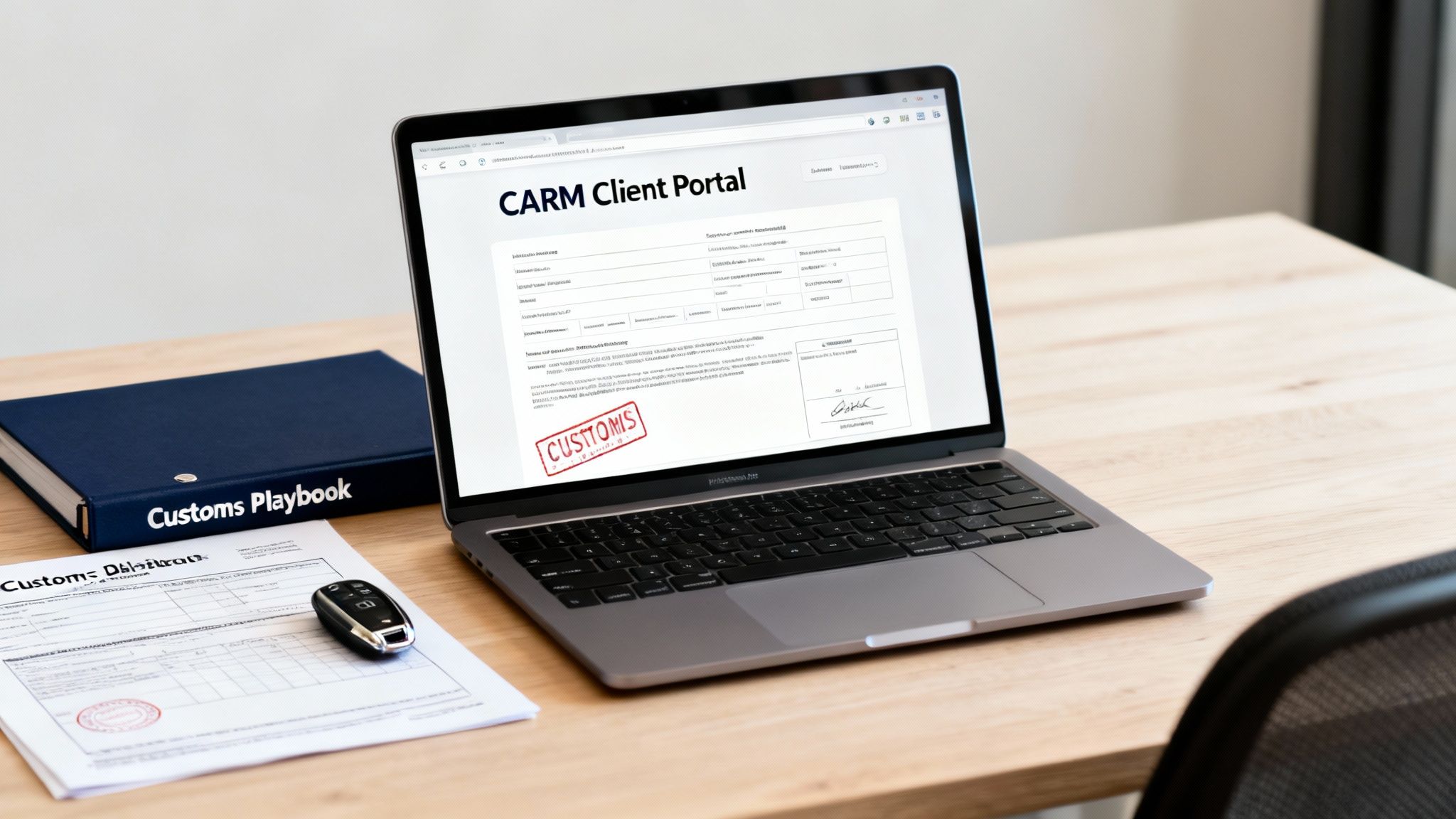
This all-in value is what you'll use to calculate the luxury vehicle tax. Your commercial invoice needs to clearly break down these costs. After you've calculated the tax, you have to pay it, and this is where the CARM Client Portal becomes essential.
The CBSA Assessment and Revenue Management (CARM) system is the official platform for handling all import duties and taxes. As an importer, you are required to use this portal to manage your payments.
- Step 1 Calculation: First, figure out the precise luxury vehicle tax owed using the "lesser of" rule.
- Step 2 Declaration: Report this amount accurately on your B3-3 Canada Customs Coding Form.
- Step 3 Payment: Remit the total duties and taxes, including the luxury tax, directly to the CBSA through your CARM account.
Getting this process down to a science is vital for maintaining a good compliance record with the CBSA. For a deeper dive, our comprehensive guide explains everything importers need to know about CARM and how to stay ahead of its requirements.
Why a Customs Broker Is Your Best Asset
While you can technically handle this process yourself, the complexities of the luxury vehicle tax make it a risky solo mission. One simple oversight can completely erase your profit margin on a high-value import.
Partnering with an experienced customs broker transforms this challenge into a predictable part of your business. A good broker doesn't just fill out forms; they act as your strategic partner at the border.
How a Broker Adds Value:
- HS Classification Expertise: They ensure the correct HS code is used every time, minimizing audit risks.
- Valuation Guidance: They help you accurately determine the taxable amount, ensuring you don’t overpay or underpay.
- Documentation Review: They meticulously check all your paperwork before it ever reaches the CBSA, catching errors that would otherwise cause delays.
- CARM Management: They can manage your CARM account, ensuring payments are made on time and your financial security is correctly posted.
Think of it this way: you’re an expert in sourcing and selling vehicles. A customs broker is an expert in getting those vehicles across the border. Let professionals handle their respective specialties for a far more efficient and reliable supply chain.
Navigating Exemptions and Special Cases
Just when you think you have the luxury vehicle tax figured out, you run into the exceptions. Not every vehicle priced over $100,000 automatically gets hit with this tax, and for importers, understanding these nuances can save your business a ton of money.
Think of these exemptions as designated off-ramps from the tax highway. The government recognizes that not all high-value vehicles are for personal luxury. Some serve critical public or specialized functions, and the rules reflect that.
Vehicles Exempt from the Luxury Tax
Certain vehicles are explicitly exempt from the luxury vehicle tax, even if their value sails past the $100,000 threshold. This is almost always because their intended use is for public service or other specific, non-recreational purposes.
Here are the main categories of exempt vehicles:
- Emergency Response Vehicles: This includes clearly marked police cars, fire trucks, and ambulances. If the vehicle is equipped and identified for emergency services, it's off the hook.
- Hearses: Vehicles designed and outfitted exclusively for transporting caskets are not subject to the tax.
- Certain Motorhomes: Motorhomes that come with self-contained living amenities like a kitchen, sleeping area, and bathroom are typically exempt.
Crucial Tip for Importers: Documentation is everything. If you're importing a vehicle you believe is exempt, you must have rock-solid proof of its intended use and modifications. A standard SUV won't qualify as an ambulance just because you say it will be one; it must be demonstrably equipped for that purpose when it crosses the border.
Special Rules for Modified Vehicles
The rules get a little more complex when you're dealing with vehicles modified for specific needs, particularly for use by individuals with disabilities. A vehicle specially equipped to be operated by or to transport a person using a wheelchair is generally not subject to the tax.
This exemption isn't automatic, though. It hinges on the nature and timing of the modifications. Proper documentation from the manufacturer or modifier is essential to prove the vehicle's status to the CBSA.
The Tricky Case of Post-Import Upgrades
Here’s a scenario that trips up a lot of importers. You bring in a base model vehicle with a declared value of $95,000, clearing it without paying the luxury tax. A week later, you install $10,000 worth of upgrades—custom wheels, a premium sound system, and performance parts. Now what?
The Canada Revenue Agency (CRA) has rules to prevent exactly this kind of workaround. If improvements made shortly after importation push the vehicle's total value over the $100,000 threshold, the luxury tax can suddenly become retroactively applicable.
- Intent Matters: The CRA looks at the total value of the vehicle, including any reasonably expected additions.
- Timing is Key: Modifications made right after import are often considered part of the initial transaction in the eyes of the CRA.
- Total Value is Assessed: The tax would be calculated based on the final value of $105,000, not just the initial import price.
This is a critical area where leaning on your customs broker is invaluable. They can help you understand how the CRA views these situations, keeping you compliant and avoiding the nasty surprise of a future tax bill complete with penalties.
Common Pitfalls and How to Avoid Them
Even the most experienced importers can get tripped up by the details of Canada's luxury vehicle tax. It’s one of those regulations where a small oversight can quickly snowball into a massive financial headache. Here, we’ll flag the most common—and costly—mistakes we see, so you can navigate the process with confidence.

The Danger of Undervaluing Your Vehicle
One of the most tempting—and riskiest—moves is trying to undervalue a vehicle to slide it just under the $100,000 threshold. Declaring a vehicle at $99,500 when its true market value is closer to $115,000 is a fast track to a CBSA audit. Officers have their own valuation tools and access to extensive databases.
If the CBSA finds the vehicle was undervalued, you'll be on the hook for the correct tax amount, plus interest and potentially hefty penalties under the Administrative Monetary Penalty System (AMPS). All of a sudden, that attempt to save a few thousand dollars ends up costing you much more.
The Solution: Always declare the true, full value of the vehicle based on what was paid or is payable. In this game, honesty isn't just the best policy—it's the only one that protects your business from fines and a black mark on your compliance record.
Forgetting to Include All Costs in the Taxable Amount
Another frequent error is calculating the luxury tax based only on the vehicle's sticker price. This is a fundamental misunderstanding of the "taxable amount." The CBSA is crystal clear: the tax must be calculated on the vehicle's value plus all the costs you paid to get it to the Canadian border.
This means you must include:
- Freight and Transportation Costs: The bill for shipping the vehicle to the Canadian port of entry.
- Insurance: Any insurance you bought to cover the vehicle during its journey.
- Other Duties and Taxes: Any other applicable non-GST/HST levies, like the Green Levy on fuel-inefficient vehicles.
Leaving these costs out leads to an underpayment of the luxury tax, and you can be sure the CBSA will catch it. This isn't a grey area; it's a hard-and-fast rule.
Failing to Provide Complete Documentation
A smooth ride through customs is built on a foundation of solid paperwork. When you're importing a luxury vehicle, any incomplete or inconsistent documentation is a massive red flag for customs officials. It suggests you're either disorganized or, worse, trying to hide something.
Your documentation has to be perfect. Any discrepancy between your commercial invoice, bill of sale, and B3-3 Canada Customs Coding Form can trigger a secondary inspection, causing painful delays.
To make sure your clearance is seamless, your paperwork package should always include:
- Commercial Invoice: Clearly itemizing the vehicle's price and all associated costs (freight, insurance, etc.).
- Bill of Sale: Verifying the transaction and the transfer of ownership.
- Proof of Origin: A certificate of origin might be needed, depending on trade agreements.
- Vehicle Registration and Title: Proving the vehicle's history and legal status.
- Conformity Documents: Proof that the vehicle meets all Canadian safety and environmental standards.
The Fix: Create a standardized checklist for every luxury vehicle import. Before the shipment even leaves its origin, audit your documents to ensure every detail lines up perfectly. This proactive step can be the difference between a one-hour clearance and a one-week delay.
Answering Your Luxury Tax Questions
Even with a solid plan, the luxury vehicle tax can throw a few curveballs. It’s a complex piece of legislation, and its nuances can catch even the most experienced importers off guard. Let's tackle some of the most common questions we hear.
Does the Luxury Vehicle Tax Apply to Used Vehicles?
This is a big point of confusion. The tax generally applies to vehicles that have never been registered with a government. However, if a used vehicle is imported and has never been registered in Canada before, it could be subject to the tax if its value is over the $100,000 threshold.
The deciding factor isn't the vehicle's age but its registration history. It is absolutely critical to verify a vehicle’s entire history before you import it. If it was registered somewhere else—even for a short time—it may be exempt, but you will need the documentation to prove it to the CBSA.
What if I Modify a Vehicle After Importation?
Pay close attention here. If you import a vehicle valued just under the $100,000 mark and then immediately make improvements that push its total value over the line, the luxury tax can kick in. The Canada Revenue Agency (CRA) has rules to prevent importers from sidestepping the tax by buying a base model only to load it up with expensive upgrades right after it crosses the border.
The total value, including improvements made shortly after import, is what matters. The CRA looks at the big picture. If the modifications were part of the intended final product, the tax will likely apply retroactively to the combined value.
Always document any post-importation modifications. It's best to consult your customs broker to ensure you stay compliant and avoid a surprise tax bill down the road.
How Does CARM Affect Luxury Tax Payments?
Think of the CARM Client Portal as your central dashboard for all customs-related financial obligations. It’s not optional; it’s a mandatory part of the process. The luxury tax you owe is calculated and rolled into your total duties and taxes, and you are required to pay these funds directly to the CBSA through CARM.
A properly managed CARM account is essential for making payments on time and maintaining a good compliance record with the CBSA. Late payments can lead to penalties, interest, and could even put your future importing privileges at risk.
Are Electric Vehicles Exempt From This Tax?
No, and this is a frequent misunderstanding. There is no blanket exemption for electric vehicles (EVs). If a new luxury EV has a retail value over the $100,000 threshold, it is subject to the tax just like any gas-powered car.
The tax is triggered by price, not powertrain. While the government offers various rebates and incentives for buying an EV, the luxury tax is typically calculated on the vehicle's value before those incentives are applied. If you’re importing high-end EVs from brands like Tesla, Lucid, or Porsche, you must factor this tax into your landed cost calculations.
Is the Tax Refundable if the Vehicle Is Exported?
In certain specific situations, yes. If you import a luxury vehicle, pay the tax, and then export it later in an unused condition, you might be eligible to apply for a rebate. This process, however, is governed by strict rules and demands meticulous documentation to prove the vehicle was never registered or used in Canada before it was exported.
This isn't an automatic refund; you must file a formal rebate application with the CRA. The process requires a clean paper trail showing the vehicle’s journey from import to export. This is another area where a customs broker provides essential guidance on your eligibility and the application requirements. For comprehensive financial management, it's also important to consider long-term estate tax planning strategies to protect your assets effectively.
Navigating the complexities of the luxury vehicle tax requires precision, foresight, and a deep understanding of CBSA regulations. At J.W. Smith Customs Brokers Ltd., we turn these challenges into streamlined solutions, ensuring your high-value shipments clear the border without costly delays or compliance risks. Let our 50+ years of experience keep your supply chain moving.
Need Help with Customs?
J.W. Smith Customs Brokers has over 50 years of experience helping Canadian businesses navigate imports with confidence. Our team of licensed customs brokers is ready to assist with your import and export needs.