Non Resident Importer in Canada: A Complete Guide for Foreign Businesses

A Non-Resident Importer (NRI) is a strategic business model that allows a foreign company to act as the official importer of record for goods sold into Canada. This means your company takes full legal and financial responsibility for customs clearance, duties, and taxes. By doing so, you control your supply chain and can sell directly to Canadian customers, providing them with a seamless, domestic-like purchasing experience with no surprise fees upon delivery.
What It Means to Be a Non Resident Importer
Imagine your U.S. or international business wants to tap into the Canadian market. Traditionally, you might sell your products to a Canadian distributor who would then handle all importing complexities and resell your goods at a markup.
The Non-Resident Importer (NRI) model flips this script entirely.
Instead of relinquishing control to a third party, your own foreign-based company becomes the legal importer of record. You are in the driver's seat, managing the entire import process from your home country. This gives you direct authority over pricing, inventory, and the customer experience, allowing you to compete on a level playing field with local Canadian businesses.
Taking Ownership of the Import Process
When you operate as a non resident importer in Canada, your company is accountable for ensuring all goods comply with Canadian regulations. This is a significant responsibility that covers several key areas:
- Customs Clearance: You are responsible for accurately declaring your goods to the Canada Border Services Agency (CBSA) and ensuring all documentation is correct.
- Duties and Taxes: Your company must pay all applicable customs duties, the Goods and Services Tax (GST), Harmonized Sales Tax (HST), and any other levies directly to the CBSA.
- Regulatory Compliance: You must adhere to all regulations set by the CBSA and other Participating Government Agencies (PGAs) that may govern your specific products.
This approach transforms your business from a passive foreign supplier into an active participant in the Canadian supply chain. You effectively become your own Canadian distributor without the cost and complexity of establishing a physical corporation or warehouse in the country.
By becoming the importer of record, you eliminate the intermediary. This direct-to-market approach not only enhances profit margins but also significantly improves the buying experience for your Canadian customers, who receive their goods with all costs landed and no unexpected charges.
For foreign businesses exploring this model, a good guide on how to set up a company abroad can provide some essential steps for international expansion. While the NRI program doesn’t require you to form a Canadian corporation, understanding the basics of cross-border operations is critical.
Ultimately, the goal is to structure your business to navigate a foreign regulatory environment smoothly. The NRI model offers a powerful framework for any international company looking to build a direct, competitive, and lasting presence in the Canadian marketplace.
The Strategic Advantages of the NRI Model
Deciding to become a non resident importer in Canada is more than a logistical adjustment; it's a core business strategy that delivers a significant competitive advantage. When you take direct control of the importing process, you transition from being a distant supplier to an active, integrated player in the Canadian market.
This model allows you to dictate your Canadian pricing strategy. Instead of selling to a Canadian distributor who adds their own markup, you control the final price your customers see. This direct channel often enables you to offer more competitive pricing while simultaneously boosting your profit margins.
Enhance the Customer Experience
One of the most significant benefits of the NRI model is creating a seamless, surprise-free experience for your customers. When a Canadian customer buys from a foreign company that is not an NRI, they are often blindsided by unexpected bills for duties, taxes, and brokerage fees upon delivery. This is a guaranteed way to create frustration and erode brand trust.
As an NRI, you manage all these costs upfront. This means you can present a single, "landed price" to your customers, just like any domestic Canadian business.
- No Surprise Fees: Customers pay one price at checkout. There are no unexpected invoices from Canada Post or a courier for taxes and duties weeks later.
- Faster Deliveries: With customs clearance managed efficiently under your control, shipments are far less likely to face delays at the border.
- Improved Brand Loyalty: A simple, transparent purchasing process encourages repeat business, generates positive reviews, and helps you build a strong brand reputation in Canada.
Gain a Competitive Edge in the Market
Operating as a non resident importer provides your business with a distinct advantage, particularly in the competitive e-commerce landscape. You are no longer just competing against other foreign sellers; you are positioned to compete directly with established Canadian retailers on their home turf.
By managing your own importation, you gain critical control over your inventory flow. This means better forecasting, fewer stockouts, and a more nimble response to market demand—all things that directly impact your bottom line and keep customers happy.
This control extends to all aspects of your Canadian operations. You can align your marketing efforts with your landed pricing, execute Canada-specific promotions, and build a direct relationship with your customer base. In essence, the NRI model removes the barriers that typically separate foreign businesses from their Canadian buyers, creating a direct path to market entry and sustainable growth.
Mastering CBSA Compliance And CARM Registration
To succeed as a non-resident importer in Canada, you must master two interconnected elements: the regulations set by the Canada Border Services Agency (CBSA) and the mandatory digital platform you will use, the CBSA Assessment and Revenue Management (CARM) portal.
The CBSA provides the rulebook for importing, and CARM is the required digital interface for managing compliance. You cannot clear goods into Canada without understanding the rules and being a registered user of the CARM portal. This digital system is now the central hub for all customs-related financial transactions and documentation.
Your First Step: The Business Number
Before you can access the CARM portal, your journey begins with the Canada Revenue Agency (CRA). To operate as an NRI, you must first obtain a Business Number (BN). This nine-digit number is your unique identifier for all government interactions in Canada.
Once you have a BN, you must add an importer/exporter program account, commonly referred to as an "RM account." This links your business directly to your importing activities and is a prerequisite for registering with the CBSA.
Entering the Digital Arena: CARM Registration
With your BN and RM account in hand, the next step is to register on the CARM Client Portal (CCP). This is not optional—it is mandatory. Every commercial importer, including NRIs, must be registered on the portal to clear goods into Canada.
CARM is designed to be your one-stop shop for all financial interactions with the CBSA. It provides a real-time view of your duties and taxes owed, allows for online payments, and is where you will formally delegate authority to your customs broker.
- Create Your Portal Account: First, create a user profile on the Government of Canada's sign-in platform and link it to your business.
- Assign a Manager: Your company must designate a Business Account Manager (BAM) within the portal. This individual has full authority to manage the account and grant access to other team members or partners.
- Delegate Authority: This is the critical step where you formally authorize your licensed customs broker to manage customs declarations on your behalf.
This infographic simplifies how the NRI model turns these compliance steps into real business advantages.
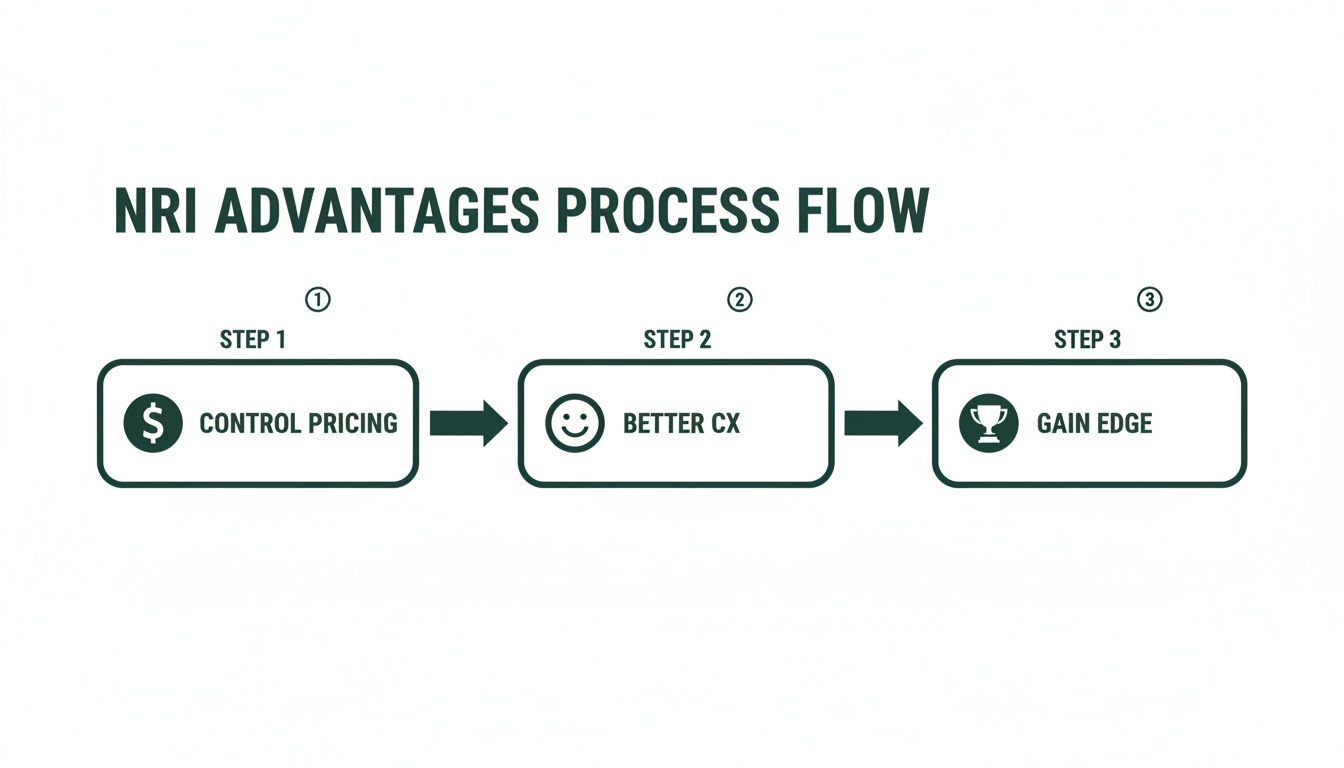 By correctly completing these compliance steps within CARM, businesses can unlock these benefits and transform regulatory requirements into a competitive edge.
The CBSA is increasing its scrutiny of non-resident importers, driven by the e-commerce boom that has led thousands of foreign businesses to ship directly to Canadians. During CARM's initial rollout, more than 5,000 NRIs registered, posting security bonds that averaged $50,000 each to secure their import privileges.
Securing Your Release Privileges: The NRI Bond
One of the most critical requirements for any importer, especially an NRI, is to post financial security with the CBSA. The standard method for this is obtaining a surety bond from a licensed provider.
This bond acts as a guarantee to the CBSA that all duties and taxes on your shipments will be paid. It is also the key to participating in the Release Prior to Payment (RPP) program.
The RPP program is essential for maintaining a fluid supply chain. It allows customs to release your goods upon arrival at the border, before duties and taxes are paid. Without it, your shipments would be held until the CBSA confirms full payment, causing significant delays that cost you time and money.
Your bond amount is typically calculated as 50% of your highest month's duties and taxes over a 12-month period, with a minimum bond amount required. A competent customs broker will help you calculate the correct figure and secure the necessary bond. To ensure your team understands these obligations, investing in regulatory compliance training is a smart move.
The process can seem complex, but it consists of a series of manageable steps. For a detailed walkthrough, refer to our guide on how to register your business for CARM. By successfully navigating these requirements, you can transform complex regulations into a simple checklist, enabling you to import into Canada with full compliance.
Understanding Your Tax and Duty Obligations
When you operate as a non-resident importer in Canada, you assume direct ownership of your financial responsibilities at the border. Getting this right is not just about compliance; it's about building a sustainable and profitable business model.
The two main financial pillars you must master are customs duties and Canadian sales taxes—specifically, the Goods and Services Tax/Harmonized Sales Tax (GST/HST). Correctly managing these ensures your shipments clear customs smoothly and your business remains in good standing with Canadian authorities, turning a complex financial puzzle into a manageable part of your operations.
Calculating Customs Duties The Right Way
The amount of duty you owe is determined by three key factors: the value of your goods, their country of origin, and their tariff classification. Each element is critical; an error in any one can result in significant financial penalties.
- Valuation for Duty: This is a common area for costly mistakes. You must declare the value based on the final price your Canadian customer pays, not an internal transfer price or wholesale cost.
- Tariff Classification (HS Codes): Every product has a unique 10-digit Harmonized System (HS) code that determines its duty rate. Accurate classification is mandatory.
- Country of Origin: This determines eligibility for preferential tariff treatment. Shipments from certain countries may qualify for reduced or zero duties under a free trade agreement, such as the Canada-United States-Mexico Agreement (CUSMA).
Properly classifying your products with the correct HS code is your first step toward financial clarity. Misclassification is a frequent error that can lead to overpayment of duties or, worse, underpayment and subsequent audits and penalties. To eliminate guesswork, you can use our practical customs duty calculator to find the correct codes and estimate your costs.
The Critical Last Sale Rule
A core concept every NRI must understand is the 'last sale' rule for valuation. The Canada Border Services Agency (CBSA) is explicit on this: duties must be calculated on the price paid by the final purchaser in Canada. You cannot use an earlier, lower wholesale price or an intercompany transfer value to reduce your duty liability.
For example: if your US-based company sells a product to a Canadian customer for $100, the value for duty is $100. It is irrelevant if your internal cost for that product was $40. Declaring the lower value is considered undervaluation and can result in severe penalties from the CBSA.
This rule levels the playing field, ensuring NRIs declare value on the same basis as Canadian-resident importers. Adherence to the last sale principle is a non-negotiable requirement for compliant importing.
To provide a clearer picture of how responsibilities are divided, here is a comparison of the key compliance duties of an NRI versus a traditional Canadian-based importer.
NRI vs Canadian Resident Importer Responsibilities
| Responsibility Area | Non-Resident Importer (NRI) | Canadian Resident Importer |
|---|---|---|
| Customs Valuation | Must use the 'last sale' value—the final price paid by the Canadian customer. | Reports the price paid to the foreign supplier. |
| GST/HST Registration | Required to register and collect GST/HST once sales exceed CAD $30,000 annually. | Required to register and collect GST/HST based on domestic and import sales. |
| Duty & Tax Payment | Directly pays all duties and taxes to the CBSA at the time of import. | Directly pays all duties and taxes to the CBSA. |
| Record Keeping | Must maintain all import and sales records for Canadian authorities for six years. | Must maintain all import and business records for Canadian authorities. |
| Customs Audits | Directly subject to audits and compliance checks by the CBSA and CRA. | Directly subject to audits and compliance checks. |
As illustrated, the NRI model places the full weight of customs and tax compliance squarely on the foreign business, making a thorough understanding of these rules essential.
Managing GST and HST Obligations
Beyond customs duties, you must also manage Canadian sales taxes. As a non-resident importer, you are responsible for collecting and remitting GST/HST once your sales to Canadian customers reach a specific threshold.
The rule is straightforward: once your revenue from Canadian sales surpasses CAD $30,000 over four consecutive calendar quarters, you are legally obligated to register for a GST/HST account with the Canada Revenue Agency (CRA). From that point forward, you must charge the applicable GST or HST rate on your sales and remit these funds to the CRA on a regular basis.
The e-commerce boom, largely driven by NRIs, has reshaped Canada's import landscape, triggering major regulatory updates like the firm enforcement of the 'last sale' rule. Previously, Canadian importers reported the final buyer-paid values, putting them at a 25-40% duty disadvantage compared to some NRIs. New CBSA policies now demand that NRIs follow the same standard. Pilot data from over 10,000 entities projects this will cause a 35% increase in average declared values per parcel in 2025. With over 15,000 NRIs registered in CARM by mid-2025, enforcing these rules—including mandatory bond posting—is a top CBSA priority. For more on these economic shifts, you can explore the findings on Canada's official international trade site.
Understanding and correctly applying these tax and duty rules is foundational to your success as an NRI. It ensures your business operates legally, avoids unexpected costs, and provides your Canadian customers with a transparent, professional experience.
Avoiding Common Pitfalls and Costly Penalties
Becoming a non resident importer in Canada is an excellent strategy for business growth, but the path is laden with compliance tripwires that can lead to serious financial consequences. The best defence against shipment delays, audits, and steep fines is a proactive understanding of what to avoid.
Treat Canadian customs compliance with the same rigour you apply to your own domestic regulations. A seemingly minor error in paperwork or valuation is not just a clerical mistake to the Canada Border Services Agency (CBSA)—it is a violation that they actively penalize. Understanding common pitfalls is the first step toward building a resilient and efficient supply chain into Canada.
Navigating Anti-Dumping and SIMA Regulations
One of the most significant financial risks for any importer is an encounter with Canada’s Special Import Measures Act (SIMA). This legislation is designed to protect Canadian industries from imported goods that are unfairly priced (dumped) or subsidized. If your products enter Canada at prices lower than their normal value in your home market, you could be subject to massive anti-dumping duties.
These are not standard tariffs. SIMA duties can be punitive, sometimes exceeding 100% of your product's value, which can instantly eliminate profitability. The CBSA is aggressive in investigating potential dumping, and as an NRI, your business is often under close scrutiny.
Canada’s enforcement of anti-dumping measures has intensified. In the 2024-2025 fiscal year, the CBSA initiated 11 new investigations into unfairly dumped and subsidized goods, many involving non-resident businesses. These actions are part of 155 active measures that protect $18.4 billion in Canadian production and support approximately 45,000 jobs. You can read more about it in the CBSA's annual departmental plan.
Critical Errors to Sidestep
Beyond SIMA, several other common mistakes can derail an NRI’s operations. Mastering these fundamentals is crucial for maintaining a clean compliance record and ensuring your goods flow smoothly across the border.
Here are the top mistakes to avoid:
- Incorrect HS Code Classification: Using the wrong Harmonized System (HS) code is a frequent and costly error. It can result in overpaying duties or, more seriously, underpaying and facing penalties during a CBSA audit.
- Improper Goods Valuation: As an NRI, you must declare the value of your goods based on the final price your Canadian customer pays—the 'last sale' principle. Attempting to use a lower wholesale or intercompany price is a serious compliance violation known as undervaluation.
- Neglecting GST/HST Registration: Once your annual sales to Canadian customers exceed the CAD $30,000 threshold, you are legally required to register for, collect, and remit GST/HST. Failure to do so is a major red flag for the Canada Revenue Agency (CRA) and can lead to back taxes, interest, and penalties.
- Incomplete or Inaccurate Paperwork: Every shipment requires precise documentation, including a properly completed Canada Customs Invoice (CCI) or a commercial invoice with all required data elements. Any missing information or inconsistencies will cause immediate delays at the border.
Proactive compliance isn't just about avoiding penalties; it's about building a predictable, efficient, and profitable Canadian sales channel. Getting your valuation, classification, and tax obligations right from day one is the foundation of a successful non resident importer strategy.
By treating these key areas as non-negotiable components of your import process, you shield your business from unnecessary financial risk and protect your reputation. A diligent approach allows you to focus on growing your market share in Canada, not resolving customs issues.
Building Your Canadian Support Team
Succeeding as a non-resident importer in Canada is not a solo endeavor. It is a team effort that relies on skilled partners on the ground in Canada. Assembling the right support system is one of the most strategic investments you can make, transforming a complex regulatory landscape into a smooth and predictable process.
Think of it like building a house in a new country. You wouldn't attempt to navigate unfamiliar building codes and source local suppliers on your own. You would hire a trusted local contractor. For an NRI, that essential contractor is your licensed customs broker.

The Essential Role of a Licensed Customs Broker
Your customs broker is your official representative to the Canada Border Services Agency (CBSA). This partnership is not just helpful—it is essential for any serious NRI. They are licensed professionals who possess deep expertise in the intricate details of customs clearance, ensuring every shipment you send is compliant and moves across the border without delay.
Their role is comprehensive and critical to your daily operations:
- Ensuring Compliance: They meticulously review your documentation, verify the accuracy of your HS tariff classifications, and confirm your valuation methods align with CBSA regulations.
- Managing Declarations: Brokers use specialized software to electronically file all necessary declarations with the CBSA. They also manage your security bond through the CARM portal, relieving you of that administrative burden.
- Problem Solving: If a shipment is flagged for inspection or a compliance issue arises, your broker is your first line of defense. They liaise directly with CBSA officers to resolve issues quickly and efficiently.
To better understand their function, you can learn more about what a customs broker does and see why they are central to international trade.
Differentiating Brokers from Freight Forwarders
It is crucial to understand the distinction between a customs broker and a freight forwarder, as they perform very different functions. A freight forwarder or logistics company is your transportation manager, arranging the truck, plane, or ship that physically moves your goods from point A to point B.
Your customs broker, in contrast, is your legal and administrative expert. They handle the complex regulatory requirements and paperwork needed to get your products legally into the country. While some larger firms offer both services, you are engaging two distinct skill sets.
A freight forwarder gets your shipment to the border. A customs broker gets your shipment across the border. Both are vital, but only a licensed broker can legally represent you to the CBSA.
Rounding Out Your Team with a Tax Advisor
Finally, to ensure comprehensive compliance and operate with confidence, consider adding a Canadian tax advisor to your team. As an NRI, you have specific obligations to the Canada Revenue Agency (CRA), particularly regarding GST/HST registration, collection, and remittance.
A tax specialist can provide clarity on your obligations, help you set up your GST/HST account correctly, and ensure your filings are accurate and timely. This proactive step helps you avoid tax-related penalties and manage your Canadian finances effectively, completing your expert support team.
Frequently Asked Questions About the NRI Program
As you explore the details of the non resident importer Canada program, several practical questions inevitably arise. Here are answers to some of the most common inquiries to help you move forward with confidence.
Do I Need a Canadian Bank Account to Be an NRI?
No, you are not required to have a Canadian bank account to operate as an NRI. Duties and taxes can be paid directly to the CBSA through the CARM Client Portal, which accepts various electronic payment methods. Your customs broker can also facilitate these payments on your behalf.
For remitting GST/HST to the Canada Revenue Agency (CRA), you can pay from a foreign bank account, but be mindful of international wire transfer fees. While not mandatory at the outset, many NRIs eventually open a Canadian dollar account to simplify financial management and reduce banking costs over time.
What Is the Difference Between an NRI and Using a DDP Service?
This is an excellent question, as both are aimed at creating a landed-cost experience for the customer, but they function differently. Delivered Duty Paid (DDP) is an Incoterm—a shipping agreement where the seller covers all costs, including import duties, to get the goods to the destination. The key distinction is that with DDP, the seller is not necessarily the legal importer of record; often, the end customer is.
As a Non-Resident Importer, your company is the legal importer of record. This is a formal business status, not just a shipping term. It provides you with direct control over customs valuation, compliance, and tax obligations in Canada, which is essential for any business planning a serious, long-term market presence.
Can I Act as My Own Customs Broker as an NRI?
While technically possible for any importer, it is highly impractical and strongly inadvisable for a non-resident importer. It is analogous to representing yourself in a foreign legal system—permissible but extremely risky. Customs clearance in Canada is a complex field requiring specialized knowledge of tariff classification, valuation rules, and constantly evolving CBSA regulations.
Furthermore, you would need specific software and a direct electronic connection to the CBSA to file declarations. This is the core function of licensed customs brokers. They are the professionals who ensure compliance, prevent costly errors, and resolve any border issues efficiently. For virtually every NRI, partnering with a licensed broker is a foundational requirement for successful importing.
Trying to navigate the NRI program on your own can feel overwhelming, but it's much simpler with an experienced partner by your side. The team at J.W. Smith Customs Brokers Ltd. has been helping businesses like yours clear goods across the Canadian border for over 50 years with confidence and speed. Let us handle the customs details so you can focus on growing your market.
Ensure your Canadian expansion is built on a compliant foundation—contact us today!
Article created using
Need Help with Customs?
J.W. Smith Customs Brokers has over 50 years of experience helping Canadian businesses navigate imports with confidence. Our team of licensed customs brokers is ready to assist with your import and export needs.