Learn safe food for canadians regulations: Your Guide to Compliance & Clearances
If you're an importer looking to bring food into Canada, you need to master the Safe Food for Canadians Regulations (SFCR). This is the single rulebook governing all food imported for sale in Canada. It's a comprehensive set of regulations designed to ensure food safety, covering products imported, exported, or traded between provinces.
For your import business, this means you can't simply ship products and hope for the best. To clear customs and enter the market, you must have specific licences, documented safety controls, and precise tracking systems in place. Failure to comply means your shipment will be rejected at the border by the Canada Border Services Agency (CBSA).
Understanding Canada's Modern Food Import Rules
Before the SFCR, Canada’s food import laws were a patchwork of 14 different sets of regulations. Each food type had unique rules, creating an inconsistent and confusing system for businesses trying to maintain compliance.
On January 15, 2019, the SFCR consolidated all previous food regulations into a single, modern framework. This created a level playing field, harmonizing food safety rules and making the importer of record directly responsible for the safety of the food they bring into the country.
Why The SFCR Matters to Your Business
This shift marked a fundamental change from a reactive to a proactive food safety model. The old system relied on inspectors catching unsafe food at the border. The SFCR puts the responsibility squarely on you, the importer, to have systems that prevent safety issues from occurring in the first place.
This proactive model is built on three core pillars that will directly shape your import operations and your interactions with the CBSA:
- Licensing: You must hold a valid Safe Food for Canadians (SFC) licence to import food. Without it, your shipments are inadmissible.
- Preventive Controls: You must have a system to identify potential food safety hazards and control them. For many importers, this requires a formal, written Preventive Control Plan (PCP).
- Traceability: You must be able to electronically track your product one step forward to your customer and one step back to your supplier.
SFCR Core Requirements at a Glance for Importers
This table summarizes the key requirements every food importer must meet for smooth, CBSA-compliant clearance into Canada.
| SFCR Pillar | What It Means for Your Import Business |
|---|---|
| Licensing | You must hold a valid Safe Food for Canadians Licence before your goods arrive at the border. This licence number is mandatory for customs clearance. |
| Preventive Control Plan (PCP) | You must have a documented food safety strategy. For many commodities, this must be a written plan detailing how you identify and control biological, chemical, and physical hazards. |
| Traceability | You must be able to electronically track your food one step forward (to whom you sold it) and one step back (from whom you received it) and produce these records within 24 hours upon request. |
| Labelling | All food labels must be accurate, truthful, and meet Canada's specific requirements for ingredients, allergens, nutritional information, and bilingual language laws. |
| Record-Keeping | You must maintain detailed records of your licensing, PCP, traceability, and supplier verification activities for a minimum of two years. |
Think of these pillars not as hurdles, but as the essential framework for a resilient and compliant supply chain that meets Canadian regulatory standards.
The Cost of Non-Compliance
Ignoring these regulations will lead to significant business disruptions. A shipment that fails to meet SFCR standards will be refused entry by the CBSA, detained at the border, or ordered destroyed at your expense. The financial losses from a single rejected shipment, including transport, storage, and product costs, can be substantial.
Beyond immediate costs, non-compliance can lead to penalties and damage your reputation with both the Canada Border Services Agency (CBSA) and your customers. Mastering how to import food into Canada under these regulations is critical. A compliant operation is a predictable one. Many importers find that specialized logistical support for international food brands helps turn this complex regulatory landscape into a competitive advantage.
Determining Your SFCR Compliance Obligations
Your first step is confirming if the Safe Food for Canadians Regulations (SFCR) apply to your business. If you are importing food into Canada for commercial purposes—meaning it will be sold or used in a commercial enterprise—the answer is yes.
The definition of "importing for sale" is broad. It covers everything from large-scale distributors supplying national grocery chains to e-commerce retailers shipping specialty items directly to consumers. If there is commercial intent, the SFCR applies, and you must meet all CBSA import requirements.
Identifying Your Importer Profile
The Canadian Food Inspection Agency (CFIA) holds all commercial importers to the same fundamental safety standards, but your business structure affects how you register and comply.
There are two main importer profiles:
- Resident Importers: Businesses with a fixed address in Canada. They must hold an SFC licence and act as the Importer of Record, legally responsible for the food's safety.
- Non-Resident Importers (NRIs): Foreign-based businesses selling food into Canada, often through e-commerce. NRIs must also obtain an SFC licence and meet all the same regulatory requirements as a resident importer to have their goods cleared by the CBSA.
Knowing your profile is essential for registration. The first step for any business is obtaining the correct credentials; our guide on how to get a business number explains this critical process.
The Scope of "Food" Under SFCR
The SFCR defines "food" broadly, covering any article manufactured, sold, or represented for use as human food or drink, including ingredients and additives.
While there are limited exceptions for certain foods regulated under other specific acts, most imported food products fall under the SFCR. It is your responsibility as the importer to correctly classify your goods and determine your obligations. For businesses handling specialized goods, understanding industry-specific food and pharma solutions is key to ensuring compliance.
A common misconception is that small-scale or e-commerce operations are exempt. This is false. The SFCR applies based on the activity (importing for commercial purposes), not the business size. An NRI selling a single specialty product online has the same fundamental duty to ensure that product is safe and compliant as a multinational corporation.
Ultimately, the responsibility for compliance rests with the Importer of Record. A knowledgeable customs broker provides a strategic advantage, helping you classify products correctly and ensuring all SFCR requirements are met before your shipment reaches the border, preventing costly CBSA delays.
The Three Pillars of SFCR Compliance
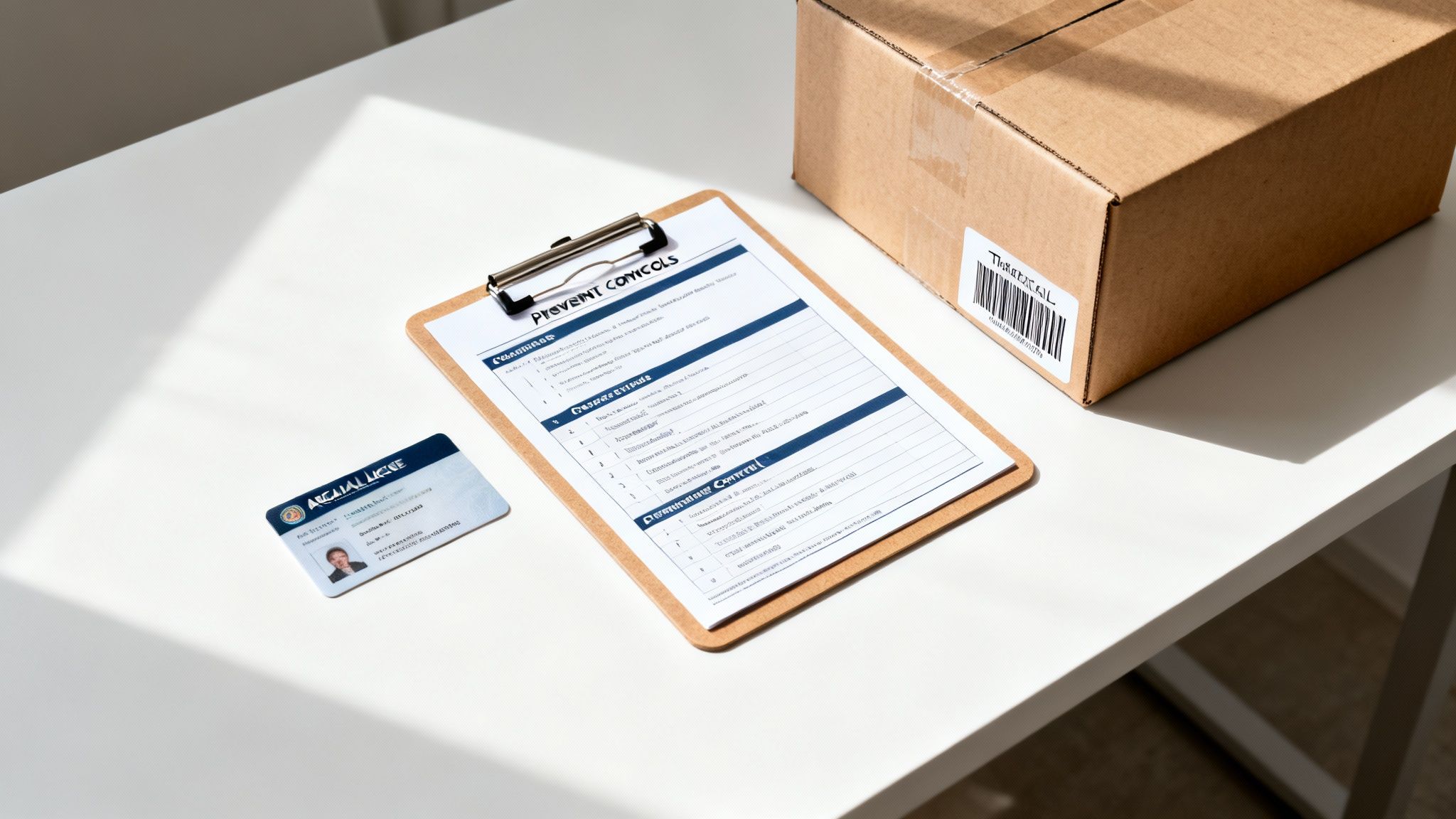
Navigating the Safe Food for Canadians Regulations (SFCR) requires mastering three core pillars: Licensing, Preventive Controls, and Traceability. For importers, these are not optional; they are the foundation for gaining legal entry into Canada.
These pillars form an integrated food safety system. Your licence provides the legal authority to import, your preventive controls demonstrate how you ensure food is safe, and your traceability system proves you can track it if a problem arises.
Pillar 1: Licensing Your Gateway to the Canadian Market
The Safe Food for Canadians (SFC) licence is the mandatory starting point. This is your legal permission from the Canadian Food Inspection Agency (CFIA) to import food. Without a valid SFC licence number on your customs declaration, your shipment will be rejected by the CBSA at the border.
The licence application is managed online through the My CFIA portal. You will need to create a business profile, detail your import activities (what you import and how), and pay the required fees.
The licence is valid for two years and is tied to your business number. It is your responsibility to keep your information current and renew on time to avoid disruptions to your supply chain. The SFC licence number is a mandatory data element for every commercial food import declaration.
Pillar 2: Preventive Controls Your Food Safety Playbook
While the licence is your ticket to import, your Preventive Control Plan (PCP) is the playbook that proves your food is safe. A PCP is a written document that systematically outlines how your business identifies and controls food safety hazards. This is often the most demanding part of the safe food for canadians regulations.
A PCP forces a proactive approach. Instead of reacting to problems, you must anticipate risks related to your product and supply chain. For many importers, this means ensuring your foreign supplier's processes meet Canadian standards.
Your PCP must address several key areas:
- Hazard Analysis: Identify all potential biological (e.g., bacteria), chemical (e.g., allergens, unapproved additives), and physical (e.g., metal fragments) hazards associated with your food.
- Control Measures: For each hazard, detail the specific steps you and your supplier will take to prevent, eliminate, or reduce it to an acceptable level.
- Monitoring Procedures: Describe how you will continuously monitor your control measures to ensure they are effective.
- Corrective Actions: Outline a pre-planned response for when a control fails, ensuring quick and effective action.
- Verification Procedures: Explain how you will regularly verify that your entire PCP is effective and being followed, through activities like record reviews and internal audits.
A PCP is not a static document. It must be reviewed and updated whenever you introduce new products, change suppliers, or alter processes. The CFIA expects your plan to accurately reflect your current operations.
As an importer, your PCP relies heavily on documentation from foreign suppliers. You are responsible for proving they meet Canadian standards by collecting and maintaining records of their food safety practices.
Pillar 3: Traceability Knowing Your Product's Journey
The third pillar is traceability—the ability to track your food through the supply chain. The SFCR mandates the "one step forward, one step back" principle, which requires meticulous electronic record-keeping.
This means you must be able to identify:
- One Step Back: The immediate supplier from whom you received the food.
- One Step Forward: The immediate customer to whom you sold or distributed the food.
The CFIA can request these records at any time, and you must be able to provide them electronically within 24 hours. This system enables rapid and precise recalls if a food safety issue is identified, protecting public health.
Your traceability records must include:
- The common name of the food
- A lot code or other unique identifier
- The name and address of the supplier you received it from
- The date of receipt
- The name and address of the customer you provided it to
- The date of provision
By building a strong foundation in Licensing, Preventive Controls, and Traceability, you not only ensure SFCR compliance but also create a more resilient and trustworthy import business ready for CBSA scrutiny.
How SFCR Affects Your Customs Clearance Process
Your Safe Food for Canadians Regulations compliance efforts directly impact your ability to clear customs. The Canada Border Services Agency (CBSA) enforces the CFIA's regulations at the border, making SFCR compliance a prerequisite for entry into Canada.
Your customs broker acts as the crucial intermediary, transmitting your import declaration to the CBSA. This electronic declaration must contain specific SFCR-related data. Any missing or incorrect information will automatically flag your shipment for inspection, causing delays or rejection.
The Digital Handshake: Your Import Declaration
When your goods arrive at the border, your customs declaration serves as a digital statement to Canadian authorities that your products meet all import requirements, including the SFCR.
For food importers, the most critical piece of data is your Safe Food for Canadians (SFC) licence number.
This number is a mandatory field in the customs data submission. Its presence signals to the CBSA that you are a licensed importer with a compliant food safety system. Without a valid SFC licence number, your shipment will be rejected by the automated clearance system.
Common Triggers for Shipment Holds and Rejections
Even with a valid licence, simple errors can stop your shipment. The CBSA's system is designed to detect inconsistencies, and any red flag can trigger a hold, secondary inspection, or refusal of entry.
Here are the most common CBSA-related errors for food importers:
- Invalid or Expired SFC Licence: Submitting an incorrect or expired licence number is an automatic failure.
- Mismatched Product Descriptions: The HS code and product description on your commercial invoice must align perfectly with your customs declaration. Vague terms like "food products" will trigger scrutiny.
- Incorrect Importer of Record Information: The legal name and address of the Importer of Record must be precise and match the details associated with the SFC licence and business number.
- Missing Permits or Certificates: Certain commodities (e.g., meat, dairy, some plant products) require additional documentation. Failure to declare these will result in an automatic hold.
The border operates on precision. A small clerical error, like a typo in a lot code on an invoice that doesn't match the customs declaration, can cause the system to flag your shipment for a manual review. These seemingly minor issues are a leading cause of preventable delays.
These enforcement actions are routine. The CFIA completes thousands of food safety investigations annually, many originating from red flags at the border. In a recent fiscal year, they completed 3,375 investigations. You can explore the latest data on food safety investigations to see the scope of their oversight.
To prepare your shipments for clearance, focus on documentation accuracy long before they arrive in Canada. For more strategies, see our guide on how to streamline your customs clearance process. Treating your import documentation with precision is key to making SFCR compliance a predictable part of your import strategy.
Your Practical SFCR Compliance Checklist
Navigating the Safe Food for Canadians Regulations requires a methodical approach. This checklist provides importers with a clear, actionable path to compliance, turning a complex set of rules into manageable steps for successful market entry.
Use this as the foundation for your ongoing compliance program. Each step builds on the last, helping you create a robust system that satisfies both CFIA regulations and CBSA clearance requirements.
Step 1: Register for a My CFIA Account
Your first action is to create an online profile in the My CFIA portal. This is the mandatory gateway for all regulatory interactions with the Canadian Food Inspection Agency, including applying for your licence. You will need your Canada Revenue Agency (CRA) Business Number (BN) to register. Ensure all company details are accurate to avoid validation delays.
Step 2: Secure Your Safe Food for Canadians Licence
Once your My CFIA profile is active, immediately apply for your Safe Food for Canadians (SFC) Licence. This licence is the non-negotiable prerequisite for importing food commercially. Without a valid SFC licence number to declare to the CBSA, your shipments will be refused entry. The licence is valid for two years, and managing its renewal is your responsibility.
Step 3: Assess Your Preventive Control Plan Needs
Not every importer needs a written Preventive Control Plan (PCP), but you must determine if you do. The requirement depends on the food commodity. High-risk categories like meat, fish, dairy, eggs, and fresh fruits or vegetables require a comprehensive written PCP. Use the CFIA's interactive tools to confirm the requirements for your specific products.
As the importer, you are responsible for ensuring the food you bring into Canada was prepared with the same level of safety as food made in Canada. This is the guiding principle of the PCP requirement.
Even if a written PCP is not required, you are still legally responsible for ensuring the food is safe and must meet all other SFCR requirements, including traceability and labelling.
Step 4: Gather Essential Supplier Documentation
As the Importer of Record, you are legally accountable for the food's safety. This requires you to verify your foreign suppliers' food safety practices. A critical part of SFCR compliance is collecting and maintaining documentation that proves your suppliers meet Canadian standards. This is the evidence that backs up your own preventive controls.
Key documents to have on file from your foreign supplier include:
- Third-Party Food Safety Certifications: Such as a Global Food Safety Initiative (GFSI) recognized certification.
- Product Specifications: Detailed information on ingredients, processing methods, and packaging.
- Certificates of Analysis: Lab results confirming the product is free from specific hazards for each lot.
- Supplier Food Safety Questionnaires: Your own documented assessment of a supplier’s systems, demonstrating due diligence.
Step 5: Establish Traceability and Recall Systems
You must implement a system for traceability and recalls. The SFCR requires you to electronically track your food one step back (to your supplier) and one step forward (to your customer). You must be able to produce these electronic records for the CFIA within 24 hours.
Your recall plan must be a written procedure detailing the exact steps you would take to remove an unsafe product from the market. The plan should define roles, outline how you will notify the CFIA, and describe how you will control the recalled product.
SFCR Importer Compliance Checklist
Use this table to track your progress and ensure all critical steps for SFCR compliance are completed.
| Compliance Step | Key Action Required | Status (To Do / In Progress / Complete) |
|---|---|---|
| 1. My CFIA Portal Registration | Create a business profile on the My CFIA portal using your Business Number (BN). Verify all company information is accurate. | |
| 2. SFC Licence Application | Apply for the Safe Food for Canadians (SFC) Licence via the My CFIA portal. Specify all food commodities you intend to import. | |
| 3. Preventive Control Plan (PCP) Assessment | Determine if a written PCP is required for your specific commodities. Develop the plan if necessary or confirm you meet other control requirements. | |
| 4. Supplier Documentation | Collect and verify food safety documents from all foreign suppliers (e.g., GFSI certificates, product specs, Certificates of Analysis). | |
| 5. Traceability System Setup | Implement a system to track food one step forward and one step back. Test the system to ensure you can produce records within 24 hours. | |
| 6. Written Recall Plan | Develop a comprehensive, written recall plan. Define roles, communication protocols, and procedures for product removal and control. | |
| 7. Labeling and Packaging Review | Ensure all imported food products meet Canadian labelling and packaging requirements under the SFCR, including bilingual labelling where required. | |
| 8. Ongoing Monitoring & Recordkeeping | Establish a system for maintaining all compliance-related records for at least two years and for regularly reviewing and updating your plans. |
By methodically completing each step, you build a strong compliance framework that meets regulatory demands and strengthens your entire import operation.
Why Canada's Food Safety System Is So Rigorous
The stringency of the Safe Food for Canadians Regulations reflects a national commitment to food safety that has evolved for nearly 150 years. This long history explains why enforcement at the border by the CBSA is so thorough and uncompromising.
For an importer, understanding this context is vital. You are entering a mature, highly regulated market that prioritizes consumer protection above all else. Canada's cautious approach to food safety was established long before the complexities of today's global supply chains.
A Legacy of Legislative Milestones
Canada’s regulatory foundation dates back to 1875, with an amendment to the Inland Revenue Act that first prohibited the adulteration of food. This marked the government's initial systematic intervention in food safety and began a long journey toward the advanced system in place today. You can explore more about this history of Canadian food policy to appreciate the depth of this commitment.
The SFCR is the modern culmination of this legacy, consolidating older regulations into a single, proactive framework designed for the globalized food market.
For importers, this historical context explains the "why" behind the meticulous documentation and strict controls required at the border. Canadian authorities view food safety not as a business formality but as a fundamental public trust built over generations.
Compliance is therefore more than a checklist; it is a requirement for participating in the Canadian market. By aligning your operations with these high standards, you position your business as a trusted partner in a market that takes food safety very seriously.
Frequently Asked Questions About SFCR for Importers
Navigating the specifics of the Safe Food for Canadians Regulations often raises practical questions for importers. Here are answers to some of the most common inquiries.
Do I Need An SFC Licence For Food Samples?
Yes, in almost all commercial contexts. If you are importing a food sample for a trade show, market analysis, recipe development, or quality assurance testing, you need a valid Safe Food for Canadians (SFC) licence. The key factor is commercial intent, not whether the sample itself is sold.
The CFIA views these activities as part of conducting business. The only exception is for food imported for personal use, a very narrow category that does not apply to business-related samples. To avoid CBSA rejection, assume a licence is required for any sample that is not for an individual's personal consumption.
What Is The Difference Between A Recall Plan And A PCP?
A Preventive Control Plan (PCP) is your comprehensive system to prevent food safety incidents. It identifies all potential hazards and outlines the controls you have in place to manage them on an ongoing basis.
A recall plan is a specific, mandatory component within your PCP. It is your emergency procedure that details the exact steps you will take to remove an unsafe product from the market if a control fails. Your PCP is about prevention; your recall plan is about response.
How Does The SFCR Apply To E-Commerce Shipments?
The SFCR applies equally to all commercial import channels, including e-commerce. The regulations are based on the activity of importing food for sale, not the business model. Non-resident importers (NRIs) selling directly to Canadian consumers face the same requirements as large-scale distributors.
An NRI shipping a product from another country to a Canadian consumer must hold an SFC licence, ensure the product is safe, meet traceability requirements, and comply with all Canadian labelling laws, including bilingual labelling. The CBSA enforces these rules on all commercial shipments, regardless of size.
Are There Different Rules for Different Foods?
Yes. While the SFCR provides a single framework, specific requirements—especially for a written Preventive Control Plan (PCP)—vary by commodity. High-risk foods like meat, fish, dairy, and fresh produce have the most stringent documentation requirements.
Conversely, some lower-risk foods like shelf-stable confectionery or baked goods may not require a written PCP. However, as the importer, you are still legally responsible for the product's safety and must meet all other SFCR obligations. It is critical to use the CFIA's official guidance and tools to determine the exact requirements for each product you import.
Navigating the complexities of the Safe Food for Canadians Regulations and CBSA clearance demands expertise. J.W. Smith Customs Brokers Ltd. provides the specialized guidance and reliable execution needed to keep your food shipments compliant and moving. Future-proof your supply chain by visiting us at https://jwsmith.com to ensure frictionless cross-border logistics.
Need Help with Customs?
J.W. Smith Customs Brokers has over 50 years of experience helping Canadian businesses navigate imports with confidence. Our team of licensed customs brokers is ready to assist with your import and export needs.