How to Reduce UPS & FedEx Brokerage Fees for Canadian Importers
If you're importing goods into Canada, that surprisingly high UPS & FedEx brokerage fee on your invoice can quickly sour a profitable shipment. It’s a common story for commercial importers. The perceived convenience of letting a courier handle everything is tempting, but it often comes with a steep premium you might not see coming.
The good news? You have the power to slash these costs. By appointing your own customs broker, importers can often see savings of 20% to 30% and, more importantly, gain a true partner dedicated to your business’s success. This is one of the most effective strategies for how to save on ups broker fees.
The High Price of Convenience for Canadian Importers
For many businesses, especially e-commerce companies juggling frequent shipments, the default brokerage service from carriers like UPS or FedEx just seems like the path of least resistance. Your package shows up, it clears customs, and you pay the bill. Simple, right?
But this convenience masks a significant hidden cost. UPS and FedEx are logistics powerhouses, but customs brokerage is an add-on service for them, not their core focus. Their fee structures are built for massive volume and automation, not for tailoring the most cost-effective solution to your specific needs. As a result, they often charge a much higher rate for customs brokerage than a third-party customs broker.
This "one-size-fits-all" model often means you're paying more than you have to. An independent customs broker, on the other hand, lives and breathes customs clearance. It’s their entire business, and they offer a specialized service that carriers simply can't match.
Why You Can Save Money with a Dedicated Broker
Bringing your own customs broker into the picture immediately changes the game. You're no longer just another tracking number in a massive logistics system; you have a partner who actually gets to know your products and import patterns. That expertise translates directly into savings.
Here are a few ways a dedicated broker cuts your costs:
Competitive Fee Structures: Independent brokers offer far more competitive rates precisely because brokerage is their specialty. You can realistically expect to save 20% to 30% when switching your broker from UPS/FedEx to J.W. Smith.
Proactive Compliance: A good broker doesn't just process paperwork. They ensure your shipments are classified correctly and meet all CBSA regulations from the start, helping you avoid costly penalties and frustrating delays down the road.
Optimized Clearance: They know the system inside and out. For instance, they can leverage programs like the Courier LVS program for low value shipments, consolidating clearances to cut down on per-package costs—a huge advantage for e-commerce businesses.
The crucial takeaway here is that you are not obligated to use the courier's brokerage service. As the importer of record, you have the right to choose who clears your goods through customs.
Making this simple choice is the first real step in learning how to save on UPS broker fees and taking back control of your import expenses. While some might consider self-clearance, it’s just not practical for high-volume commercial shippers. The process involves travelling to a CBSA office, wrestling with complex paperwork, and sinking a significant amount of time into it for every single package—making it completely unscalable for a growing e-commerce business.
The most effective strategy is clear: appoint a professional who can manage the entire process efficiently on your behalf.
Deconstructing Your UPS Brokerage Invoice
To get a handle on your costs, you have to understand them first. Opening a UPS invoice can feel like trying to decipher a secret code, loaded with line items that don't make a lot of sense. By breaking this document down, you can pinpoint exactly where your money is going and find some major opportunities for savings. If you want to dig deeper into the numbers, it helps to learn how to efficiently extract data from invoices for a clearer picture.
The jargon might seem intimidating, but two charges usually stand out: the Entry Preparation Fee and the Bond Fee. Getting a grip on these two is the key to taking back control of your import expenses.

Unpacking the Entry Preparation Fee
The Entry Preparation Fee is the main charge for the brokerage service itself. Think of it as the fee for getting the customs paperwork processed and cleared with the Canada Border Services Agency (CBSA).
But it's not a single, fixed cost. It’s based on a tiered schedule that goes up with the declared value of your goods. While that might sound logical on the surface, it creates a system where you're essentially penalized for importing higher-value products, even if the clearance paperwork is no different from that of a cheaper item.
Key Insight: The Entry Preparation Fee isn't based on how complex the clearance is—it's based on your shipment's value. This structure often means you’re paying a premium for what is largely a standardized, automated service.
The Bond Fee Explained
The second major charge is the Bond Fee, which you might also see listed as an Advancement or Disbursement Fee. This is one of the most misunderstood and surprisingly costly parts of a UPS brokerage invoice.
Here’s how it works: Your shipment lands at the border, and the CBSA needs the duties and taxes paid right away. UPS pays this amount for you, acting like a short-term lender. The Bond Fee is what they charge you for fronting them this "cash advance."
It’s usually calculated as a percentage of the duties and taxes paid, but here's the catch—it comes with a high minimum charge. This minimum is especially painful for low value shipments. For instance, a minimum fee of CAD $10 on a shipment that only owes CAD $30 in taxes is effectively a 33% interest rate on a loan that lasts only a few days.
When you add these fees together, the costs pile up fast. UPS has distinct brokerage and service fees for Canadian imports that change with shipment value and service type. For their UPS Standard ground service, the Entry Preparation Fee is free for items under CAD $20, but it jumps to CAD $19.45 for a CAD $100 item and CAD $29.00 for a CAD $200 one. On top of that, when UPS fronts the duties and taxes, they tack on a bond fee of around 2.7% of the amount, often with a minimum of CAD $6 to $10. For just one CAD $500 package, an importer could get hit with a hefty entry fee plus the bond fee, inflating the final landed cost significantly.
Once you start spotting these fees on your invoice, you'll see just how quickly the convenience of carrier brokerage turns into a major business expense. This is exactly where an independent customs broker like J.W. Smith provides real value, offering a transparent, flat-fee structure that gets rid of these costly surprises.
How an Independent Broker Delivers Major Savings
Using the default brokerage service from a courier is a lot like buying snacks at the movie theatre. It’s right there and it’s convenient, but you know you're paying a huge premium for a one-size-fits-all product. Switching things over to an independent customs broker is the smart move—like going to a specialty shop where you get expert advice, better prices, and service that’s actually built around your needs.
This isn’t just about making small tweaks to your import process. It’s a fundamental shift that puts you back in the driver's seat when it comes to your costs. For any commercial importer, especially e-commerce businesses juggling a constant flow of shipments, this move has a direct impact on the bottom line. An independent broker like J.W. Smith isn’t just another vendor; they become a strategic partner in your supply chain.
By making this one change, importers regularly see savings of 20% to 30% on their customs clearance costs. That’s not an exaggeration. It's the real-world result of moving from a high-volume, automated system to a specialized, client-focused one.
The True Cost of Carrier Brokerage
The high fees charged by couriers like UPS and FedEx are a direct result of their business model. Their main job is logistics—moving millions of packages from point A to point B as fast as humanly possible. Customs brokerage is just an add-on service, and it's priced for maximum convenience, not competitiveness.
An independent broker, on the other hand, operates from a completely different playbook. Their entire business is built around navigating the tangled mess of customs regulations efficiently and affordably.
Transparent, Competitive Fees: Instead of a confusing, value-based fee schedule and surprise bond fees, a good independent broker offers a clear, often flat-fee structure. You know exactly what you're paying for, which makes budgeting and cost forecasting a whole lot easier.
Specialized Expertise: A dedicated broker gets to know your products. They focus on accurate HS code classification, making sure you pay the correct duty rate and stay on the right side of CBSA regulations, which helps you avoid costly errors and audits down the road.
Proactive Problem Solving: When a problem pops up—and in logistics, they always do—you're not stuck calling a massive call centre. You have a direct line to an expert who knows your account and can fix clearance issues before they turn into major delays.
Appointing your own customs broker turns a necessary expense into a competitive advantage. You gain a partner who actively works to keep your costs low and your supply chain moving smoothly.
How to Assign J.W. Smith as Your Broker
Taking that first step toward real savings is surprisingly simple. If you are sending your items via courier/parcel service (i.e.: FedEx, UPS, DHL) and you want to appoint a customs broker, simply have your tracking number handy and give them a call.
Here’s how it works:
Have your tracking number ready. This is the key piece of information the courier will need to pull up your shipment.
Call the courier’s customer service line. The operator will ask you for your tracking number.
Request to update the brokerage information. Once confirmed, simply ask to update the brokerage information to J.W. Smith Customs Brokers.
The consent for brokerage must come from the importer of record. If any more information is needed, it can be found on our Contact page. This one-time action is the fastest way to learn how to save on UPS broker fees for a shipment that's already on its way.
Of course, for e-commerce businesses and other high-volume shippers, doing this for every single package just isn't practical. The much better long-term solution is to set up a permanent relationship with your broker, which we'll cover later on. Partnering with a dedicated firm unlocks consistent financial benefits, and you can learn more about how a customs broker can help you save time and money in our detailed guide.
Why High Fees Hurt Low Value Shipments the Most
For high-volume importers and e-commerce businesses, the real damage from inflated UPS brokerage fees isn't from one big shipment, but from a thousand small ones. The fee structure couriers use disproportionately punishes low value shipments, turning thin margins into real losses when multiplied across hundreds of orders.
This is exactly where the standard carrier brokerage model falls apart for a growing business. The problem is baked into the minimum charges, especially the bond or advancement fee. A small order might only have a few dollars in actual duties and taxes, but the fee to pay it is often a fixed, much higher amount. This creates a painful imbalance that directly eats into your profit on every single sale.

The Courier LVS Program Advantage
A knowledgeable customs broker knows how to use the Courier LVS program. This CBSA program is designed specifically to streamline the clearance of qualifying goods valued under a certain threshold. Instead of processing every small package one by one, a broker can consolidate them for clearance.
This consolidation is the key to how to save on UPS broker fees. By clearing many low value shipments under a single entry, the cost per package plummets. This delivers several key benefits for your business:
Reduced Per-Shipment Costs: You sidestep the high minimum fees tied to individual clearances.
Predictable Budgeting: Your clearance costs become consistent and much easier to forecast.
Faster Clearance Times: Brokers who specialize in this program are experts at moving these shipments through customs without a hitch.
Increased Profit Margins: Lowering your landed cost on every single item gives your bottom line a direct boost.
For an e-commerce business, saving even $5 per package is huge. Over 500 shipments a month, that small change adds up to $30,000 in annual savings—capital you can pour back into growth, marketing, or inventory.
Is Self-Clearance a Practical Solution?
Some importers wonder if they can just bypass brokers entirely and self-clear their goods to avoid the fees. While it’s technically possible, it is not a workable strategy for any commercial business. The process means you have to physically go to a CBSA inland office with your paperwork for every single shipment.
For a business handling frequent imports, the time, travel, and administrative headaches make self-clearance completely impractical and unscalable. The labour costs and potential for errors would quickly erase any savings, highlighting the value of a professional broker who manages these complexities for you.
A Step-By-Step Guide To Appointing Your Own Broker
Tired of getting hit with surprise UPS brokerage fees? Taking control of your customs clearance is far easier than most importers think. For any single shipment already on its way, you can switch to a new broker with just one quick phone call.
This simple, proactive step puts you back in charge of your costs. It lets you tap into the expertise and competitive rates of a dedicated customs broker like J.W. Smith, turning a frustrating expense into a smooth part of your logistics.
Making The Switch For A Single Shipment
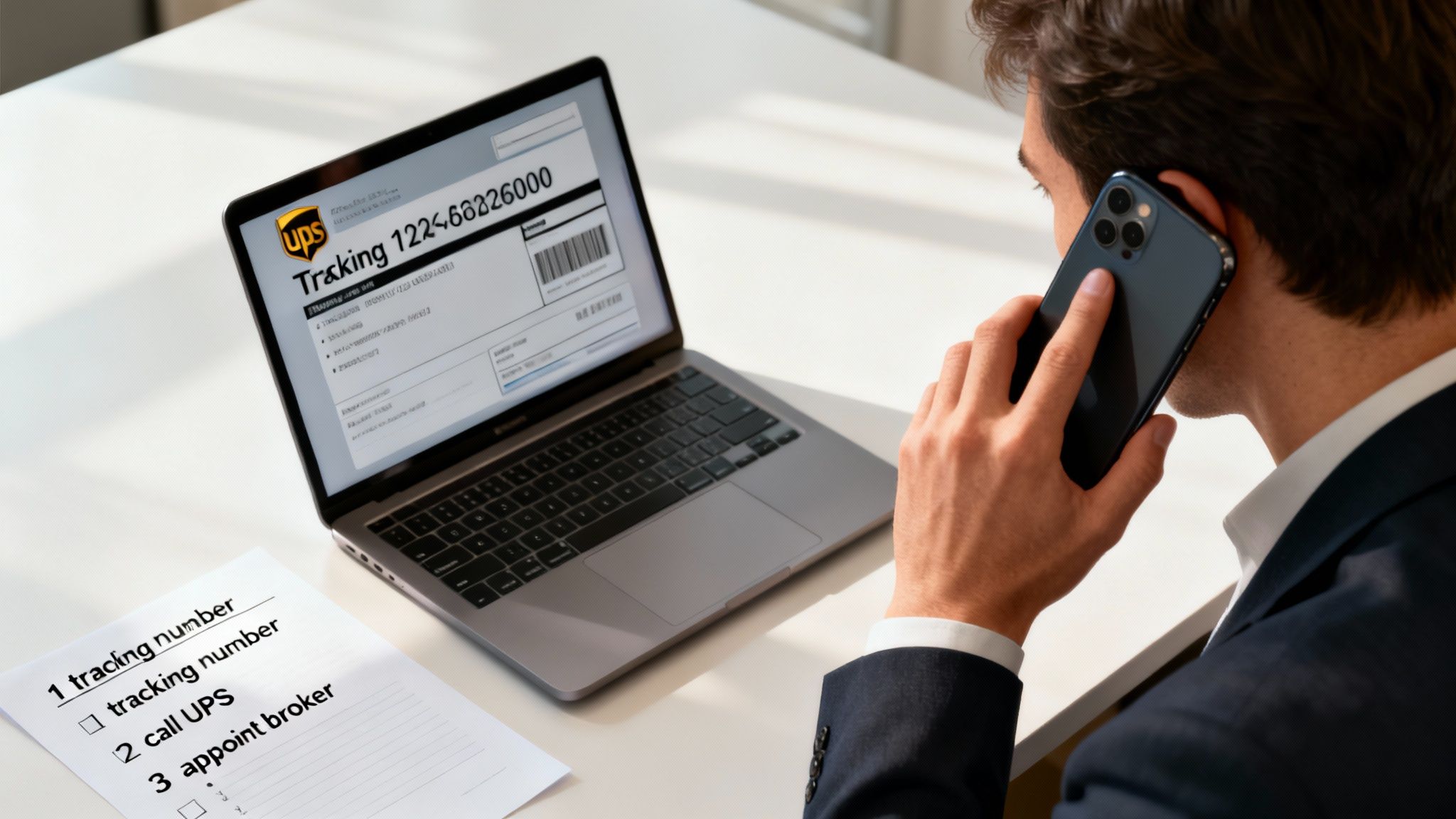
If you have a package en route, you don't have to let UPS handle the clearance. You can redirect it to a broker of your choice.
Here’s how you can appoint J.W. Smith to clear an in-transit shipment:
Grab your tracking number. This is the key piece of information UPS needs to locate your package in their system.
Call UPS directly. Once you connect with an operator, give them the tracking number to pull up your shipment details.
Ask to change the broker. All you have to say is, "I would like to update the brokerage information to J.W. Smith Customs Brokers."
It’s that simple. One crucial detail: this request must come from the importer of record to be valid with UPS and meet CBSA regulations. If the operator needs more information on J.W. Smith, everything they need is on our Contact page.
Creating A Permanent Solution For Your Business
While changing the broker shipment by shipment works in a pinch, it’s not a practical long-term strategy if you’re importing frequently. Who has time to call UPS for every single package? The smarter, more efficient solution is to set up a permanent instruction with your chosen broker.
This is done by signing a General Agency Agreement (GAA), which you might also hear called a Power of Attorney (POA). This is the legal document that officially authorizes your customs broker to act on your behalf for all things customs. If you're appointing a broker, it's wise to understand the legal side of things; you can learn more about What Does POA Stand For to see just how important this document is.
Once a GAA is on file, all your future shipments arriving via UPS—or any other carrier, for that matter—will automatically be sent to your designated broker for clearance. This one-time setup means no more phone calls and ensures you always get the benefit of lower fees and expert service.
For any commercial importer, this permanent arrangement is the most effective way to consistently save money on brokerage fees. To get into the nitty-gritty of making this change for your business, check out our guide on how to switch your customs broker. It lays out a clear roadmap for building a partnership that delivers real value.
Is Self-Clearing Your Shipments a Viable Option?
You might be wondering if you can just sidestep brokerage fees altogether and clear your shipments yourself. While it's technically possible for an individual bringing in a one-off personal item, it’s a completely impractical and inefficient strategy for any commercial business.
For e-commerce sellers and other businesses that import regularly, the time, direct labour costs, and potential for critical errors make self-clearance a dead end. It’s an unscalable process that, in the long run, actually ends up being more expensive. If anything, trying it once will show you the immense value a professional customs broker brings to the table.
The Reality of the Self-Clearance Process
Self-clearing isn’t just about filling out a form online. It's a manual, time-consuming grind that requires you to physically intervene in the customs process for every single shipment.
Here’s a realistic look at what you’d have to do:
Wait for the Paperwork: First, you have to track down the courier (like UPS or FedEx) and ask them to send over the commercial invoice and cargo control documents.
Drive to a CBSA Office: Next, you need to physically drive to an official CBSA inland office that actually handles these types of transactions. Not all of them do.
Tackle the Forms: Once you get there, you’ll need to correctly fill out complex forms, like the B15, and present everything to a customs officer.
Pay and Prove It: After waiting for the officer to process everything, you pay the duties and taxes on the spot. They’ll give you a stamped receipt, which you then have to send back to the courier as proof before they will finally release your shipment.
As you can see, the process involves a ton of phone calls, document juggling, and actual travel—all of which pull you away from running your business.
For a commercial importer, time is money. The hours spent driving to a CBSA office, waiting in line, and managing paperwork for a single package could be better invested in marketing, sales, or customer service.
And you have to repeat this entire ordeal for every single shipment. If your business depends on a steady flow of goods, this quickly becomes an administrative nightmare. Any mistake in the paperwork can trigger even more delays or penalties.
On top of that, with new requirements like CARM constantly changing the rules, staying compliant is practically a full-time job. You can find out more in our guide to register your business for CARM to get a sense of the evolving compliance landscape. Ultimately, the only scalable solution is to work with a professional broker who manages these complexities for you.
Frequently Asked Questions About UPS Brokerage Fees
If you've ever imported goods, you know that unexpected costs can pop up. UPS brokerage fees are a common source of confusion for Canadian importers, so let's clear the air and answer some of the most pressing questions.
Can I Refuse to Pay UPS Brokerage Fees?
Once UPS has already cleared a shipment for you, the service has been rendered, and you're on the hook for the fee. You can't refuse to pay for a service you've already received. However, you absolutely have the right to refuse their brokerage service for all future shipments.
The trick is to be proactive. Before your next package even reaches the border, you need to inform UPS that you’ll be using your own customs broker. This move lets you sidestep their brokerage service and the associated fees entirely, putting you back in control of the clearance process and your costs.
How Do I Permanently Switch My Customs Broker for All UPS Shipments?
Calling UPS for every single package isn't a realistic solution, especially if you're running a busy e-commerce business. To make the switch permanent and stop the cycle, you need to formalize a relationship with a broker you trust.
This is done by signing a General Agency Agreement (GAA) or a Power of Attorney (POA) with a firm like J.W. Smith. This is the legal document that authorizes your broker to act on your behalf in all customs matters. Once it's on file, all your future shipments are automatically routed to them for clearance. No more surprise fees, no more last-minute phone calls—just consistent, predictable service at your preferred rates.
Does This Process Also Work for Other Couriers Like FedEx or DHL?
Yes, it absolutely does. The right to choose your own customs broker isn't a UPS-specific loophole; it's your right as the importer of record. This applies to shipments handled by any courier, whether it's FedEx, DHL, or anyone else.
The specific steps to notify each carrier might differ slightly, but the strategy is the same. Appointing your own dedicated broker is a universal tactic for cutting costs, ensuring compliance, and gaining an expert partner for your import operations. It's the single most effective way how to save on UPS broker fees and similar charges from every other carrier.
Ready to take control of your import costs and partner with an expert who can save you up to 30% on customs brokerage? J.W. Smith Customs Brokers Ltd. has over 50 years of experience making cross-border shipping simple and affordable. Contact us today to learn how we can streamline your customs clearance and boost your bottom line.
Article created using Outrank
Need Help with Customs?
J.W. Smith Customs Brokers has over 50 years of experience helping Canadian businesses navigate imports with confidence. Our team of licensed customs brokers is ready to assist with your import and export needs.