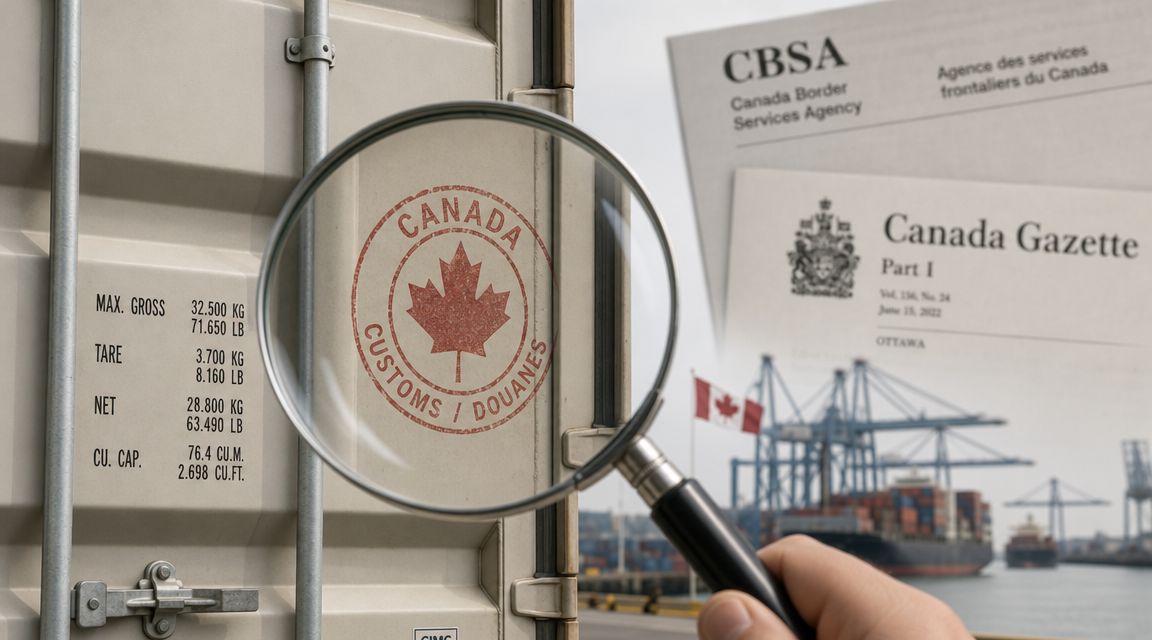
Think of a temporary import to Canada as a short-term visitor pass for your goods. It’s a way to bring items into the country for a specific reason—like a trade show or a repair job—without paying the usual import duties and taxes, on the condition that they leave when they're done.
The fundamental rule is simple: what comes in must eventually go out. And the Canada Border Services Agency (CBSA) takes this rule very seriously.
Understanding the Basics of a Temporary Import
This process is essentially a handshake agreement with the CBSA. You're telling them, "These goods are just visiting, not moving in permanently." The main benefit is saving a ton of cash on duties and taxes, but it all hinges on you following the rules and providing a financial guarantee.
This guarantee, usually a security deposit or a bond, ensures that if your goods decide to overstay their welcome, the government can collect the duties and taxes that would have been owed. Once you prove the goods have been exported, you get your security back. Simple, right? Well, mostly.
Why Use a Temporary Import?
The real value here is avoiding significant upfront costs on goods that won't be sold or consumed in Canada. This process is designed for items that will return to their country of origin in substantially the same condition they arrived in.
Common scenarios where a temporary import to Canada is the perfect fit include:
- Trade Shows and Exhibitions: Bringing in booths, promotional materials, and product displays.
- Professional Equipment: Think film crews with cameras, musicians with instruments, or surveyors with specialized tools.
- Commercial Samples: For salespeople carrying product samples to show potential Canadian buyers.
- Goods for Repair or Alteration: Sending machinery to Canada for specialized service before it's returned home.
If you want a broader look at how goods move across international borders, this guide on general import and export trade regulations is a great resource.
Your Main Options at a Glance
Navigating CBSA requirements is manageable, but choosing the right path from the start is crucial. Each method is built for a specific purpose, and picking the wrong one is like trying to use a screwdriver to hammer a nail—it’s messy and it just won’t work.
Here’s a quick overview of the primary pathways for your temporary import.
Quick Guide to Temporary Import Options in Canada
| Import Method | Best For | Key Document | Security Deposit Required? |
|---|---|---|---|
| ATA Carnet | Goods travelling to multiple countries for trade shows or as professional equipment. | ATA Carnet | No (Bond is secured during Carnet application) |
| E29B Temporary Admission Permit | Goods not eligible for a Carnet or coming from a non-Carnet country. | Form E29B | Yes |
| Personal & Household Effects | Individuals moving to Canada temporarily for work or study. | Form BSF186 / BSF186A | No |
| Samples of Negligible Value | Low-value samples for soliciting orders. | Commercial Invoice | No |
This table gives you a starting point, but the specifics of your goods, their value, and their purpose will ultimately determine the best approach. Getting it right saves you time, money, and a lot of headaches at the border.
Choosing Your Temporary Import Method
Not all temporary imports into Canada follow the same script. The best route for your goods depends entirely on what you're bringing in, why, and where it's headed next. Think of it like deciding between a local bus and an international flight—both get you somewhere, but one is clearly better suited for certain journeys.
Making the right choice upfront is critical. It saves you from border delays, unexpected costs, and the kind of paperwork headaches that can derail a project. For most commercial temporary entries, you’ll be looking at two primary pathways: the ATA Carnet and Canada's own E29B Temporary Admission Permit.
The ATA Carnet: The Passport for Your Goods
The ATA Carnet is often called a "passport for goods," and for good reason. It’s an internationally recognized customs document that allows for duty-free and tax-free temporary importation of goods into over 80 countries. If your business involves frequent international travel with the same set of equipment, the Carnet is your new best friend.
Imagine you're a U.S.-based film crew shooting scenes in Vancouver for a month before heading to the UK. An ATA Carnet simplifies everything.
- One Document to Rule Them All: A single Carnet covers your entry into Canada, your exit, and your subsequent entry into the United Kingdom. No need to file different paperwork at each border.
- No Security Deposit at the Border: The financial guarantee (or bond) is sorted out when you first apply for the Carnet in your home country. This means you don't have to post a cash or surety bond directly with the CBSA upon arrival.
- Predictable Costs: You know the full cost of the Carnet and its bond upfront, making it much easier to budget for your project.
Key Takeaway: The ATA Carnet is the gold standard for goods moving through multiple countries, like professional equipment for tours, commercial samples for a multi-country sales trip, or displays for international trade shows.
The E29B Temporary Admission Permit: Canada's Go-To Form
What if your goods aren't jet-setting around the globe? Or what if you're coming from a country that doesn't participate in the Carnet system? That's where Form E29B, Temporary Admission Permit, comes into play. This is Canada's specific solution for temporary imports that don't fit the Carnet model.
Let's say a German machinery manufacturer is sending a specialized piece of equipment to a facility in Ontario for a three-month trial. The E29B permit is the perfect tool for this job. The process involves posting a security deposit directly with the CBSA, which is equal to the duties and taxes you would have paid if the goods were being permanently imported.
Don't panic—this isn't a fee. It's a refundable guarantee. Once the machinery is successfully re-exported from Canada and you provide the right proof to the CBSA, you get your security deposit back in full.
Even seemingly simple goods can fall under very specific rules. For example, Canada’s temporary import requirements for U.S. romaine lettuce in certain seasons demand particular documentation to ensure food safety. This shows how even perishable items require careful planning, which is often managed by a customs broker who understands these specialized regulations. To see how detailed these measures can be, you can learn more about the temporary requirements for U.S. romaine lettuce.
Making the Right Call: Carnet vs. E29B
So, how do you decide? It usually boils down to two key factors: your itinerary and the origin of your goods. While both methods achieve a similar goal, their mechanics are quite different.
Choose the ATA Carnet if:
- Your goods will be entering multiple Carnet-member countries.
- You want to avoid posting a direct security deposit with Canadian customs.
- You prefer a single, standardized document for your entire international journey.
Choose the E29B Permit if:
- Your goods are only coming to Canada.
- The country of export is not a member of the ATA Carnet system.
- The goods don't meet the specific categories covered by a Carnet (e.g., items intended for repair or alteration).
Choosing the correct temporary import method is half the battle won. It sets the stage for a smooth entry, predictable costs, and a hassle-free exit. If you’re ever in doubt, a quick consultation with a customs broker can clarify the best path forward.
Assembling Your Temporary Import Paperwork
Let's be honest, nobody gets excited about paperwork. But when you're bringing goods into Canada temporarily, getting your documents in order is the single most important thing you can do. Think of it as your non-negotiable hall pass—without it, your goods aren’t getting past the border.
A small oversight on a single form can snowball into a massive headache, turning a straightforward entry into a logistical nightmare. You need to give the CBSA a crystal-clear picture of what's coming in, why it's here, and exactly when it's leaving.
Mastering Form E29B: The Temporary Admission Permit
When an ATA Carnet isn't the right fit, Form E29B, the Temporary Admission Permit, becomes your go-to document. This form is your official request to the CBSA, so filling it out correctly is absolutely critical. It’s more than just a form; it’s your declaration of intent.
Pay close attention to these fields on the E29B, as this is where importers trip up most often:
- Detailed Goods Description: Vague descriptions like "tent" or "computer" are immediate red flags for customs officers. Be hyper-specific. Instead of "tent," write "One red 10x10 promotional tent with J.W. Smith company logo." Instead of "computer," list "Two Dell Latitude 7420 laptops, serial numbers XYZ123 and ABC456." The more detail, the fewer questions you'll face.
- HS Codes: Every item needs a correct Harmonized System (HS) code. This 10-digit number tells the CBSA precisely what the product is and determines the potential duties and taxes, which in turn sets the value of your security deposit.
- Value for Duty (VFD): You must declare the fair market value of your goods in Canadian dollars, backed up by a commercial invoice. This isn't the time for creative accounting.
- Intended Date of Export: Be realistic. This date is your firm deadline. If you miss it without getting an extension, you risk forfeiting your entire security deposit.
For a full rundown of this and other essential documents, you can check out our detailed guide to Canada customs forms.
Navigating the ATA Carnet Vouchers
If you're using an ATA Carnet, your main job is to understand its colour-coded voucher system. The Carnet is a booklet, and a specific voucher is used each time you cross a border.
- Yellow Vouchers: For exportation from and re-importation back into your home country.
- White Vouchers: For importation into and re-exportation from foreign countries (like Canada).
- Blue Vouchers: For transiting through countries on your way to a destination.
When you enter Canada, the CBSA will process a white importation voucher. When you leave, they'll process a white re-exportation voucher. It is absolutely essential to make sure the officer stamps and detaches the correct portion at each stage. A missed stamp creates a gap in your chain of proof, which can cause serious problems down the road.
Essential Supporting Documents
Neither the E29B nor the ATA Carnet travels alone. They need a supporting cast of documents to verify the information you've provided. Failing to include these is like showing up to an exam without a pencil—you simply aren't prepared.
This decision tree helps visualize the two main pathways for your temporary import paperwork.
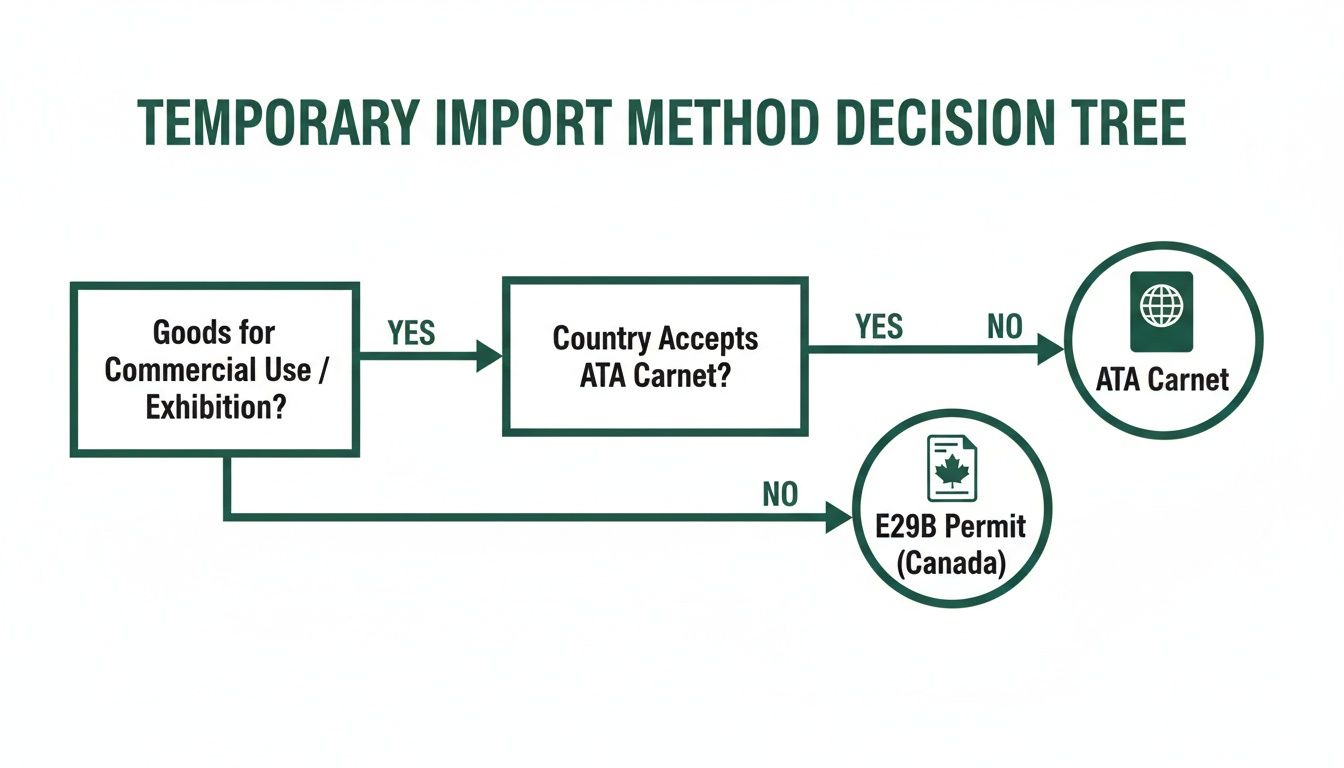 The choice between a Carnet and an E29B Permit really comes down to your specific travel plans and the nature of your goods. This chart helps guide you to the correct primary document.
Your essential document checklist should always include these items:
- A Commercial Invoice: This needs to list every single item, its HS code, country of origin, and value. Even if no sale is taking place, a pro-forma commercial invoice is required to establish the value of the goods for customs.
- A Packing List: This document details the contents of each box or crate, matching the descriptions on the commercial invoice. It helps the CBSA quickly locate specific items if they decide to inspect.
- Transportation Documents: This means the bill of lading for ocean or truck freight, or the airway bill for air shipments. As you prepare your paperwork, it's also a good idea to understand the importance of a consignment note, as it serves as a critical legal document detailing the freight carriage contract.
Broker Tip: We always advise clients to create a "customs binder" with physical copies of every single document. Keep one in the truck and save digital copies to a cloud service. If anything gets misplaced at the border, you have an immediate backup. It’s a simple step that can save the day.
Understanding Bonds and Security Deposits
How much is this temporary import really going to cost? This is the big question, and the answer comes down to the security deposit. Let's get one thing straight: this isn't a fee you pay and never see again. Think of it as a damage deposit for your goods—a guarantee you provide to the CBSA.
When you use a Form E29B for a temporary import, the CBSA needs financial assurance that if your goods end up staying in Canada, the government can collect the duties and taxes that would have been owed.
This security deposit is your pledge that the goods will be exported on time and in the same general condition.
How Security Deposits and Bonds Work
The deposit amount is calculated based on the full duties and taxes that would apply if your goods were being imported for sale. This includes the Goods and Services Tax (GST), Harmonized Sales Tax (HST), and any other tariffs. The CBSA holds onto this money until you can prove the items have officially left the country.
You have a few options for posting security:
- Cash or Certified Cheque: Simple and direct, made out to the Receiver General for Canada. The downside? This can tie up a serious amount of your working capital.
- Transferable Bond: Issued by an approved financial institution.
- Surety Bond: For most businesses, this is the most practical and popular route. A customs broker or surety company posts a bond to the CBSA on your behalf. Instead of fronting the full security amount, you just pay a much smaller fee to the bonding company, freeing up your cash flow.
The goal of the security deposit isn't to be a revenue tool for the government. It's simply a mechanism to ensure compliance. Follow the rules, export your goods on time, and you'll see every dollar of that security returned.
Calculating the Security for Your Temporary Import
Let's walk through a real-world scenario. Imagine you're bringing a specialized piece of manufacturing equipment from the United States into Ontario for a six-month demonstration at a trade show.
- Value of the Machinery: $50,000 CAD
- Applicable Duty Rate: We'll assume it's duty-free under CUSMA.
- HST Rate in Ontario: 13%
The math here is pretty straightforward:
$50,000 (Value) x 13% (HST) = $6,500
In this case, you would need to post a $6,500 security deposit with the CBSA. If you opt for a surety bond through your customs broker, you would pay a small premium to the bonding company instead of putting up that entire amount yourself. If you're new to this, our guide explains in more detail what a customs bond is and how it works in these exact situations.
Getting Your Money Back
This is the part everyone cares about. Getting your security deposit back is all about providing the CBSA with undeniable proof that the goods have been re-exported. Once your items leave Canada, you need to show evidence that the temporary import is officially closed out.
Acceptable proof usually includes:
- A validated copy of your E29B form, stamped by the CBSA when you exited.
- Export documents from the country you're entering (like U.S. Customs entry forms).
- Transportation documents, such as a bill of lading, proving the goods have physically left Canada.
Once the CBSA is satisfied with your proof, they'll cancel the E29B permit and start the process of refunding your deposit. It can take several weeks, but as long as your paperwork is in order, it's a very standard procedure.
Exporting Your Goods and Avoiding Common Pitfalls
You’ve successfully navigated the paperwork and brought your goods into Canada. Now comes the most critical part: getting them out on time and proving to the CBSA that you did.
This is where you close the loop. A mistake at this final stage can instantly turn your duty-free temporary import into a very expensive permanent one. Failing to get the right documentation upon exit is like running a marathon and forgetting to cross the finish line—none of the effort up to that point will count.
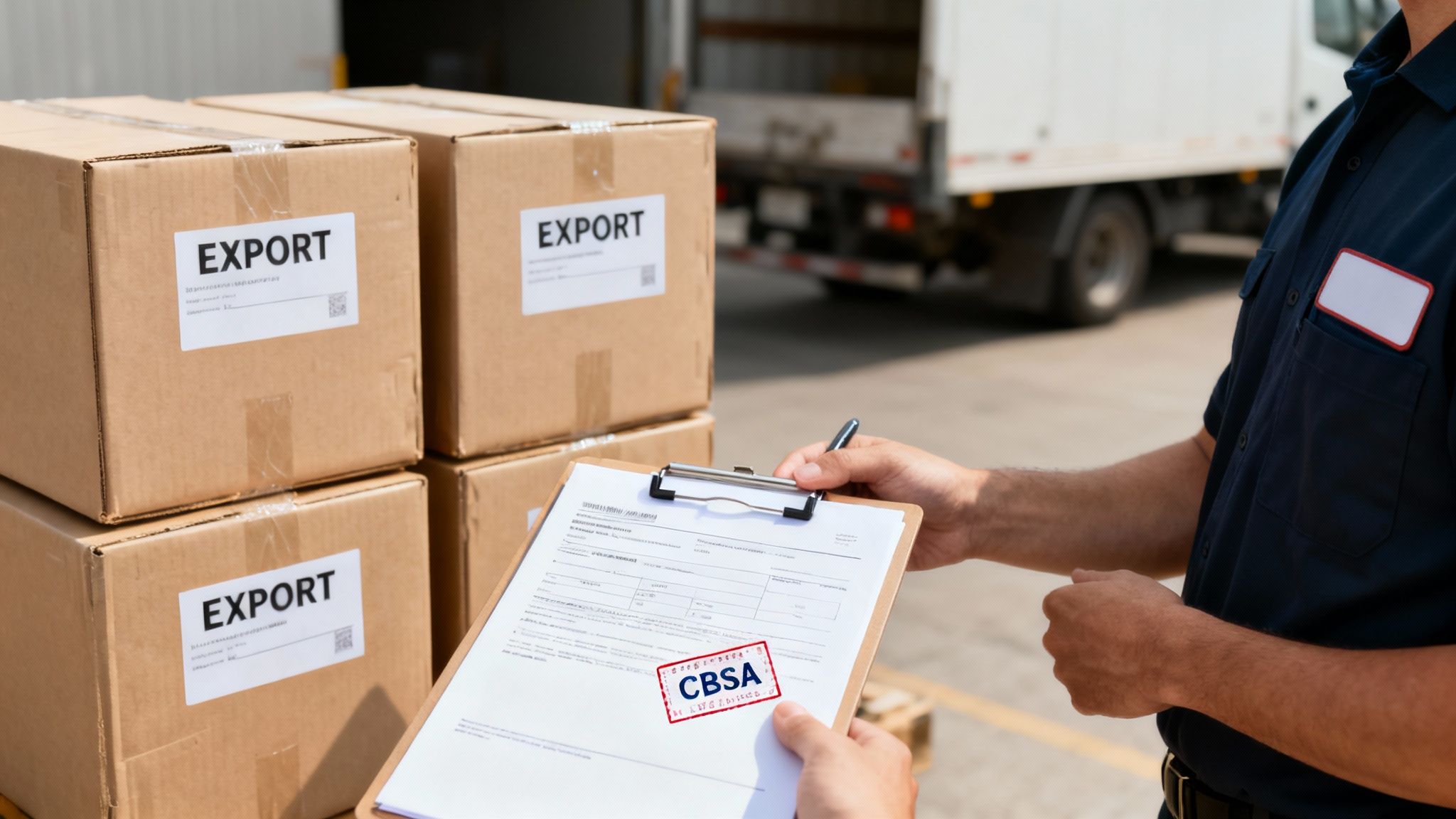
Securing Your Proof of Export
The burden of proof falls entirely on you, the importer. The CBSA won't chase you down to confirm your goods have left; it’s up to you to present them with indisputable evidence. A truck driver saying, "Yep, I took it back across the border," won't cut it.
So, what counts as valid proof? You need official, verifiable documentation.
- CBSA-Stamped Paperwork: This is the gold standard. When you exit Canada, you must present your temporary import documents (like the E29B permit or ATA Carnet) to a border services officer. They will review the goods, stamp the paperwork, and officially "acquit" the entry.
- Foreign Customs Documents: If your goods are heading right back into the U.S., a copy of the official U.S. Customs and Border Protection (CBP) entry form can serve as strong supporting evidence.
- Transportation Records: Documents like a bill of lading or a cargo control document showing the goods were shipped from Canada can also work, but this is often seen as secondary proof.
The absolute best practice is to get your original E29B form stamped by the CBSA at the port of exit. For ATA Carnet users, getting the white "re-exportation" voucher properly stamped is non-negotiable.
Common Pitfalls That Cost Importers Dearly
We’ve seen it all. A few common, easily avoidable mistakes are responsible for most of the financial pain associated with temporary imports.
Missing the Re-Export Deadline
Every temporary import comes with an expiry date. Missing it, even by a single day, gives the CBSA the right to assume your goods have been permanently diverted into the Canadian economy.
Cautionary Tale: An American tech company brought a $100,000 server rack to Toronto for a three-month trial. A project delay pushed their schedule back, and they forgot to request an extension on their E29B permit. They exported the server two weeks late and were shocked when the CBSA kept their entire $13,000 HST security deposit. That was one expensive project delay.
Selling or Disposing of Goods Without Authorization
The terms of a temporary import are clear: the goods must be exported in the same condition. If an opportunity comes up to sell an item while it's in Canada, you can't just hand it over and pocket the cash.
You must first contact your customs broker to formally "import" the goods. This involves filing a B3 customs entry and paying all applicable duties and taxes. Only then is the item legally allowed to stay in Canada. Selling it under the table is a serious compliance breach that guarantees the loss of your security deposit and invites further penalties.
Forgetting the Exit Stamp
This is perhaps the most heartbreaking mistake. A European orchestra toured Canada with millions of dollars worth of instruments under an ATA Carnet. At the end of their tour, the tired crew loaded everything onto the plane and flew home, completely forgetting to have their Carnet stamped by the CBSA at the airport.
Months later, they received a massive claim from their national guaranteeing association for the full duties and taxes on every single instrument. Why? From the CBSA's perspective, those instruments never left. The lack of an exit stamp erased all evidence of their departure.
Closing out your temporary import is just as important as starting it. For more information on formal procedures, our complete guide on exporting from Canada and its requirements provides additional context on documentation.
Answering Your Top Temporary Import Questions
We've walked through the mechanics of bringing goods into Canada temporarily, but a few key questions always come up. Let's tackle them head-on to help you avoid any surprises at the border.
What Happens if I Miss the Re-Export Deadline?
Missing the re-export deadline on your E29B permit is a costly mistake. The CBSA will simply cash in your security deposit to cover the duties and taxes they believe are owed. Once that happens, there’s no getting it back.
The moment you anticipate a delay, you need to act. Don't wait until the last minute. Get in touch with your customs broker or the CBSA right away. In many cases, it’s possible to apply for an extension or formally “land” the goods by filing a B3 customs entry and paying the required duties. Being proactive is your only real defence.
Can I Sell Goods I Brought in Temporarily?
The short answer is a hard no. Any item brought into Canada under a temporary import provision is just a visitor. It can't be sold, leased, or put to work in the Canadian marketplace. The entire premise of a temporary import is that the goods will leave.
If your plans change and a Canadian buyer suddenly appears, you must first change the status of your goods from temporary to permanent. This involves working with your broker to file the correct paperwork (a B3 customs entry) and paying all the duties and taxes. Selling the goods without doing this first guarantees you'll lose your security deposit and attract unwanted attention from the CBSA.
The Golden Rule of Temporary Imports: The goods have to leave Canada in more or less the same condition they arrived in. If you want to sell them, you have to change their customs status before any money changes hands.
How Do I Choose Between an ATA Carnet and an E29B Permit?
This is the most common point of confusion, but the right choice usually becomes obvious once you look at your itinerary.
An ATA Carnet is your best bet if your goods are on a world tour, visiting multiple member countries (there are over 80 of them!). It’s like a passport for your equipment, making it perfect for international trade show circuits or concert tours. You handle the security once when you apply, and that single document gets you across multiple borders.
An E29B Temporary Admission Permit is Canada’s own solution. You’ll go this route when a Carnet isn't an option. Maybe your goods are coming from a non-Carnet country, or the items themselves don’t qualify (like something coming in for a repair). If Canada is your only stop, the E29B is the tool for the job.
A quick chat with your customs broker can clear this up in minutes. We can look at your specific shipment and tell you which path is the most efficient and cost-effective.
Navigating the rules for a temporary import to Canada requires a sharp eye for detail, but you don’t have to go it alone. The team at J.W. Smith Customs Brokers Ltd. has spent over 50 years making sure our clients' goods cross the border without a hitch. We handle the complexities of bonds, paperwork, and CBSA acquittal so you can focus on your business. To keep your temporary imports on track and on budget, get in touch with our experts today.
Need Help with Customs?
J.W. Smith Customs Brokers has over 50 years of experience helping Canadian businesses navigate imports with confidence. Our team of licensed customs brokers is ready to assist with your import and export needs.