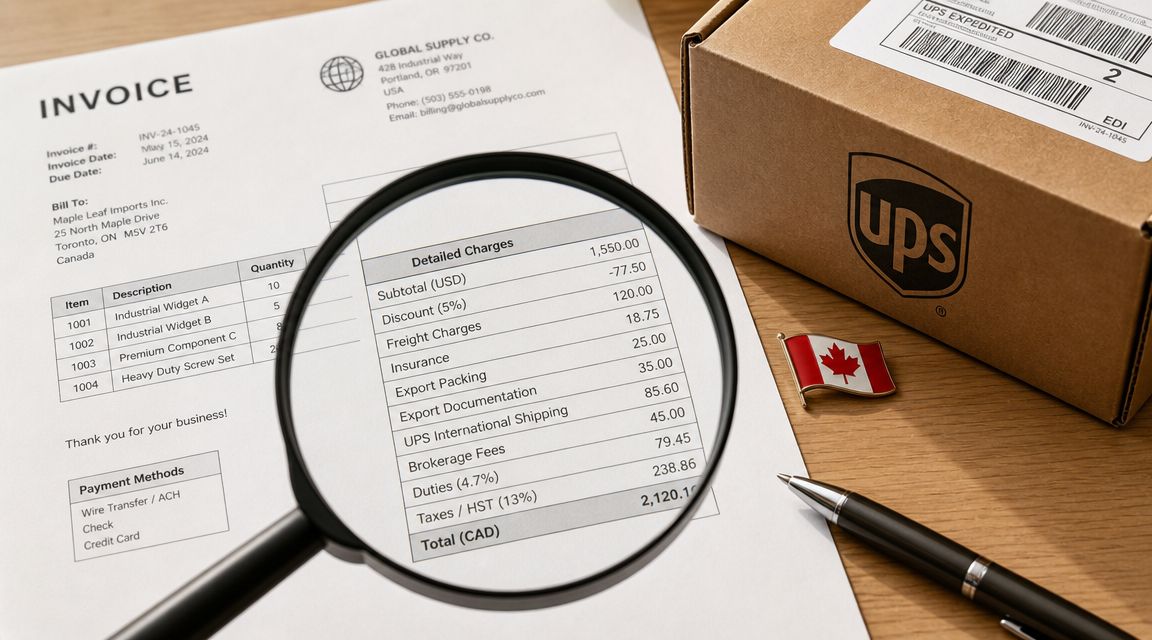
You ordered the goods. You paid the supplier. You paid the freight. Then a UPS Canada customs brokerage invoice lands on your desk like an uninvited relative at dinner.
The total looks wrong. The line items look cryptic. Half the wording sounds like it was written by someone paid by the syllable.
If that sounds familiar, you're not dealing with a rare problem. You're dealing with a very normal courier-brokerage problem. The invoice usually blends government charges with courier service fees, and if you don't know where one ends and the other begins, it's hard to tell what's legitimate, what's avoidable, and what needs to be challenged.
A lot of importers assume the invoice is just “customs”. It isn't. Some charges are tied to border compliance. Some are tied to the carrier's process. Some appear because the shipment data was weak before the goods ever reached Canada. That's why the smartest move isn't just paying faster. It's reading smarter.
That Surprise UPS Invoice You Werent Expecting
A common version goes like this. A small importer brings in product from the U.S. or overseas. The shipment arrives. The goods are released. Everyone assumes the hard part is over.
Then the invoice shows up later.
Now there's frustration, because the importer thought shipping charges covered the whole trip. Instead, the UPS Canada customs brokerage invoice includes duties and taxes, plus service charges for clearance, document handling, and other administrative work. The shipment may already be in your warehouse by the time you see the bill, which makes the whole thing feel less like a choice and more like a trap.
The surprise usually isn't that customs costs money. The surprise is how many different buckets the money can fall into.
That matters because importers often attack the wrong problem. They argue with the duty amount when the actual issue was poor classification data. Or they complain about brokerage in general when the expensive part came from preventable add-on fees.
The better approach is practical. First, separate what belongs to the government from what belongs to the courier. Second, figure out what triggered the courier charges. Third, decide whether this is a one-off clean-up job or a sign you need a different brokerage setup.
Why this keeps happening
Courier brokerage is built for volume. It's designed to move a lot of shipments quickly, not to hold your hand through every line item. That works fine until your paperwork is vague, your goods are regulated, or your shipping terms leave cost responsibility muddy.
When that happens, the invoice becomes the clean-up crew.
The invoice is annoying, but it's also useful
If you read it properly, it tells you where your import process is leaking money. It can reveal bad commercial invoices, weak HS classification practices, inconsistent supplier paperwork, or overreliance on courier brokerage for shipments that should have been handled another way.
Annoying? Yes. Useless? Not at all.
What Am I Even Looking At
A UPS brokerage invoice is basically a restaurant bill with customs paperwork attached. You ordered one thing. The bill arrives with the main item, taxes, service charges, and a few extras you didn't notice when you sat down.
The trick is not to stare at the total first. The total is where panic starts. The detail section is where answers live.
Start with the identity block
At the top, check the shipment basics before you read a single charge:
- Consignee name: Make sure the invoice is billed to your business.
- Tracking or waybill number: Match it to the shipment record in your purchasing or receiving system.
- Shipper details: Confirm the sender is the supplier you expected.
- Reference numbers: Look for your purchase order, vendor reference, or internal shipment number if one was provided.
If any of that is off, stop there. Don't spend twenty minutes decoding fees on a shipment that isn't yours or was billed under the wrong account.
Then find the split between charge types
Most importers make one mistake immediately. They treat the summary box like the whole story. It isn't.
You want to separate the invoice into three practical buckets:
Government charges
These are the amounts tied to import compliance, such as duties and taxes.Brokerage fees
These are charges for UPS handling customs clearance tasks.Additional charges
These can include document-related or transaction-related items that stack onto the invoice.
UPS's Canada rate guide says customs-related charges for imports to Canada can be calculated as either CA$30 or CA$33 per shipment or CA$0.30 or CA$0.33 per pound (about CA$0.67 or CA$0.73 per kilogram), whichever is greater, and notes that rates are in Canadian funds. The same guide also lists customs-brokerage-related bond thresholds of CA$50 per instance or request for bonds under CA$100,000 and CA$100 per instance or request for bonds at or above CA$100,000. That's why the invoice often behaves more like a formula than a flat fee ticket, as shown in the UPS Canada Rate & Service Guide.
Why the detail matters more than the summary
A summary total tells you what hurts. A detailed breakdown tells you why it hurts.
Read the itemised section slowly. Look for language tied to entry preparation, cancellation, bonds, paper handling, or other agency processing. If the shipment involved regulated goods, food, health products, plant material, or anything that triggers other government review, the invoice can get crowded in a hurry.
Practical rule: If you can't explain each line in plain English, you're not ready to approve the invoice.
That isn't being difficult. That's basic cost control.
Decoding the Most Common Brokerage Invoice Charges
A UPS brokerage invoice usually blends three different buckets of money onto one page. Government money. UPS service fees. Charges triggered by paperwork problems or special handling. If you do not separate those buckets, the invoice looks random when it is usually following a logic.
Start with the basic rule. Duty and tax come from the import itself. Brokerage charges come from the work done to clear it. Extra charges show up when the shipment creates more work than a straightforward entry.
Government charges and courier charges follow different rules
Duties and taxes are based on the product, its tariff classification, its country of origin, and the value declared for customs. If one of those inputs is off, the government side of the invoice can be off too.
Brokerage fees are different. They reflect what UPS or its customs affiliate had to do. Prepare the entry. Advance funds. Handle paper billing. Correct a filing. Deal with another government department. That is why two shipments with the same product value can land with very different brokerage totals.
That difference matters for cost control. You may owe the tax either way. You have more room to prevent or reduce the service side.
Common fee lines and what they usually mean
UPS publishes brokerage-related charges for imports cleared by UPS SCS, Inc., including entry base fees and add-on charges such as paper invoice fees, entry cancellation fees, PGA fees, agent fees, and line fees, as shown on the UPS brokerage general rates page. The names may vary by invoice, but the pattern is familiar.
| Fee Name | What It Usually Means | Can You Reduce or Avoid It? |
|---|---|---|
| Entry base fee | The core charge for preparing and submitting the customs entry | Sometimes, if you change your clearance setup |
| Paper invoice fee | A charge for paper-based billing or document handling | Often yes, with electronic billing and cleaner document flow |
| Entry cancellation fee | A fee for stopping or replacing an entry after work has started | Usually yes, with better shipment instructions upfront |
| PGA fee | A charge linked to shipments reviewed by another government agency | Sometimes no, if the goods legitimately trigger review |
| Agent fee | A handling charge tied to agent involvement in the clearance process | Depends on how the shipment is routed and cleared |
| Line fee | A per-line charge when invoice detail creates more entry work | Often reducible with a cleaner commercial invoice |
The trap is assuming every line is fixed and unavoidable. It is not. Some charges are the direct result of how the shipment was set up before it ever reached the border.
What usually drives the invoice up
The ugliest invoices tend to come from the same small set of problems.
- Vague product descriptions. “Parts,” “samples,” and “accessories” force questions nobody wants to answer at 4:30 p.m.
- Messy commercial invoices. Too many lines, mixed goods, missing origin details, or inconsistent values create more processing work.
- Regulated products. Food, health products, plant material, and similar goods often pull in another agency.
- Midstream changes. Revised values, corrected consignee details, or last-minute document fixes can trigger rework.
- Paper-heavy processes. Old habits still cost money.
None of that is theoretical. Courier invoices get expensive when the broker has to clean up weak shipping data under time pressure.
The commercial invoice often explains the brokerage bill
If you want to know why a shipment cost more to clear, start with the supplier paperwork. The commercial invoice is the blueprint for the customs entry. If the blueprint is sloppy, the bill usually reflects it.
That is why importers should review the Canada customs invoice requirements for commercial invoices before goods ship, not after the brokerage charges arrive. Clear descriptions, consistent values, country of origin, and properly structured line items do more than help compliance. They cut out avoidable brokerage work.
I tell clients the same thing all the time. A bad invoice can turn a routine import into a custom project.
The strategic fix is not just disputing charges
Yes, you should question any line you cannot explain. But the bigger win is changing the model that creates these surprises in the first place.
Courier brokerage is built for volume and speed. That can work for simple shipments. It gets expensive fast when your imports need tighter document control, predictable billing, or real advice before the shipment moves. A dedicated customs broker such as J.W. Smith gives importers a different setup. Clear instructions, cleaner entries, and fewer mystery fees showing up after delivery.
That is a core reason to decode these invoices. Not just to understand the pain, but to stop buying it.
Finding and Reading Your UPS Brokerage Invoice
Sometimes the invoice is attached to the shipment paperwork. Sometimes it arrives after delivery. Sometimes it's buried in an online billing portal like it's playing hide-and-seek.
The first job is finding the document attached to the customs transaction, not just the freight invoice.
Where to look first
Try these locations in order:
- Shipping documents with the delivery: Receiving teams often file these without flagging the brokerage portion.
- Your UPS billing account: Account holders may see separate invoice streams for transportation and brokerage.
- Accounts payable inboxes: Brokerage invoices often land there before anyone in logistics sees them.
- Mail from UPS: Yes, paper still appears. Customs billing hasn't fully joined the future.
Once you have it, pull the purchase order, supplier commercial invoice, and receiving record beside it. Reading a brokerage invoice without the source paperwork is like auditing a meal with no menu.
A simple three-step reading method
Use the same routine every time.
Verify the shipment identity
Match consignee, tracking number, shipper, and date to your records.Separate taxes from service fees
Mark government amounts first. Then isolate brokerage-related charges so you can see what UPS charged for its work.Question every non-obvious line
Ask what triggered it, whether it matches the shipment profile, and whether better documents could have prevented it.
If the invoice and the commercial paperwork tell two different stories, customs will pick one. You may not like which one.
A lot of billing disputes trace back to poor invoice content from the seller. If you need a practical checklist for invoice fields before the shipment moves, this guide on the Canada Customs Invoice and what to include is worth keeping handy.
What a good review looks like
A good review isn't emotional. It's methodical.
Circle the line items you understand immediately. Highlight the ones you don't. Then compare each questionable fee against the shipment facts. Was there a cancellation? Did the goods involve another agency? Did the supplier send a proper invoice? Did the shipment have an unusual number of product lines?
That process turns a vague complaint into a useful internal note. It gives you something specific to raise if the charge is wrong.
Fighting Back How to Dispute Incorrect Charges
If a charge looks wrong, don't start with outrage. Start with evidence. Couriers respond better to clean facts than to righteous anger, even when the righteous anger is deserved.
A dispute works best when you can point to one line, one reason, and one document that supports your position.

Good reasons to challenge a charge
Not every charge is wrong just because it's painful. Focus on issues you can support:
- The shipment details don't match the billed transaction.
- The value used appears incorrect compared with the supplier invoice.
- The classification or product description was applied incorrectly based on the actual goods.
- A service fee appears for work that wasn't needed on that shipment.
- A cancellation or administrative charge appears when no such event occurred.
- The paperwork submitted to UPS was complete, but the fee suggests avoidable correction work.
How to build the dispute file
Before you contact UPS, collect the documents that matter most:
- Commercial invoice: The supplier's original customs document.
- Proof of value: Purchase order, payment record, or sales invoice.
- Tracking and shipment record: To tie your claim to the correct movement.
- Correspondence: Any email showing instructions, corrections, or prior approvals.
- Brokerage invoice: The actual bill, marked with the line item you're disputing.
Then write the dispute like a broker would. Short. Specific. Boring, in a good way.
A structure that gets taken seriously
Use a simple format in your email or portal message:
- Identify the invoice and shipment
- Name the exact line item in dispute
- State why it appears incorrect
- Attach supporting documents
- Request a correction or credit review
For example:
We are requesting review of the billed entry cancellation fee on invoice [number] tied to tracking [number]. Our records do not show a cancelled entry event for this shipment. Attached are the commercial invoice, shipment record, and delivery confirmation. Please confirm the basis for the charge or issue a credit if billed in error.
That tone works because it gives the reviewer something to do.
Escalation without drama
If frontline support stalls, escalate neatly. Ask for a supervisor review. Keep the same paper trail. Don't rewrite the story from scratch every time. Add dates, names, and previous responses.
Keep this sentence handy: “Please note this as a formal billing dispute and confirm the next review step.”
Persistence matters. Sloppiness hurts. If your own paperwork is inconsistent, the courier will usually lean on that inconsistency rather than your argument.
How to Avoid Surprise Brokerage Fees in the Future
The pattern usually looks the same. A shipment clears, the package shows up, and then a brokerage invoice lands in accounts payable with charges nobody approved, nobody budgeted for, and nobody can explain without opening three emails and a customs file.
That surprise started earlier. It started when the supplier used a vague product description, when no one named the customs broker before pickup, or when the courier got treated as the default broker because it felt convenient at the time. Convenience is expensive when customs decisions are being made on the fly.

Fix the document problem first
Start with the commercial invoice. If the description is sloppy, the classification is more likely to drift, and every downstream cost gets harder to control. “Parts” is not a description. Neither is “samples” or “accessories.” Customs wants to know what the goods are, what they do, what they're made of when that matters, and where they were made.
That is why brokerage fees feel random to importers. They are often the price of missing detail.
Use product descriptions your broker can clear without guessing. Build a simple review step before shipping. If your team needs better classification discipline to avoid costly customs delays, set up an HS code reference process before goods are in transit, not after the courier has already filed something expensive.
Stop defaulting to courier brokerage
Courier brokerage is built for speed and volume. Your cost control is not the courier's first design priority.
If you import more than occasionally, appoint your own broker before the shipment moves. That changes who reviews documents, who owns classification consistency, and who gets called when something looks wrong at the border. It also gives you one customs process across carriers instead of a different surprise depending on who delivered the box.
Importers who want to tighten that process can start with this guide on how to save on UPS brokerage fees.
Build a prevention checklist people will use
Keep it short enough that shipping, purchasing, and accounts payable will follow it:
- Before shipping: Confirm the importer of record and the customs broker.
- Before pickup: Check product descriptions, values, origin, and invoice terms.
- Before arrival: Confirm HS codes are pre-approved for repeat products.
- After first release on a new lane: Review the invoice for patterns, not just obvious errors.
- For repeat imports: Store product data centrally so each shipment is not rebuilt from memory.
A checklist is not glamorous. Neither is paying avoidable brokerage.
The strategic shift that works
The long-term fix is control. Control over who brokers the shipment, how products are classified, what paperwork goes to customs, and how fees are quoted before freight is moving.
That is why importers move away from default courier brokerage and toward a dedicated, compliant partner such as J.W. Smith. The goal is not just a lower invoice. The goal is a customs process that behaves predictably. When that happens, the invoice stops being a monthly mystery and starts reflecting decisions you made on purpose.
Partnering with a Dedicated Broker for Predictable Costs
At a certain point, reading courier invoices more carefully isn't enough. If the model itself keeps producing surprise charges, the practical fix is to change the model.
A dedicated customs broker works differently from courier brokerage. The broker's job is customs compliance first, not parcel movement first. That sounds like a small distinction, but it changes everything from classification discipline to document review to how costs are quoted and controlled.

What importers usually gain
A dedicated broker can give you:
- Consistent customs handling across carriers and shipment types
- Upfront visibility into brokerage structure instead of after-the-fact surprises
- Better document control before goods arrive at the border
- A repeatable process for HS classification, CARM support, and release planning
For businesses comparing options, a firm such as J.W. Smith Customs Brokers Ltd. handles Canadian customs clearance, CARM and bond support, and shipment coordination across carriers, which is the kind of setup importers often look for when they want one brokerage process instead of several courier versions of the same headache. If you're weighing what to look for in a long-term brokerage relationship, this guide on how to choose the right customs broker for your business is a useful starting point.
The point isn't to make invoices prettier. It's to make them predictable.
If you're tired of decoding every UPS Canada customs brokerage invoice after the fact, J.W. Smith Customs Brokers Ltd. can help you build a cleaner import process before the charges pile up. A dedicated brokerage setup gives you clearer documentation, steadier customs handling across carriers, and fewer unpleasant billing surprises.
Need Help with Customs?
J.W. Smith Customs Brokers has over 50 years of experience helping Canadian businesses navigate imports with confidence. Our team of licensed customs brokers is ready to assist with your import and export needs.