A customs bond is a financial guarantee you provide to the Canada Border Services Agency (CBSA). Think of it as a contract that assures the CBSA that all duties, taxes, and other fees related to your imported goods will be paid in full and on time.
This financial security is not just a regulatory formality; it's a critical tool for importers. It allows your shipments to be released by customs before you've paid the final duties and taxes, which is essential for maintaining a fluid supply chain.
Your Key to Unlocking Smoother Imports
At its core, a customs bond is a three-party agreement that demonstrates your commitment to complying with all CBSA import regulations. Without this financial backing, your goods would be held at the border until every dollar of duty and tax is calculated and paid. This would cause significant delays and disrupt your entire supply chain.
The bond is what gives you access to the Release Prior to Payment (RPP) program, a vital privilege for Canadian importers. The RPP program allows you to take possession of your commercial goods as soon as they arrive in Canada, deferring the payment of duties and taxes to a consolidated monthly bill.
How Does This Benefit Your Business?
Securing a customs bond provides several actionable advantages that are essential for any competitive importer. These benefits directly impact your cash flow, operational efficiency, and overall compliance with CBSA regulations.
- Improved Cash Flow: You don't have to pay duties and taxes upfront for every shipment. This frees up working capital that can be reinvested into other critical areas of your business.
- Faster Clearance Times: Your goods are released from customs control almost immediately upon arrival. This helps you avoid costly delays, demurrage and storage fees, and disruptions to your production schedules or inventory levels.
- Simplified Logistics: It streamlines the entire import process, creating a predictable and efficient flow of goods across the border.
A customs bond isn’t just regulatory paperwork; it's a strategic tool for effective supply chain management. It transforms the import process from a slow, transactional system into a streamlined, trust-based relationship with the CBSA.
By posting a bond, you demonstrate financial responsibility. In return, the CBSA grants you the flexibility necessary to operate a modern, fast-paced import business in Canada.
To make this clear, here’s a breakdown of what a customs bond involves.
Customs Bond at a Glance
This table simplifies the key parties and the function of a customs bond in Canada.
| Component | Description | Why It Matters for Importers |
|---|---|---|
| Principal | This is you, the importer. | You are the party legally responsible for fulfilling all customs obligations, including payment of duties and taxes. |
| Surety | An insurance or surety company that issues the bond. | The surety financially guarantees payment to the CBSA if you, the principal, fail to meet your obligations. |
| Obligee | The Canada Border Services Agency (CBSA). | The CBSA requires the bond to protect government revenue and ensure compliance with trade regulations. |
| Bond Amount | The specific dollar value of the financial guarantee. | This amount must be sufficient to cover your potential duties and taxes, as per CBSA calculations. |
| Purpose | To secure Release Prior to Payment (RPP) privileges. | It allows you to take possession of your goods immediately upon arrival while deferring payment, directly improving cash flow and operational speed. |
These components work together to create a system of trust that keeps Canadian commerce moving efficiently.
Why the CBSA Requires Financial Security
The Canada Border Services Agency (CBSA) requires financial security for a straightforward reason: to protect government revenue. With billions of dollars in goods crossing the border annually, the CBSA needs a reliable guarantee that all owed duties and taxes will be collected. A customs bond provides this assurance.
The bond is a formal, legally binding promise, backed by a surety company, that you will meet your financial obligations to the Government of Canada. Without this security, the risk of non-payment would create a significant gap in funds designated for public services. It is a fundamental risk management tool for the agency.
Unlocking the Release Prior to Payment Program
The most critical, direct benefit of posting financial security is gaining access to the Release Prior to Payment (RPP) program. For any commercial importer, RPP is not a mere convenience—it is essential for maintaining a competitive and efficient supply chain.
The program allows you to take possession of your goods as soon as they arrive in Canada, well before the duties and taxes are due. Instead of paying for each shipment individually at the border, you can clear your goods quickly and settle all payments through a single, consolidated monthly statement. This provides a major advantage for both your operational speed and cash flow management.
A customs bond sends a clear message to the CBSA: "I am a financially responsible importer. You can release my shipment now, and I guarantee payment." It is the key that unlocks a faster, more predictable cross-border operation.
To understand the scale, in a recent fiscal year, the CBSA managed commercial goods valued at over $879 billion. To handle this volume and the associated financial risk, mandatory security is non-negotiable. It ensures these revenues are protected, helping the agency keep revenue non-compliance below its 5% target. You can review these figures in the CBSA's 2024-25 Departmental Plan.
CARM Makes It a Non-Negotiable Requirement
The implementation of the CBSA Assessment and Revenue Management (CARM) system has solidified the bond requirement. Under CARM, importers wanting to maintain RPP privileges must post their own financial security directly.
This change places the responsibility squarely on you, the importer. To ensure your goods clear the border without costly delays, you must secure your own bond and manage it through the CARM Client Portal. In this modernized customs environment, a bond is not optional for RPP eligibility; it is a mandatory requirement for any business that depends on an uninterrupted flow of imported goods.
Choosing the Right Bond for Your Business
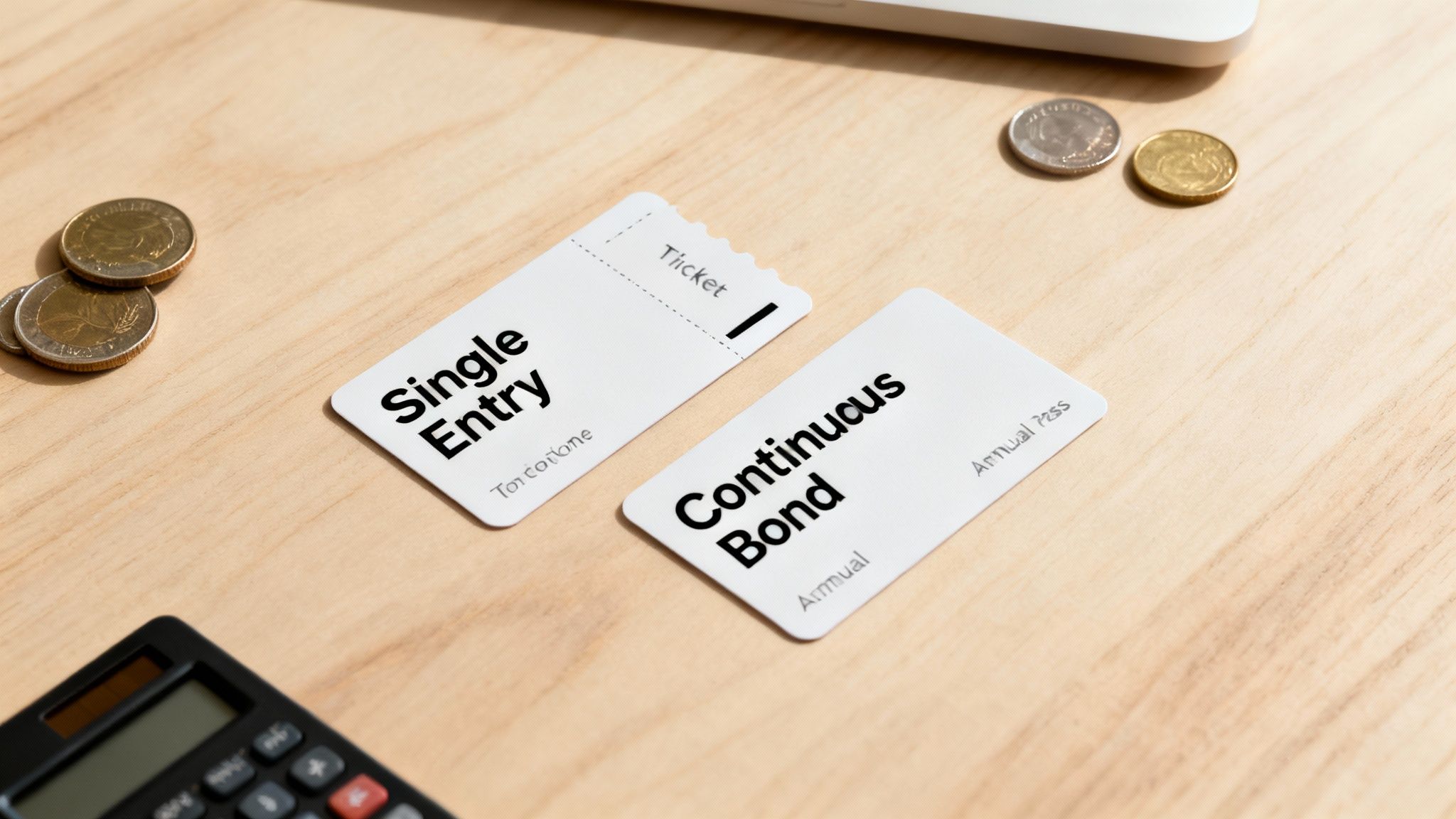
Selecting the correct type of customs bond is a strategic decision that directly impacts your company's efficiency and budget. Your choice should align with your import frequency and business model. In Canada, importers have two primary options, each designed for a different operational need.
Single Entry Bonds: The Pay-Per-Shipment Option
A Single Entry Bond, also known as a transactional bond, is designed to cover one specific import shipment. Once that shipment clears customs and all associated duties and taxes are paid, the bond's purpose is fulfilled.
This option is suitable for businesses that import infrequently (e.g., a few times per year) or are bringing in a single, high-value shipment. A Single Entry Bond provides the necessary financial security without requiring a long-term commitment. However, for regular importers, the costs and administrative effort can accumulate quickly, as a new bond is required for every shipment.
Continuous Customs Bonds: The Annual Pass for Importers
For any business with a regular flow of imports, the Continuous Customs Bond is the industry standard. This bond provides blanket coverage for all your shipments for a full 12-month period, regardless of volume or port of entry in Canada.
While the upfront premium is higher than that of a single bond, it offers significant cost savings and administrative convenience for frequent importers. A general guideline is that if you import more than five times a year, a continuous bond is the more economical and efficient choice. For a detailed look at this type of security, you can learn more about the specifics of the D120 import bond and its role in securing ongoing RPP privileges.
Opting for a Continuous Customs Bond is an investment in operational predictability. It eliminates the need to arrange security for each shipment, streamlines your customs process, and helps maintain an uninterrupted supply chain.
This approach not only reduces per-shipment costs but also simplifies your entire logistics operation, allowing you to focus on growing your business rather than managing repetitive customs paperwork.
Making the Right Financial Decision
The choice between a single entry and a continuous bond comes down to analyzing your import frequency and projected duty/tax liabilities for the year. By calculating your break-even point, you can make an informed decision that benefits your bottom line.
Single Entry vs. Continuous Customs Bond
| Feature | Single Entry Bond | Continuous Customs Bond |
|---|---|---|
| Best For | Infrequent importers (fewer than 5 shipments/year) or one-time, high-value shipments. | Regular importers with multiple shipments throughout the year. |
| Coverage | Covers a single import transaction. A new bond is needed for each subsequent shipment. | Covers all import shipments for a 12-month period, nationwide. |
| Cost Structure | Pay-per-shipment fee. Becomes costly and inefficient for frequent importers. | A single, annual premium that provides better value for higher import volumes. |
| Convenience | Less convenient, requiring new paperwork and payment for every shipment. | Highly convenient. Set it up once a year for uninterrupted customs clearance. |
Review your import forecast for the upcoming year. If you anticipate consistent or growing import volumes, the continuous bond is the most practical and forward-thinking choice.
How to Calculate Your Required Bond Amount
Determining the correct bond amount is a critical step for CBSA compliance. The CBSA uses a clear formula to ensure your financial security is adequate to cover your potential duty and tax liabilities.
The CBSA's methodology is based on risk assessment. Your bond amount must be linked to your highest anticipated monthly duties and taxes over a 12-month period. To do this, you need to analyze your past import data or create a reliable forecast. Identify the single month with the highest total payments for duties, Goods and Services Tax (GST), and any other applicable taxes. This figure is the starting point for your calculation.
The CBSA Calculation Explained
The formula set by the CBSA is straightforward. Your bond must be equal to at least 50% of your highest monthly total of duties and taxes.
The CBSA has also established minimum and maximum thresholds to standardize the requirement across businesses of all sizes.
- Minimum Bond Amount: The minimum required bond is $25,000.
- Maximum Bond Amount: For most importers, the bond amount is capped at $10 million.
This structure ensures that even smaller importers provide sufficient security, while large-scale importers have a predictable ceiling on their financial guarantee.
The objective of this calculation is to establish a reasonable security deposit. The CBSA requires assurance that if you were to default on payments during your busiest import month, your bond would cover at least half of that liability.
A Practical Example of the Calculation
Let's apply this formula to a real-world scenario. Imagine your company imports consumer electronics.
- Identify Peak Month: After reviewing your payment history, you determine that November was your peak month, with a total of $90,000 paid in duties and GST.
- Apply the Formula: You then calculate 50% of that peak amount: $90,000 x 0.50 = $45,000.
- Check the Minimum: Since $45,000 is greater than the $25,000 minimum, your required bond amount is $45,000.
Your business must secure a customs bond for at least $45,000 to be compliant and maintain its Release Prior to Payment (RPP) privileges. Accurately projecting this amount is the most important step in securing the correct financial security.
Securing and Managing Your Bond in the CARM Portal
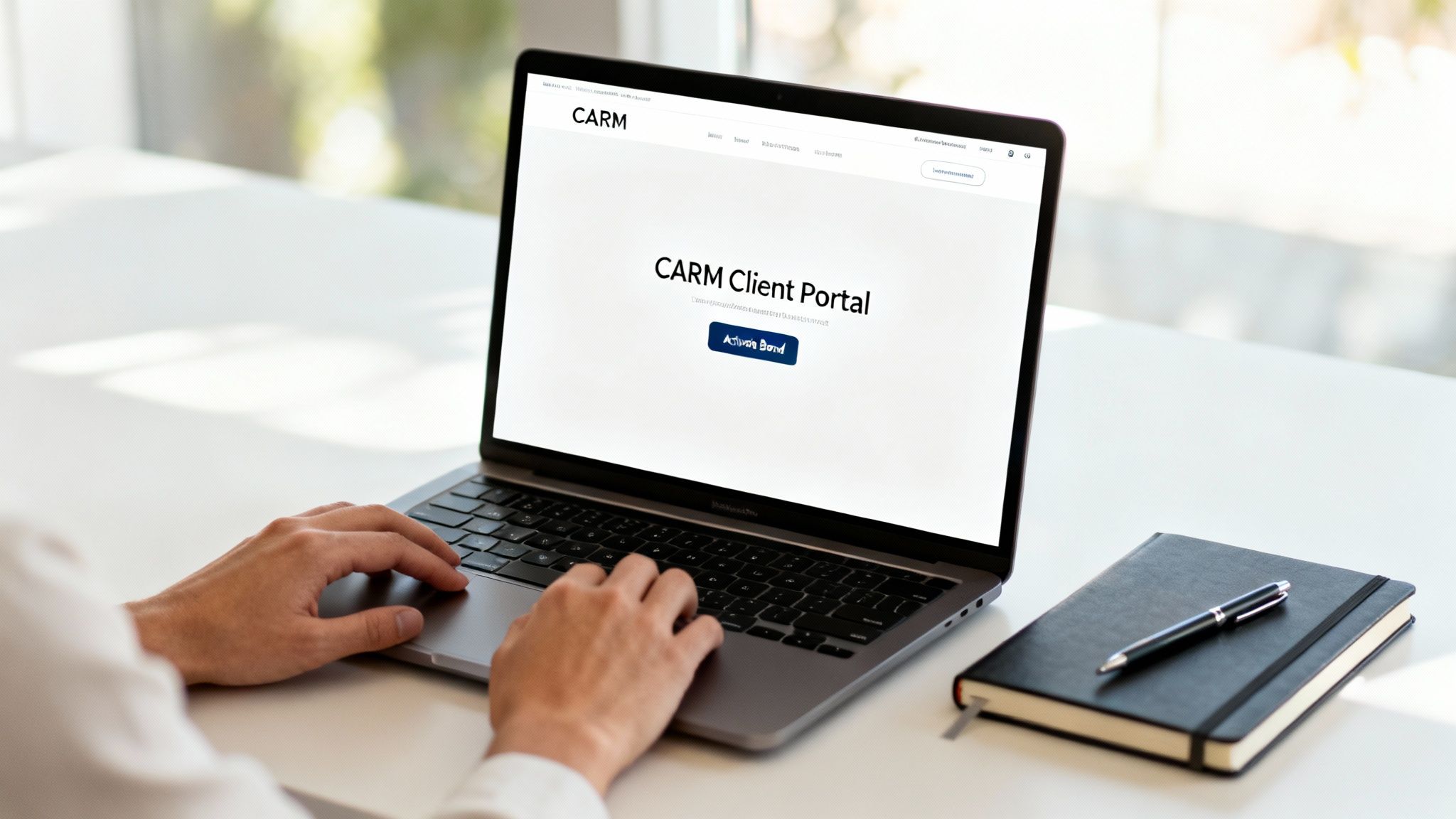
The CBSA Assessment and Revenue Management (CARM) system has fundamentally changed how importers manage their financial security. Previously, many importers could use their customs broker’s bond to clear shipments. CARM mandates that importers secure their own bond to maintain Release Prior to Payment (RPP) privileges.
This shift puts the responsibility for obtaining and managing financial security directly on you, the importer. To avoid costly border delays, you must get your own customs bond and post it within the CARM Client Portal. While this requires more direct involvement, it also gives you greater control and visibility over your customs activities.
Steps to Secure and Activate Your Bond
The process is straightforward and involves coordinating with your customs broker and a surety company.
Engage an Experienced Customs Broker: Your broker is your most valuable partner in this process. They have established relationships with licensed surety companies and can help you secure a bond at a competitive premium rate.
Obtain a Bond from a Surety Company: Your broker will assist you with the application. The surety company will assess your business's financial standing and import history. Upon approval, they will issue the customs bond for the required amount.
Activate the Bond in CARM: Once the bond is issued, the surety company transmits the details electronically to the CBSA. Your final step is to log in to your CARM Client Portal, navigate to the financial security section, review the bond details, and provide your digital acceptance. This activates the bond.
Under CARM, managing your bond is an active responsibility, not a task you can delegate entirely. Ensuring your bond is correctly posted and remains valid is a core compliance function for every Canadian importer.
The Broker’s Role in a CARM World
Although you are now responsible for your own bond, partnering with a knowledgeable customs broker is more important than ever. Their expertise extends beyond simply connecting you with a surety; they ensure the entire process is managed correctly and efficiently. For help getting started, see our guide to register your business for CARM.
To improve efficiency, using tools like document workflow automation software can help you manage your bond and other compliance documents in the CARM Portal with greater accuracy. Your broker assists by:
- Ensuring Correct Configuration: They verify that your bond amount is calculated correctly and meets all CBSA requirements, preventing potential compliance issues.
- Troubleshooting Issues: If you encounter problems during the activation process in the portal, your broker has the expertise to resolve them quickly.
- Proactive Management: A good broker monitors your import activity and will advise you if your bond amount needs to be increased, helping you stay ahead of compliance requirements and avoid shipment disruptions.
This partnership ensures your financial security is managed effectively, keeping your supply chain moving without interruption.
Common Mistakes That Can Disrupt Your Supply Chain
Even a small error related to your customs bond can cause significant supply chain disruptions, leading to costly delays and operational headaches. Proactive management is key to building a resilient import strategy that keeps your goods flowing smoothly across the border.
A common and costly mistake is underestimating the required bond amount. As your business grows, your import volumes and corresponding duty/tax liabilities will increase. If your bond amount falls below the mandatory 50% of your peak monthly liability, the CBSA can suspend your RPP privileges, effectively halting your shipments until you increase your security.
Letting Your Bond Expire
Another frequent error is allowing a continuous customs bond to expire. This is not a minor administrative oversight; an expired bond results in the immediate revocation of your Release Prior to Payment privileges.
An expired bond is like an expired passport for your business—your goods are stopped at the border. They cannot be released until you either post new security or pay all duties and taxes upfront for every shipment.
This can bring your operations to a halt, causing you to miss delivery deadlines and damage customer relationships. The importance of maintaining this privilege is clear when you review how Release Prior to Payment bonds work and why they matter.
To avoid these preventable disruptions, adopt a proactive approach:
- Schedule Regular Reviews: Review your import volumes and duty/tax payments on a quarterly basis. This will help you determine if your bond amount remains sufficient for your current business activity.
- Set Calendar Reminders: Mark your bond renewal date in your calendar. Set multiple reminders starting at least 90 days before expiry to ensure you have ample time to complete the renewal process.
- Communicate with Your Broker: Inform your customs broker of any significant business changes, such as new product launches or anticipated seasonal surges in volume. They can advise you if a bond adjustment is necessary before it becomes a critical issue.
Your Customs Bond Questions Answered
For those new to importing, customs bonds can seem complex. Getting clear, actionable answers to your questions is essential for planning your logistics and avoiding costly surprises at the border. Here are some of the most common queries from importers.
Can I Import into Canada Without a Customs Bond?
Yes, but it is not a viable option for any commercial importer. Without a bond, you lose your Release Prior to Payment (RPP) privileges. This means for every shipment, you must pay all duties and taxes in full—via cash or certified cheque—at the border before your goods can be released.
This pay-as-you-go model creates severe cash flow constraints and introduces unpredictable delays, making it impractical for any business that relies on a smooth and efficient supply chain.
How Long Does It Take to Get a Customs Bond?
Typically, the process takes approximately three to five business days. The surety company needs time to conduct its due diligence, which includes reviewing your business's financial health and import history before issuing the bond.
To avoid delays, begin the application process well in advance of your first shipment's arrival. Working with an experienced customs broker can often expedite this process, as they have established relationships with surety providers.
Proactive planning is crucial. Attempting to secure a bond while your goods are already in transit is a recipe for expensive storage fees and logistical disruptions.
What Happens If My Shipment Arrives Before the Bond Is Active?
This is a scenario to avoid at all costs. If your goods arrive at the border and your bond is not yet active in the CARM portal, the CBSA will hold your shipment. It will not be released until the bond is finalized and accepted in the portal or until you pay all duties and taxes upfront.
During this time, your shipment will incur storage and demurrage fees, which can accumulate rapidly and add significant, unplanned costs to your import.
How Does a Customs Broker Help with My Bond?
A customs broker acts as your expert guide and partner throughout the entire bonding process. Their role is to:
- Calculate the correct bond amount based on your import activity.
- Navigate the application process with surety companies to secure competitive terms.
- Ensure the bond is correctly registered and activated in the CARM portal.
- Provide ongoing management and advice to ensure you remain compliant.
Their expertise is invaluable for navigating CBSA requirements, avoiding penalties, and, most importantly, ensuring your goods move across the border without interruption.
Navigating customs bonds and CARM compliance is a critical piece of a healthy supply chain. The expert team at J.W. Smith Customs Brokers Ltd. provides the guidance and support you need to secure the right bond, manage your customs obligations, and keep your shipments on schedule. Learn how we can simplify your cross-border trade today.
Need Help with Customs?
J.W. Smith Customs Brokers has over 50 years of experience helping Canadian businesses navigate imports with confidence. Our team of licensed customs brokers is ready to assist with your import and export needs.