If you're bringing goods into Canada, you've probably heard the acronym CBSA. But what exactly is the Canada Border Services Agency? In short, they're the country's gatekeepers, managing who and what comes in and out. For an importer, they're the agency that can either wave your shipment through smoothly or stop it dead in its tracks.
Your Guide To The Canada Border Services Agency
Whether you’re running a small Shopify store or a large supply chain, understanding the CBSA isn't just a good idea—it's critical. Getting to know their role is the first step toward a more predictable and stress-free import process. Think of the CBSA as the diligent concierge for the entire country. Their job is massive, covering everything from national security to ensuring a level playing field for Canadian businesses.
The Mission Behind The Uniform
The CBSA's mandate is broad, but for an importer, it all comes down to a few key functions. They are tasked with protecting Canadians while making sure legitimate trade can flow. It’s a constant balancing act between strict enforcement and practical facilitation.
Formed in 2003, the agency pulled together several border-related departments into one unit. This combined customs services, immigration enforcement, and port-of-entry inspections, creating the single, powerful agency importers deal with today. You can dig deeper into their history on the official Government of Canada website.
The core purpose of the CBSA is to provide integrated border services that support national security and public safety priorities while facilitating the free flow of admissible people and goods.
Here's a quick look at what that means for your business.
The CBSA's Core Responsibilities At A Glance
This table breaks down the main jobs of the CBSA into what they mean for your business.
| Responsibility Area | What It Means For You (The Importer) |
|---|---|
| Border Enforcement | Officers inspect shipments to screen for prohibited or unsafe goods. Think firearms, illegal drugs, and products that don't meet Canadian safety standards. |
| Customs & Revenue Collection | They collect all applicable duties and taxes (GST/HST) on your goods. This is a critical part of your landed cost calculations. |
| Immigration Screening | While less direct for cargo, this function impacts the movement of people, including commercial drivers crossing the border. |
| Trade Program Administration | The CBSA manages trade agreements and programs that can reduce or even eliminate duties on your goods if you qualify. |
Every decision the CBSA makes can impact your bottom line. A simple paperwork mistake could trigger costly delays, unexpected inspections, or steep financial penalties. On the flip side, a solid grasp of their processes lets you prepare shipments correctly, minimizing risks and keeping your goods moving.
The Three Hats Importers Need To Know
To really get what the CBSA is all about, stop thinking of them as one single entity. Instead, picture them as an agency that wears three very different hats. Knowing which hat they have on helps demystify their actions and lets you anticipate what’s coming next. It's like learning their playbook—when you can recognize their priorities, you're already a step ahead.
Hat One: The Security Enforcer
First and foremost, the CBSA is Canada’s security guard at the gate. With this hat on, their top priority is protecting the country from harm. This means screening for illegal drugs, weapons, counterfeit goods, and even products that don't meet Canadian safety standards. This is why your shipment might get flagged for a random inspection. It’s never personal; it’s a critical part of their mandate. Accurate and hyper-detailed product descriptions on your commercial invoice are your best friends here—vague information is a classic red flag.
Hat Two: The Tax Collector
The second hat is that of the meticulous tax collector. In this role, the CBSA is focused on one thing: assessing and collecting the correct amount of duties and taxes on every commercial shipment. They are responsible for keeping a level playing field for domestic businesses by enforcing Canada's tariff and tax laws. This is where the accuracy of your customs paperwork becomes absolutely critical. The CBSA relies entirely on your declared value and Harmonized System (HS) codes to calculate what you owe. A simple mistake can trigger penalties or future audits. And make no mistake, this is a massive undertaking.
In a recent Year in Review, the agency reported an astonishing 30.7 million releases of commercial goods, alongside processing 149 million courier shipments. You can explore more data on these massive trade volumes in the full CBSA report.
Hat Three: The Trade Facilitator
Finally, the CBSA puts on its most business-friendly hat: the trade facilitator. While it can sometimes feel like their main job is to create hurdles, a huge part of their mission is actually to keep legitimate trade moving as quickly as possible. This involves managing programs designed to speed up clearance for trusted, compliant businesses. These programs help pre-vetted importers get their goods across the border faster, cutting down wait times and making supply chains more predictable. Understanding these three distinct roles—Enforcer, Collector, and Facilitator—is key. When you prepare shipments to satisfy all three functions, you set yourself up for smoother customs clearance every time.
How The CBSA Interacts With Your Shipments
This is where the rubber meets the road. The process isn't random; it's a structured sequence of digital handshakes between your carrier, your customs broker, and the CBSA. It all starts well before your truck pulls up to the booth. Your carrier electronically transmits a manifest of everything on board, giving the CBSA an advance look. Shortly after, your customs broker submits the formal customs declaration with all the details of your import. This is the moment of truth where your paperwork is put to the test.
Green Light, Yellow Light, Red Light
Think of the customs clearance process like a traffic light. The CBSA decides which light your shipment gets based on the data they receive. Your goal is always a green light.
- Green Light: Released. The best-case scenario. The CBSA’s automated systems reviewed your declaration, and everything checks out. Your shipment is authorized to enter Canada, often within minutes of arrival.
- Yellow Light: Held for Review. A customs hold. Something in your paperwork—maybe a vague product description—has triggered a closer look. A CBSA officer will now manually review your documents.
- Red Light: Held for Inspection. The most significant delay. Your shipment has been flagged for a physical examination. Your goods will be moved to a secure area, which can take anywhere from a few hours to several days.
What a CBSA Release Really Means
When your customs broker tells you your shipment is "released," it means the CBSA has given it the green light from a customs perspective. They are satisfied that the goods have been properly reported. However, this doesn't automatically mean all duties and taxes are settled. The release is provisional. The final accounting and payment of duties often happen afterward on a monthly schedule. This distinction is crucial for cash flow planning, especially with the rollout of the CARM system.
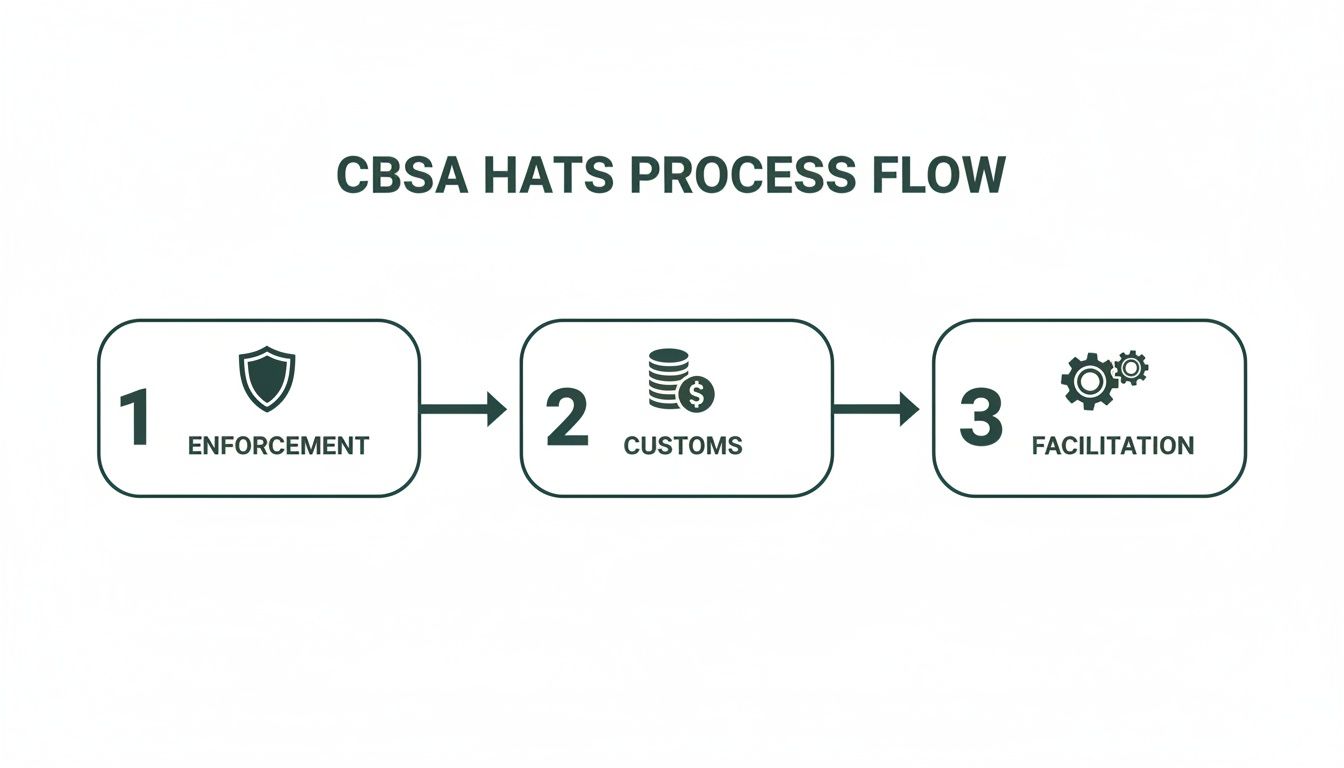
This flow illustrates the constant balancing act the CBSA performs. Your job is to provide the clear, accurate information they need to breeze through each step. Inaccurate data is what creates friction and turns a potential green light into a costly red one. To get a better handle on the specific documents involved, you can check out our guide on essential customs forms for Canada at https://jwsmith.com/blog/customs-forms-for-canada.
AMPS Penalties: The High Cost of Small Mistakes
Getting on the wrong side of the CBSA can do more than just mess with your schedule—it can hit your wallet, hard. This is where the Administrative Monetary Penalty System (AMPS) comes in. Think of AMPS as a traffic ticket system for import errors. Its goal is to encourage compliance, not just to collect fines. AMPS covers a huge range of violations, from tiny clerical mistakes to more serious infractions. The whole system is designed to correct behaviour and make sure every importer is playing by the same rules.
Common Mistakes That Trigger Fines
The financial penalties can escalate quickly, turning a minor oversight into a significant expense. For example, failing to report your goods correctly, undervaluing a shipment to pay less duty, or using the wrong HS code are all common triggers. A single incorrect digit in a tariff classification is enough to lead to a fine.
A crucial part of what the CBSA is tasked to do involves revenue collection. An AMPS penalty serves as a powerful reminder that every single detail on your customs declaration matters for maintaining a fair trade environment.
These penalties are also tiered. A first-time mistake might result in a smaller fine, but repeat violations will lead to much steeper penalties. The CBSA tracks these infractions, so a pattern of non-compliance will quickly put your business under a microscope.
Why Prevention Is Your Best Strategy
The vast majority of AMPS penalties are entirely avoidable. They almost always happen because of a lack of due diligence or a misunderstanding of import regulations. This is where a proactive approach and a trusted partner become invaluable.
Here are a few examples of seemingly small errors that come with costly consequences:
- Incorrect Valuation: Declaring goods at their purchase price instead of the price to the ultimate purchaser in Canada.
- Vague Descriptions: Using generic terms like "parts" or "samples" instead of providing the detailed descriptions the CBSA requires.
- Failure to Obtain Permits: Importing goods that need a permit from another government department (like Health Canada) without securing it first.
These errors don't just add unnecessary costs; they disrupt your entire supply chain. The CBSA collected $47.5 billion in total revenue from duties and taxes, which shows the massive financial scale they manage and why accuracy is non-negotiable. You can learn more about their revenue collection activities from the CBSA's Year in Review.
Working with an experienced customs broker is the most effective way to stay off the AMPS radar. A good broker doesn't just file paperwork; they act as your compliance shield, catching potential errors before they become expensive problems. For more insights, you can review these six common mistakes to avoid in customs clearance at https://jwsmith.com/blog/6-common-mistakes-to-avoid-in-customs-clearance.
CARM: Your New Digital Handshake With Customs
The way importers interact with the CBSA is undergoing its biggest shake-up in decades. It's called the CBSA Assessment and Revenue Management (CARM) initiative. Don't let the long government name throw you off; just think of CARM as your company’s direct digital account with the CBSA.

This system moves away from the old paper-based, broker-led process to a more direct, online relationship with customs. While it’s a big adjustment, the goal is to give you more transparency and control over your import activities. It's like switching from mailing cheques to using online banking—a little setup upfront for a lot more visibility down the road.
The Two Pillars of CARM
At its heart, CARM has two main parts every importer needs to get their head around. Nailing these is essential for keeping your shipments moving.
- The CARM Client Portal (CCP): This is your new online dashboard for everything customs-related. It's a secure portal where you can see your import history, handle payments directly with the CBSA, and get a clear view of what your customs broker is doing on your behalf.
- Financial Security Requirement: This is the big one. Previously, your customs broker could use their security bond to clear your goods. Under CARM, importers now need to post their own financial security—usually a surety bond—to cover any duties and taxes.
Simply put, CARM makes you the captain of your own ship. You are now directly responsible for your account with the CBSA. That means registering on the portal and securing your own bond to participate in the Release Prior to Payment (RPP) program.
The RPP program is what lets your goods get released from customs before duties and taxes are paid, which is critical for a smooth supply chain. If you don't have your own bond in place, your shipments could sit at the border until every last cent is paid.
Your Action Plan for CARM Compliance
While this might sound like a lot of new responsibility, getting set up is actually a straightforward process. The trick is to act sooner rather than later. Your first move is to register your business on the CARM Client Portal. Once you’re in, you must delegate authority to your customs broker, which allows them to keep managing your declarations. This digital handshake ensures they can still handle the day-to-day customs work while you maintain ultimate oversight. You can discover more insights about the CBSA's trade programs and their impact on their official site.
Navigating this change is easier with an expert guide. For a detailed walkthrough, you can learn more about setting up your CARM account and bond in our article at https://jwsmith.com/carm.
Your Compliance Playbook For Stress-Free Importing
Knowing what the CBSA is and what they do is one thing; staying on their good side is another. The best way to think about compliance isn't as a burden, but as your secret weapon for a fast, predictable supply chain. It’s about building good habits that make your shipments easy to process. The core of this plan is simple: make your shipments easy for the CBSA to say "yes" to.
Building Bulletproof Habits
Strong compliance begins long before your goods get close to the border. A critical first step, before you even think about shipping, is understanding what a Business Number is. This unique identifier is essential for all your federal government interactions, especially with the CBSA.
Once you have that sorted, focus on these three critical habits:
- Maintain Accurate Records: The law is clear. You must keep all customs-related documents for six years following the import date. This includes everything from commercial invoices and packing slips to proof of origin certificates.
- Conduct Regular Self-Audits: Don't wait for the CBSA to find a mistake. Get in the habit of periodically reviewing your HS code classifications and declared values. Regulations change, and what was compliant last year might not be today.
- Perfect Your Paperwork: Make sure every commercial invoice contains all required data fields. We're talking clear product descriptions (no generic terms!), correct values, currency, country of origin, and complete importer details. Every missing piece is a potential delay.
Pro Tip: If you find a past error during a self-audit, don’t panic. The CBSA has a Voluntary Disclosures Program that allows you to correct mistakes without facing harsh penalties. In many cases, you'll just need to pay the duties and taxes you originally owed.
By adopting these practices, you transform compliance from a reactive scramble into a proactive strategy. You build a resilient import process that saves you time, money, and stress every single time your goods cross the border.
Frequently Asked Questions
Even with a solid game plan, importers often have specific questions about dealing with the CBSA. We get it. Here are clear, straightforward answers to some of the most common queries we hear.
What Is The Difference Between CBSA And Canada Customs?
This is a common point of confusion, but the answer is simple: The CBSA is Canada Customs. In 2003, the government merged the old Canada Customs and Revenue Agency with border enforcement and immigration screening. This created the single agency we know today as the CBSA. So, if you hear someone use the term "Canada Customs," they're just using an older name for the CBSA's customs-related work.
Can I Talk To The CBSA Directly About My Shipment?
While you technically can contact the CBSA, it’s almost never the most efficient way to solve a problem with a specific shipment. The CBSA manages millions of transactions daily and isn't set up to provide direct support to individual importers for routine releases. Your best and most effective point of contact will always be your customs broker. We have the direct lines of communication and system access needed to trace shipments and resolve issues far more quickly than an importer can on their own.
Why Did My Shipment Get Inspected If My Paperwork Was Perfect?
This can be frustrating, but it's a normal part of the process. Even with flawless documentation, your goods can still be flagged for a random inspection. Think of it as part of the CBSA’s compliance verification strategy. They pull a certain percentage of shipments for examination just to ensure the integrity of the entire system. While it might cause a delay, it doesn't mean you’ve done anything wrong. Your best defense is to maintain a history of consistent, accurate declarations, which builds a strong compliance record and reduces your chances of being targeted for inspection over time.
Navigating the complexities of the CBSA is what we do best. At J.W. Smith Customs Brokers Ltd., we combine over 50 years of experience with modern efficiency to keep your supply chain moving. Let us handle the border so you can focus on your business. Learn more and get a quote on our website.
Need Help with Customs?
J.W. Smith Customs Brokers has over 50 years of experience helping Canadian businesses navigate imports with confidence. Our team of licensed customs brokers is ready to assist with your import and export needs.