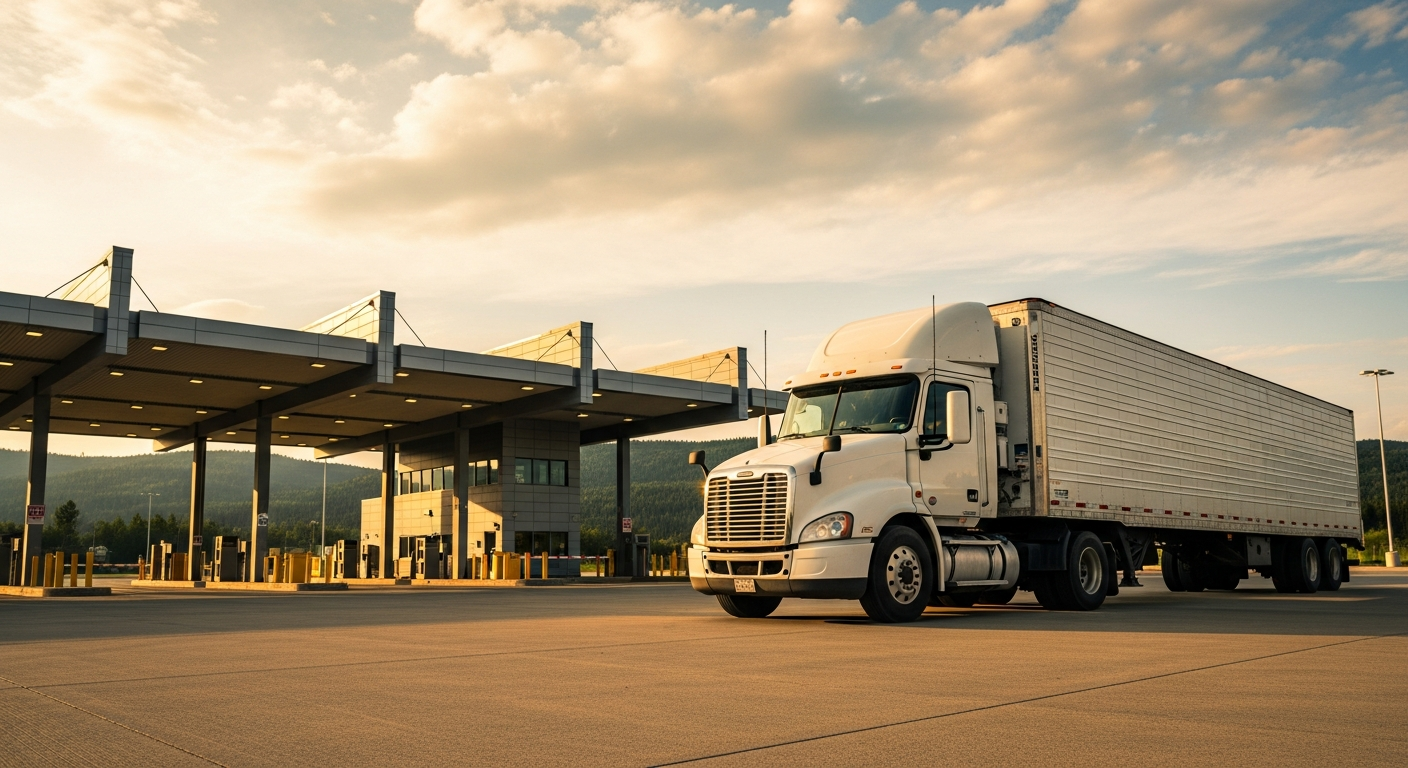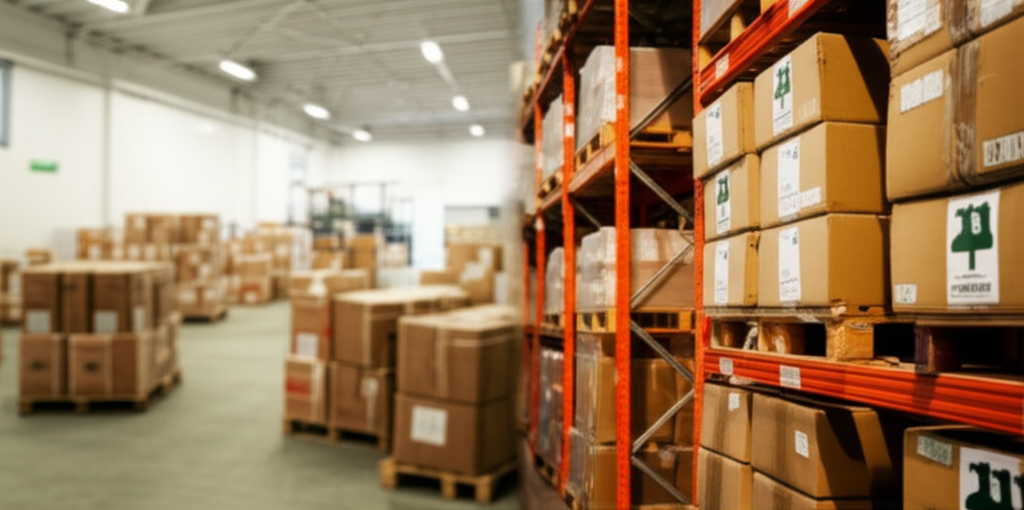
For Canadian importers, the core difference between a sufferance warehouse and a bonded warehouse boils down to two things: purpose and duration. A sufferance warehouse is a mandatory, short-term stop for goods awaiting customs clearance. A bonded warehouse is a strategic, long-term storage solution that allows importers to defer duties and taxes for up to four years, providing significant financial and logistical advantages.
Sufferance vs Bonded Warehouse: The Core Differences
When goods arrive in Canada, they must be reported to the Canada Border Services Agency (CBSA). If they cannot be released at the first point of arrival, they are moved to a privately owned, CBSA-licensed sufferance warehouse for temporary holding and potential examination. This is where the distinction between warehouse types becomes critical, directly impacting your supply chain, cash flow, and market readiness. Understanding this difference is a key part of your import strategy.
A Quick Comparison
Think of a sufferance warehouse as a mandatory transit lounge for your goods—a secure area where they must wait before being officially released into Canada. A bonded warehouse, however, is an optional strategic tool. It’s a secure facility where goods can be stored long-term, giving you flexibility in managing inventory and finances.
This distinction has tangible financial and operational consequences. One path requires immediate action and payment upon release, while the other offers a powerful tool for inventory management and duty deferral.
Quick Comparison: Sufferance vs. Bonded Warehouse
This table provides an at-a-glance summary of the key differences to help you understand their distinct roles in the Canadian import process.
| Feature | Sufferance Warehouse | Bonded Warehouse |
|---|---|---|
| Primary Purpose | Mandatory, short-term holding for goods awaiting CBSA release. | Optional, long-term storage to defer duties and taxes. |
| Storage Time Limit | Up to 40 days (less for perishables and other specified goods). | Up to 4 years (with potential for extension on certain goods). |
| Duty/Tax Payment | Due immediately upon customs release from the warehouse. | Deferred until goods are withdrawn for consumption in Canada or exported. |
| Permitted Activities | Strictly holding and CBSA examination; manipulation or alteration is prohibited. | Value-added services (labelling, testing, repackaging) are permitted under CBSA regulations. |
| Best For | All shipments that are not released at the border and require temporary control. | Importers seeking strategic inventory management, cash flow optimization, or market preparation. |
Ultimately, understanding which warehouse serves which purpose is key. While many import shipments will pass through a sufferance warehouse if not cleared at the first point of arrival, a bonded warehouse is a strategic choice made to support a specific business model.
Understanding the CBSA Regulatory Framework
The differences between sufferance and bonded warehouses are rooted in their distinct legal mandates under the Canada Border Services Agency (CBSA). These aren't just two types of buildings; they operate under separate regulations that define their purpose, limitations, and your responsibilities as an importer.
Legally, a sufferance warehouse is considered an extension of the border. It's a temporary holding area designed for one purpose: CBSA control and examination of unreleased goods. The regulations governing these facilities, detailed in CBSA’s D-Memorandum D4-1-4, are built around the CBSA's need to maintain absolute control until all import requirements are met.
The Legal Purpose Defines the Function
For an importer, this legal distinction is critical. Goods in a sufferance warehouse are not yet legally "in Canada," and your ability to interact with them is nearly zero. They are held "in sufferance" pending a final customs decision. This is a tactical hurdle you must clear quickly.
A bonded warehouse, by contrast, is a strategic program designed to facilitate trade. Its legal framework, under the Customs Bonded Warehouses Regulations, allows you to defer duties and taxes. This is a voluntary program you choose to leverage for financial and logistical benefits—not a mandatory stop imposed by the CBSA.
Actionable Insight for Importers: View the sufferance warehouse as a mandatory checkpoint requiring swift action to avoid penalties. View the bonded warehouse as an optional, strategic tool to manage cash flow and prepare goods for the Canadian market over months or years.
How Regulations Impact Your Liability
The regulations for each facility directly shape your liability. In a sufferance warehouse, your primary responsibility is to ensure the goods are accounted for and cleared in a timely manner. The warehouse operator is bonded and responsible to the CBSA for the goods in their custody, but the onus is on you to finalize the customs release.
In a bonded warehouse, the responsibility on the importer increases. While the operator maintains a security bond, you are responsible for meticulous inventory tracking and ensuring duties and taxes are paid correctly when goods are withdrawn for Canadian consumption. This flexibility comes with a higher compliance burden, especially with evolving systems. Mastering these obligations is a core component of modern importing, which you can learn more about in our guide on everything importers need to know about CARM.
Operational Differences: Storage Duration and Permitted Activities
The day-to-day operational differences between a sufferance and a bonded warehouse are where the strategic advantages for an importer become clear. Two factors matter most: how long your goods can be stored, and what you are legally permitted to do with them during that time. These operational realities will directly shape your logistics strategy and your ability to prepare goods for the Canadian market.
Time is a Major Factor
In a sufferance warehouse, the clock is always ticking. These facilities are designed for short-term holding with strict timelines. According to CBSA regulations, general goods can only remain in a sufferance warehouse for a maximum of 40 days. The window is even shorter for specific goods like perishables.
Bonded warehouses are built for long-term strategic storage. They provide significant breathing room, allowing goods to be stored for up to four years. This vast difference in storage duration is a critical planning factor for any business managing inventory cycles or dealing with seasonal demand.
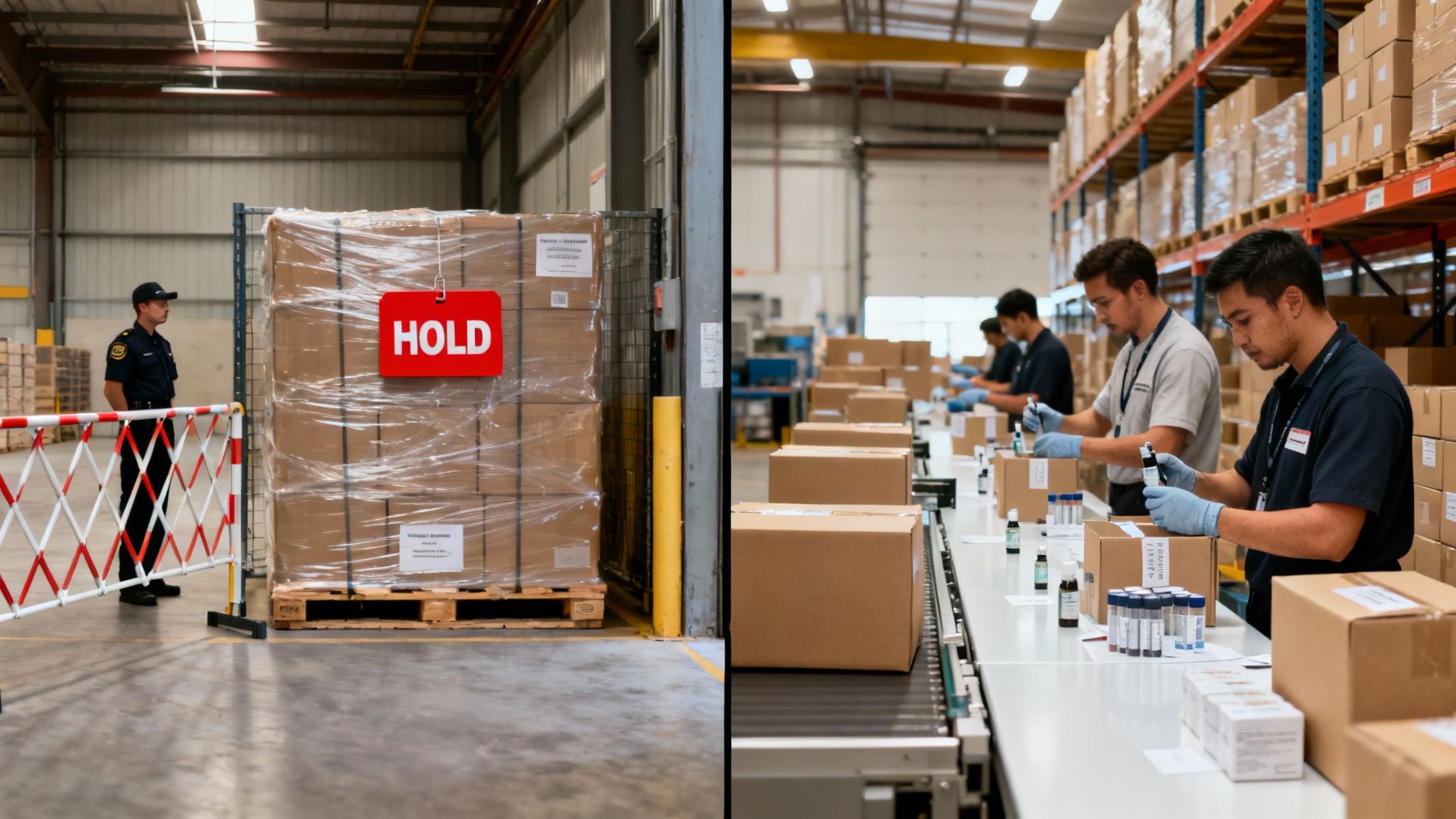
Permitted Activities: A Stark Contrast
The difference in permitted activities is even more significant than the storage limits. A sufferance warehouse is a secure holding area under direct CBSA oversight. Its sole function is to hold your shipment until it is officially released into Canada.
Actionable Insight for Importers: The rule in a sufferance warehouse is "hands-off." Your goods are under customs control, and any manipulation—including labelling, repackaging, or inspection without prior CBSA authorization—is strictly prohibited. Violations can lead to penalties.
A bonded warehouse is a strategic staging ground. Here, you can perform a range of value-added services before your goods officially enter the Canadian market and before you pay duties and taxes. For many importers, this operational freedom is a game-changer.
Unlocking Value-Added Services in a Bonded Warehouse
While goods are stored in a bonded warehouse, you can perform various tasks that are forbidden in a sufferance facility. This allows you to prepare products for Canadian customers and meet compliance standards, all while deferring import duties and taxes. Understanding these options is a key part of learning how to import goods to Canada.
Permitted activities include:
- Marking and Labelling: Applying compliant Canadian labels, such as those meeting French language requirements.
- Repackaging: Transferring products into new packaging suitable for retail sale or distribution.
- Testing and Inspection: Conducting quality control checks to ensure products meet Canadian standards.
- Taking Samples: Withdrawing samples for potential buyers or marketing purposes.
- Diluting or Assembling: Performing minor alterations that do not fundamentally change the nature or tariff classification of the goods.
This operational advantage transforms a bonded warehouse from a simple storage facility into an active, value-adding component of your supply chain, giving you the agility to respond to market demands and optimize your inventory.
Analyzing the Financial Implications for Your Business
Your choice between a sufferance and a bonded warehouse has direct and significant financial implications that extend beyond storage fees. It impacts your cash flow, bonding requirements, and total landed costs. For a Canadian importer, understanding these financial differences is crucial for making a strategically sound decision.
The most significant financial differentiator is the timing of duty and tax payments. With a sufferance warehouse, these payments are due as soon as the CBSA releases the goods. This requires having capital readily available to cover these costs immediately, which can strain cash flow, especially for large or frequent shipments.
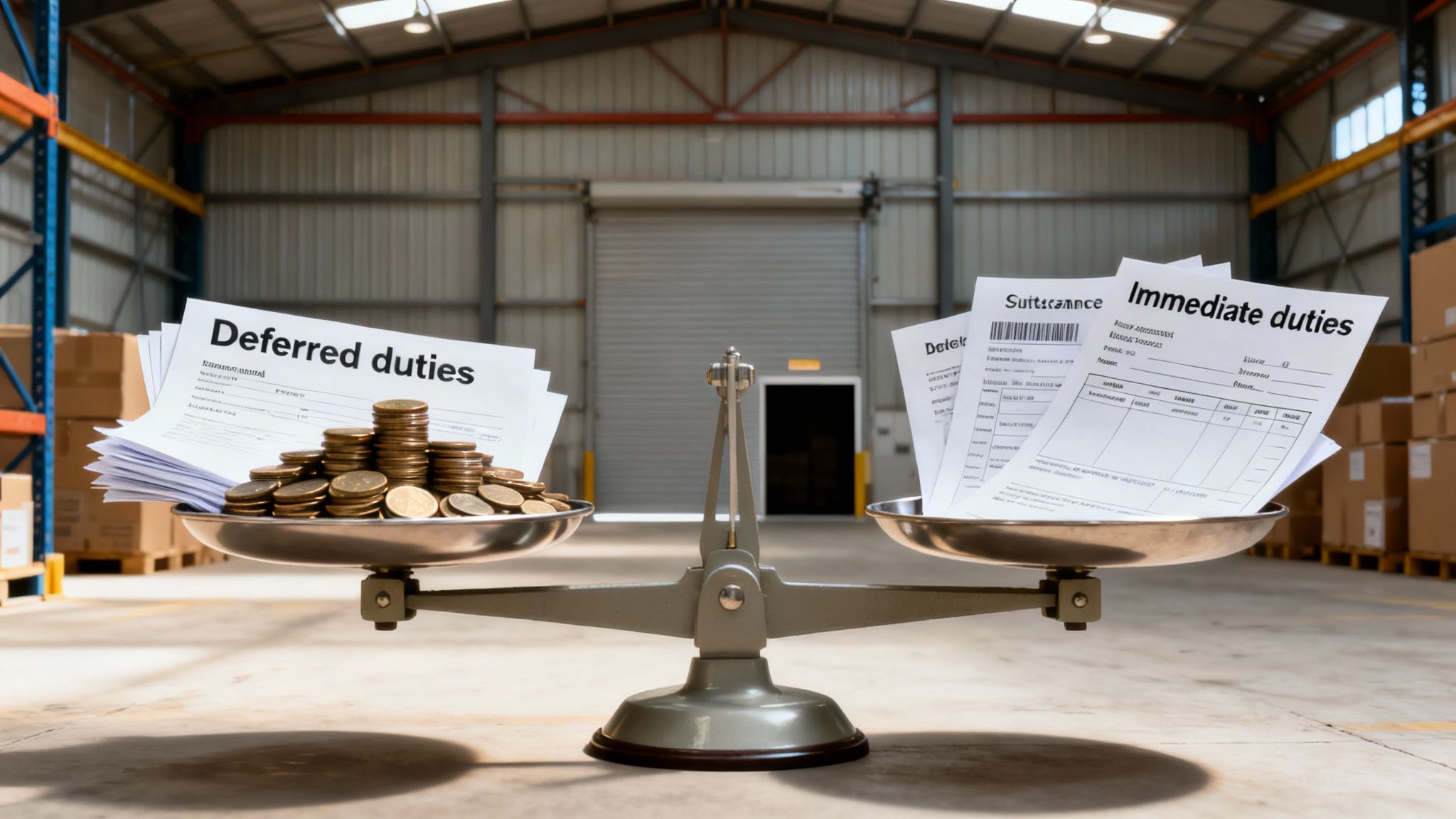
The Power of Duty Deferral
A bonded warehouse provides the powerful advantage of duty deferral. It allows you to postpone paying duties and taxes for up to four years. You only pay when you withdraw the goods from the warehouse for consumption in Canada. This deferral can be exported, duty-free.
Actionable Insight for Importers: Use a bonded warehouse to align your largest import costs (duties and taxes) with your revenue stream. For seasonal goods, import them months in advance to secure favorable pricing but only pay duties when you ship them to retailers for the selling season. This transforms a major upfront expense into a manageable, just-in-time cost.
This deferral frees up working capital that can be invested in other business growth areas, such as marketing, product development, or expanding inventory.
Understanding Security Bond Requirements
Both warehouse types must be licensed and post a security bond with the CBSA. This bond guarantees that the government will receive the duties and taxes owed on the goods stored within. For sufferance warehouses, the bond is calculated based on the volume of shipments processed.
Bonded warehouse operators must also post security, and importers using these facilities often need to secure their own financial guarantees. This is an administrative cost to factor in, but it enables the significant benefit of duty deferral. You may need to arrange a customs bond for your goods to cover your liability.
Comparing Storage and Administrative Costs
The cost structures for each warehouse type reflect their intended purpose.
- Sufferance Warehouse Costs: Fees are structured to encourage rapid turnover. Expect an initial handling fee followed by daily storage charges that escalate quickly. The model is designed to get goods cleared and moved out efficiently.
- Bonded Warehouse Costs: These facilities are designed for longer-term storage, typically with monthly rates. In addition to storage fees, you must account for the administrative costs of maintaining meticulous inventory records and managing the documentation for each withdrawal.
When analyzing the costs, it's clear that a sufferance warehouse represents a short-term, tactical expense. A bonded warehouse, while involving more administrative oversight, is a strategic financial tool that provides control over cash flow and market timing.
Choosing the Right Warehouse for Your Import Strategy
Selecting between a sufferance and a bonded warehouse is a strategic business decision that directly impacts your supply chain efficiency, cash flow, and market responsiveness. Aligning your warehouse choice with your specific operational needs is essential for a compliant and cost-effective import process.
A sufferance warehouse is the mandatory first stop for any shipment not cleared by the Canada Border Services Agency (CBSA) at its first point of arrival. It's an unavoidable, temporary holding facility for goods requiring examination or final documentation. This model works for businesses with just-in-time supply chains that prioritize immediate customs clearance and market entry.
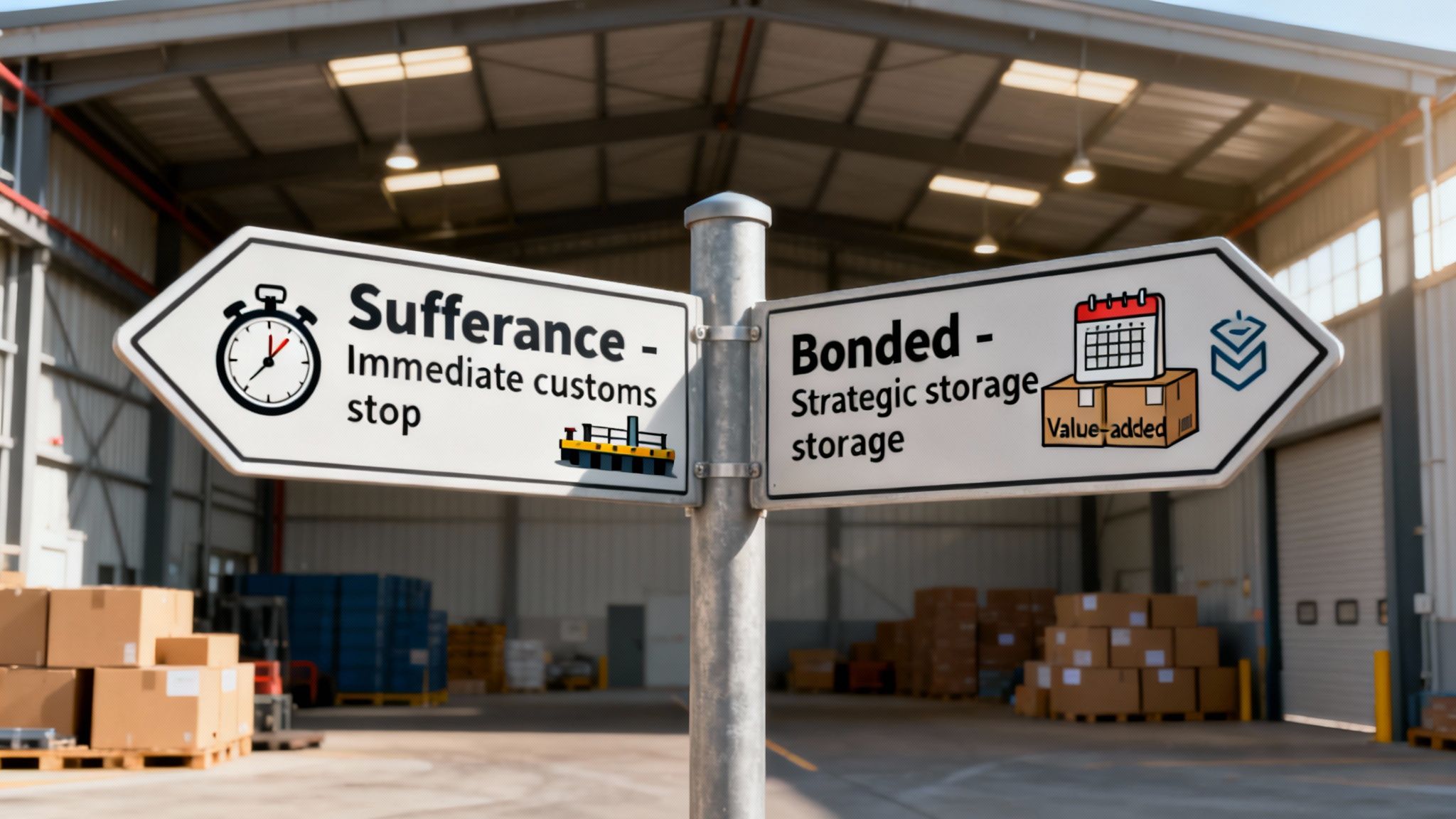
When to Choose a Bonded Warehouse
A bonded warehouse is a deliberate, strategic choice. It is not a mandatory step but a powerful tool for specific business scenarios. Opting for a bonded facility is the smart move when your goals include long-term planning, financial management, and market preparation.
Consider these scenarios where a bonded warehouse provides a clear advantage:
- Managing Seasonal Inventory: Import seasonal goods like winter coats during the summer to take advantage of lower costs. Store them in a bonded warehouse and pay duties only when you ship them to retailers in the fall.
- Operating as a Distribution Hub: Use a bonded warehouse as a Canadian distribution centre. Store bulk inventory and fulfill Canadian orders as they come in, paying duties only on the goods you withdraw. This is ideal for non-resident importers.
- Preparing Goods for the Canadian Market: If your products require Canadian-compliant labelling, repackaging, or minor assembly, these value-added services can be performed in a bonded warehouse while duties are deferred.
The Competitive Edge of Value-Added Services
The ability to perform value-added services is the single greatest operational advantage of a bonded warehouse. Sufferance facilities are strictly for holding; bonded warehouses are for preparation and optimization. This functional difference creates a major competitive advantage, as detailed in this breakdown of warehouse differences on pcb.ca.
Actionable Insight for Importers: Leverage a bonded warehouse to turn storage time into productive time. Instead of just paying for space, use it to ensure your products are fully compliant and retail-ready (e.g., adding French-language labels) before they officially enter the Canadian market. This proactive step prevents delays and compliance issues down the line.
In short, a sufferance warehouse is a tactical necessity to be managed efficiently. A bonded warehouse is a strategic asset you can use to optimize your financial and operational performance, turning storage into a value-adding step in your supply chain.
Answering Your Top Questions
Navigating Canadian customs warehouses involves practical questions about compliance, liability, and procedures. Knowing the rules for moving goods, liability for damages, and storage limits is essential for maintaining a smooth and compliant supply chain. Here are answers to common questions from importers.
Can I Move Goods from a Sufferance to a Bonded Warehouse?
Yes. This is a common and strategic logistics maneuver known as an in-bond transfer. If your goods are in a sufferance warehouse and you need more time for clearance or wish to defer duties, you can arrange for them to be moved to a licensed bonded warehouse. This transfer must be authorized by the CBSA and requires precise documentation. The goods remain under customs control throughout the process, and duty/tax obligations remain deferred.
What Happens if I Exceed the Storage Time Limit?
The CBSA strictly enforces storage time limits, and the consequences for exceeding them are severe and differ by warehouse type.
- In a Sufferance Warehouse: You have 40 days for general goods. After this period, the goods are deemed "unclaimed." The CBSA will issue a Form E44, Notice — Unclaimed Goods, giving you a final 30 days to clear or export them. Failure to act results in the goods being forfeited to the Crown and potentially sold or destroyed.
- In a Bonded Warehouse: While the four-year limit is generous, if goods exceed this timeframe, they must be either entered for consumption in Canada (with all duties and taxes paid) or exported from Canada. Abandonment is not an option.
Who is Liable for Damaged or Lost Goods?
In both sufferance and bonded warehouses, the licensed warehouse operator is legally responsible to the CBSA for the security and control of all goods in their facility. This liability is backed by a security bond they post with the CBSA, which covers the potential duties and taxes.
Actionable Insight for Importers: The warehouse operator's liability to you for loss or damage is typically limited by their contract. Do not rely solely on their bond. Ensure you have adequate cargo insurance to cover the full commercial value of your goods against unforeseen events.
Are There Restrictions on What I Can Store?
Yes. Certain goods are prohibited or restricted in both warehouse types. You cannot store items that are prohibited from entering Canada, such as counterfeit goods. Additionally, hazardous materials (e.g., explosives, certain chemicals) require specialized facilities and cannot be stored in standard warehouses due to safety regulations. Always confirm with the warehouse operator beforehand to ensure they are licensed and equipped to handle your specific commodities.
Trying to navigate these regulations alone is a tough job. The expert team at J.W. Smith Customs Brokers Ltd. provides the clarity and guidance needed to manage your imports efficiently, ensuring your goods move smoothly from port to final destination. Let us handle the complexities so you can focus on your business.
Need Help with Customs?
J.W. Smith Customs Brokers has over 50 years of experience helping Canadian businesses navigate imports with confidence. Our team of licensed customs brokers is ready to assist with your import and export needs.