Why Use a Customs Broker for Canadian Imports

Almost 90 percent of all commercial imports into the Canadian market pass through the hands of a licensed customs broker. The rules for bringing goods across borders can frustrate even experienced business owners, and costly fines or unexpected shipment delays are real risks. Understanding what a Canadian customs broker actually does means you can sidestep common mistakes, save money, and keep your supply chain running smoothly right from the start.
Table of Contents
- What Is A Customs Broker In Canada?
- Types Of Customs Broker Services Offered
- How Brokers Streamline Customs Clearance
- Legal Compliance And CBSA Regulations
- Risks Of Dyi Customs Clearance
- Comparing Brokers To Alternative Solutions
Key Takeaways
| Point | Details |
|---|---|
| Role of Customs Brokers | Customs brokers act as intermediaries between importers and the Canada Border Services Agency (CBSA), simplifying the complexities of cross-border trade regulations. |
| Importance of Compliance | Navigating Canadian import regulations is crucial; professional brokers help prevent legal penalties by ensuring adherence to CBSA standards. |
| Strategic Trade Guidance | Customs brokers provide strategic advice on trade agreements and tariff classifications, potentially unlocking cost savings for businesses. |
| Risks of DIY Management | Managing customs clearance independently can lead to significant financial and legal risks; hiring licensed customs brokers mitigates these dangers. |
What Is a Customs Broker in Canada?
A customs broker is a licensed professional who acts as an intermediary between importers and government agencies, specifically helping businesses navigate the complex landscape of cross-border trade regulations. In Canada, customs brokers are registered with the Canada Border Services Agency (CBSA) and provide critical services that simplify the intricate process of importing commercial goods into the Canadian market.
Customs brokers serve as expert translators of international trade rules, helping businesses understand and comply with detailed import regulations. They handle critical tasks such as classifying goods using the Harmonized System (HS) codes, calculating accurate duty and tax rates, preparing essential import documentation, and ensuring all shipments meet Canadian customs requirements. This expertise prevents costly delays, potential fines, and shipment rejections that could disrupt a company’s supply chain operations.
The role of a customs broker extends far beyond simple paperwork management. These professionals provide strategic guidance on trade agreements, tariff classifications, and import compliance. They help businesses optimize their import processes by identifying potential duty savings, navigating preferential trade programs like the Comprehensive and Progressive Agreement for Trans-Pacific Partnership (CPTPP), and ensuring all documentation meets the stringent standards of Canadian border authorities.
Pro Tip for Importers: Always select a customs broker with proven experience in your specific industry and a deep understanding of the product categories you import. Their specialized knowledge can save your business significant time, money, and potential compliance headaches.
Here’s a summary of key service areas where Canadian customs brokers add distinct business value:
| Service Area | Broker’s Role | Business Impact |
|---|---|---|
| Regulatory Navigation | Interpreting and applying CBSA regulations | Reduces risk of legal penalties |
| Strategic Trade Guidance | Advising on agreements like the CPTPP | Unlocks cost savings via exemptions |
| Duty & Tax Optimisation | Accurate duty calculation and exemption finding | Minimizes unnecessary financial outlay |
| Compliance Management | Ensuring precise documentation and classification | Avoids shipment delays and rejections |
| Process Automation | Implementing electronic submission systems | Speeds up clearance and reduces errors |
Types of Customs Broker Services Offered
Customs brokers provide a comprehensive suite of services designed to simplify the complex world of international trade for Canadian businesses. These services go far beyond basic paperwork processing, offering strategic support that can significantly impact a company’s import operations. Customs clearance expertise is at the core of their professional offerings, ensuring smooth and compliant cross-border transactions.
The primary services offered by customs brokers typically include:
- Customs Documentation Preparation: Completing and filing all required import documents, including commercial invoices, certificates of origin, and detailed customs declarations
- Tariff Classification: Accurately identifying the correct Harmonized System (HS) codes for imported goods to determine appropriate duty rates
- Duty and Tax Calculation: Precise calculation of import duties, taxes, and potential exemptions based on current trade agreements
- Compliance Consulting: Providing expert guidance on import regulations, trade restrictions, and potential compliance challenges
Beyond these core services, customs brokers also offer advanced strategic support that can transform a company’s import operations. They provide valuable business intelligence, helping companies navigate complex international trade landscapes, assess global market changes, and identify opportunities for cost reduction. This might include advising on preferential trade programs, helping businesses leverage trade agreements like the Comprehensive and Progressive Agreement for Trans-Pacific Partnership (CPTPP), and developing strategies to optimize import processes.
Pro Tip for Importers: Request a comprehensive service audit from your customs broker to identify potential inefficiencies and cost-saving opportunities in your current import processes. A thorough review can uncover hidden savings and streamline your cross-border trade operations.
How Brokers Streamline Customs Clearance
Customs brokers play a pivotal role in simplifying and accelerating the complex customs clearance process for businesses importing goods into Canada. By leveraging their deep understanding of regulatory requirements and advanced technological systems, they transform what could be a bureaucratic nightmare into a streamlined, efficient workflow. Customs clearance processes require intricate knowledge that most businesses simply cannot manage internally.
The streamlining process involves several critical strategies:
- Electronic Document Management: Utilizing advanced digital platforms to submit and track documentation instantly
- Automated Compliance Checks: Implementing sophisticated software that automatically validates documentation against current regulations
- Real-Time Communication: Maintaining direct communication channels with Canada Border Services Agency (CBSA) to resolve potential issues quickly
- Proactive Problem Resolution: Identifying and addressing potential clearance obstacles before they become significant delays
Beyond technical solutions, customs brokers bring strategic expertise that dramatically reduces processing times and potential complications. They understand the nuanced requirements of different product categories, can accurately classify goods using Harmonized System (HS) codes, and know precisely how to navigate complex trade agreements. This expertise allows them to optimize duty calculations, ensure proper documentation, and minimize the risk of shipment delays or unexpected penalties.

Pro Tip for Importers: Develop a comprehensive pre-clearance checklist with your customs broker that includes all potential documentation requirements for your specific product categories, helping you anticipate and prevent potential clearance bottlenecks.
Legal Compliance and CBSA Regulations
Navigating the complex landscape of Canadian border regulations requires an intricate understanding of legal requirements that can overwhelm most businesses. The Canada Border Services Agency (CBSA) enforces stringent compliance standards that demand precise documentation, accurate classification, and complete transparency for all commercial imports. CBSA regulatory updates can change rapidly, making professional guidance essential for businesses seeking to maintain legal import operations.
Key legal compliance areas that customs brokers manage include:
- Tariff Classification: Accurately identifying the correct Harmonized System (HS) codes for imported goods
- Valuation Reporting: Ensuring accurate declared value of imported merchandise
- Origin Verification: Confirming and documenting the precise country of origin for goods
- Duty and Tax Calculation: Precise computation of applicable import duties and taxes
- Regulatory Documentation: Preparing and submitting all required import permits and certificates
The consequences of non-compliance can be severe, ranging from substantial financial penalties to potential seizure of goods and legal prosecution. Customs brokers serve as critical intermediaries who understand the nuanced legal framework governing Canadian imports. They provide proactive guidance to help businesses anticipate potential regulatory challenges, interpret complex trade agreements, and maintain strict adherence to CBSA requirements. This expertise helps companies avoid costly mistakes that could interrupt their supply chain and expose them to significant financial and legal risks.
Pro Tip for Importers: Develop a comprehensive compliance tracking system that documents every regulatory requirement for your specific product categories, and schedule quarterly reviews with your customs broker to stay current with evolving CBSA regulations.
Risks of DIY Customs Clearance
Attempting to manage customs clearance independently can expose businesses to significant financial and legal risks that far outweigh potential cost savings. The complex regulatory landscape of Canadian imports demands specialized knowledge that goes well beyond basic paperwork filing. Customs clearance best practices require a level of expertise most businesses simply do not possess internally.
The primary risks of DIY customs clearance include:
- Incorrect Tariff Classification: Misclassifying goods can result in substantial financial penalties
- Documentation Errors: Even minor mistakes can trigger shipment delays or complete rejection
- Compliance Violations: Unintentional breaches of CBSA regulations can lead to severe legal consequences
- Unexpected Duty Assessments: Improper valuation can trigger retrospective duty charges
- Supply Chain Disruptions: Clearance errors can halt entire shipment processes, causing significant business interruptions
Beyond immediate financial implications, DIY customs clearance exposes businesses to complex legal challenges that can have long-lasting repercussions. The Canada Border Services Agency (CBSA) maintains stringent enforcement standards, with penalties that can include substantial monetary fines, shipment seizures, and potential import privileges revocation. Small errors in documentation, classification, or valuation can trigger comprehensive audits that consume significant time and resources, potentially damaging a company’s reputation and operational stability.
Pro Tip for Importers: Conduct a comprehensive internal audit of your current import processes and compare the potential cost of compliance errors against the relatively modest investment in professional customs brokerage services.
Comparing Brokers to Alternative Solutions
Businesses exploring customs clearance options face multiple potential approaches, each with distinct advantages and risks. While some importers consider self-management or alternative solutions, licensed customs brokers offer a professionally managed pathway that significantly reduces operational complexity and compliance risks. Choosing the right customs broker requires understanding the key differences between available options.
The primary alternative solutions and their comparative characteristics include:
-
Self-Management
- Lowest upfront cost
- Highest personal time investment
- Maximum compliance risk
- Requires extensive regulatory knowledge
-
Unlicensed Agents
- Lower cost than professional brokers
- Limited regulatory expertise
- Potential for non-compliance
- No guaranteed professional accountability
-
Licensed Customs Brokers
- Comprehensive regulatory expertise
- Direct CBSA relationships
- Proactive compliance management
- Strategic import optimization
- Reduced long-term financial risks
Professional customs brokers distinguish themselves through deep regulatory understanding and established institutional relationships. Unlike self-management or unlicensed alternatives, licensed brokers provide comprehensive strategic support that goes beyond simple documentation. They offer nuanced guidance on trade agreements, help businesses optimize duty calculations, and maintain ongoing compliance with evolving Canadian import regulations. Their expertise translates into tangible financial benefits, often saving businesses more money through strategic import management than their service fees.
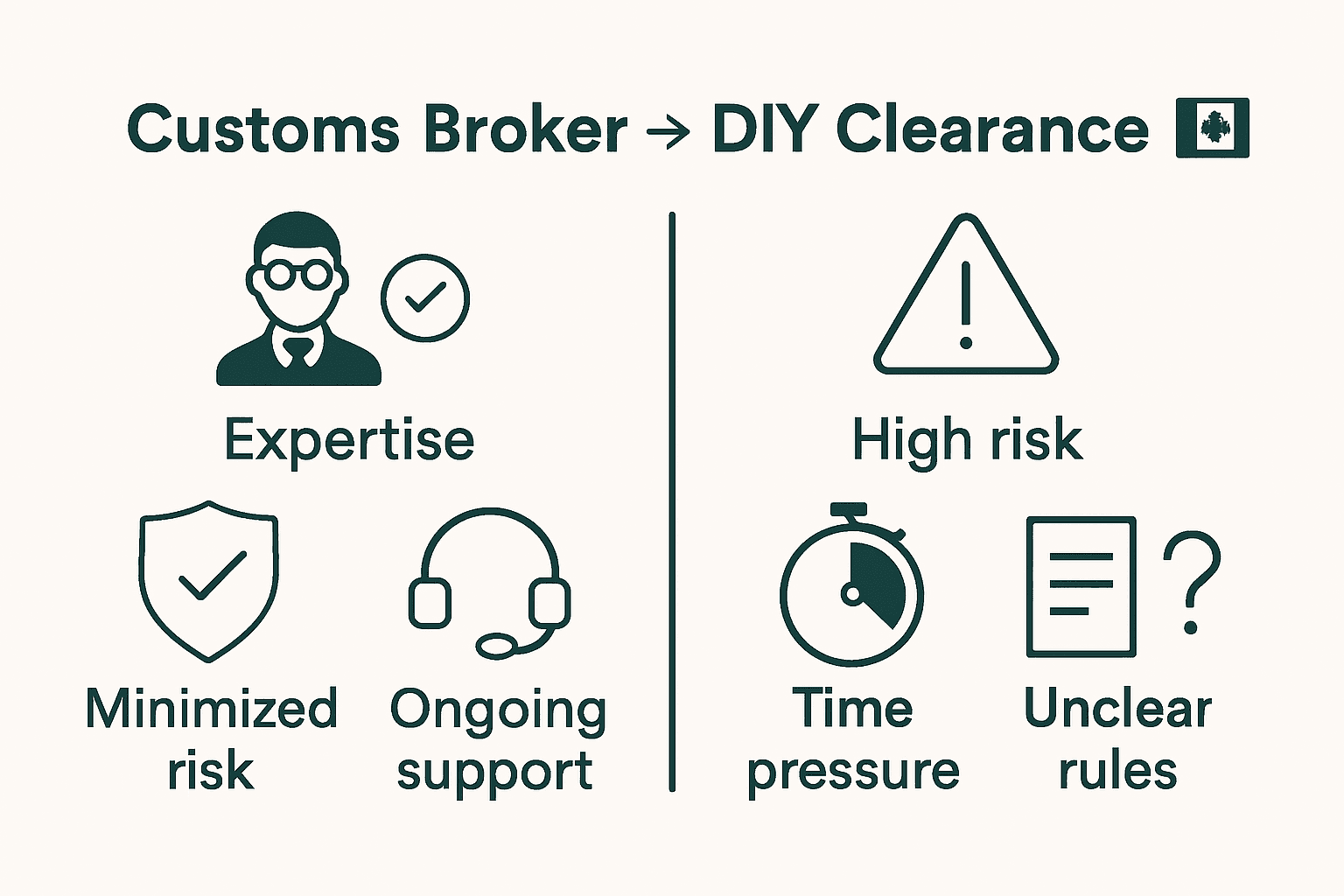
The following table compares customs clearance methods for businesses evaluating their options:
| Clearance Method | Expertise Needed | Risk Level | Ongoing Support |
|---|---|---|---|
| Self-Management | Extensive import knowledge | Highest | None |
| Unlicensed Agent | Basic regulatory familiarity | Moderate to High | Limited |
| Licensed Customs Broker | Professional accreditation | Lowest | Comprehensive, strategic |
Pro Tip for Importers: Calculate your total potential compliance costs, including staff time, potential penalties, and opportunity costs, before deciding against professional customs brokerage services. The true expense of DIY approaches often exceeds professional management fees.
Simplify Your Canadian Imports with Expert Customs Brokerage
Navigating the complexities of Canadian customs clearance can be daunting. From ensuring precise Harmonized System (HS) classification to maintaining full CBSA compliance, the risks of costly delays, fines, and shipment disruptions are real challenges that many importers face. The article highlights critical pain points like regulatory navigation, duty and tax optimisation, and the importance of professional guidance to prevent shipment rejections and legal penalties.
At J.W. Smith Customs Broker Ltd., we specialise in resolving these specific challenges with over 50 years of experience supporting Canadian and US businesses that import commercial goods. Our personalised service offers you a dedicated point of contact who understands your industry’s nuances and can streamline your customs clearance process, including CARM registration assistance and local freight delivery. Discover how our comprehensive customs clearance services can protect your supply chain and help you seize cost-saving opportunities through strategic import consulting.
Take control of your customs processes today by requesting a tailored Customs Clearance Estimate. Learn more about how to choose the right customs broker and explore our expert customs clearance solutions designed to keep your imports compliant, efficient, and on time. Don’t risk costly mistakes—partner with a trusted Canadian customs broker who puts your business first.
Frequently Asked Questions
What services do customs brokers provide for importing goods?
Customs brokers offer a range of services including customs documentation preparation, tariff classification, duty and tax calculation, and compliance consulting. They help businesses navigate complex regulations to ensure smooth imports.
How do customs brokers help businesses avoid import delays?
Customs brokers streamline the customs clearance process by utilizing electronic document management, automated compliance checks, and proactive problem resolution. Their expertise helps prevent delays caused by documentation errors or compliance issues.
Why is it risky to manage customs clearance without a broker?
Attempting to handle customs clearance independently can lead to significant risks, such as incorrect tariff classification, documentation errors, and compliance violations. These issues can result in financial penalties, shipment rejections, and supply chain disruptions.
How can a customs broker save me money on imports?
Customs brokers can optimize duty calculations and help identify potential duty savings through trade agreements. Their strategic guidance helps businesses navigate exemptions and ensure compliance, which can ultimately reduce import costs.
Recommended
- Comprehensive 5-Step Guide for Importers | J.W. Smith Customs Brokers
- How to Choose the Right Customs Broker for Your Business | J.W. Smith Customs Brokers
- 6 Common Mistakes to Avoid in Customs Clearance | J.W. Smith Customs Brokers
- How a Customs Broker Can Help You Save Time and Money | J.W. Smith Customs Brokers
- Waarom Internationale Verzending Onmisbaar Is Voor Bedrijven
Need Help with Customs?
J.W. Smith Customs Brokers has over 50 years of experience helping Canadian businesses navigate imports with confidence. Our team of licensed customs brokers is ready to assist with your import and export needs.